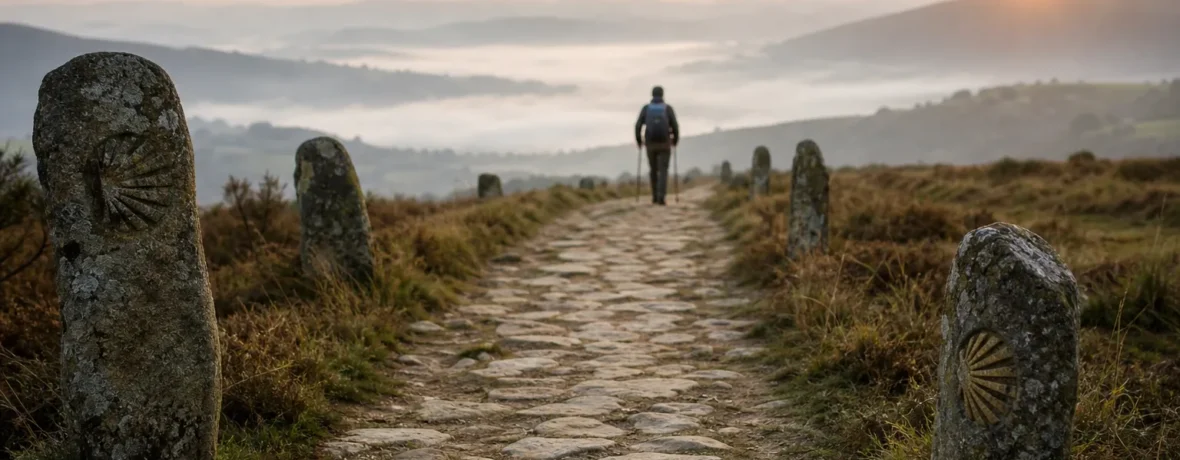
What is a pilgrimage? A pilgrimage is a journey made with intention, usually on foot or by simple travel, toward a place that carries spiritual, cultural, personal, or ancestral meaning. It has three parts: a purpose you name, a route you accept, and a change you are willing to meet when you return.
What is a pilgrimage in plain hiking terms?
A pilgrimage is a walk with a why.
That sounds simple because it is. The trail can be dirt, pavement, gravel, boardwalk, beach, or old road. The destination can be a cathedral, a mountain, a grave, a river source, a border, a hometown, a memorial, or a place where your life cracked open. What makes it a pilgrimage is not the scenery. It is the meaning you carry and the attention you give.
A hike asks, “Where are we going?” A pilgrimage asks, “What are we carrying?” That is the split. Distance helps, but distance alone does not make the walk holy, serious, or transformative. You can walk 20 miles [32 km] and only chase mileage. You can walk 3 miles [5 km] and meet grief, gratitude, forgiveness, or resolve in a way that changes the week after you get home.
The British Pilgrimage Trust describes pilgrimage as a journey, often on foot, toward a place of meaning, with the walker seeking insight along the way. That is a clean working definition. Here is the column take: if the walk has no named intention, no attention, and no reckoning at the end, call it a hike. A good hike, maybe. But not a pilgrimage.
How is pilgrimage walking different from hiking?
Pilgrimage walking puts meaning ahead of performance.
A regular hike can be about fitness, views, solitude, speed, wildlife, or a big day outside. All worthy. A pilgrimage can include every one of those things, but they are not the center. The center is the reason you step out in the first place.
| Walk type | Main focus | Typical question |
|---|---|---|
| Day hike | Route, scenery, exercise | Can I finish this trail safely? |
| Backpack | Self-reliance, distance, camp craft | Can I live well outside for several days? |
| Pilgrimage | Meaning, attention, change | What am I walking toward, and what am I leaving behind? |
Do not make this precious. You do not need robes, ancient roads, incense, a passport stamp, or a dramatic vow. You need honesty. You need a route that gives you enough time to stop performing. You need a destination that means something beyond “nice overlook.”
And you need humility. The trail does not owe you revelation. Some days you get clarity. Some days you get sore calves, gas-station coffee, wet socks, and a mood like a kicked hornet nest. That still counts. Walking with meaning does not mean walking with constant peace.
Does a pilgrimage have to be religious?
No, but it does have to be more than recreational.
Many pilgrimages are religious. That history is deep, global, and alive. People walk to shrines, temples, churches, mosques, sacred mountains, holy rivers, and ancestral sites. If that is your path, treat it with respect. Learn the customs. Dress and behave like a guest. Do not turn someone else’s sacred place into your content backdrop.
But a pilgrimage can also be personal without being shallow. You might walk to mark recovery, mourn a parent, turn 50, leave a job, repair a friendship, honor a veteran, or revisit the town where your family story began. The line is not religion versus nonreligion. The line is reverence versus consumption.
Here is the test: if the destination asks something of you, and the walk gives you time to answer, you are in pilgrimage territory.
How do you plan a walking pilgrimage?
Start with the purpose, then choose the route.
Too many walkers do this backward. They pick the famous path first, then try to bolt meaning onto it. That can work, but it often turns pilgrimage into tourism with blisters. Better: name the reason. Then pick the ground that fits it.
- Name the intention in one sentence. Keep it plain. “I am walking to grieve my brother.” “I am walking to mark the end of treatment.” “I am walking to ask what comes next.”
- Choose a destination with weight. It can be public, private, sacred, ordinary, or strange to everyone but you.
- Pick a route you can respect. Match the miles, terrain, weather, and resupply to your current body, not your fantasy body.
- Build in silence. Podcasts can wait. If the whole walk is noise, you may finish entertained and unchanged.
- Create a small ritual. Carry a stone, write one line each night, say a name at the end, or sit still for 10 minutes before turning home.
- Plan the return. A pilgrimage is not over at the destination. Decide how you will bring the walk back into your daily life.
Use normal hiking judgment. The National Park Service Hike Smart guidance is blunt in the right way: plan your route, know your limits, carry the right gear, and tell someone where you are going. Meaning does not replace a headlamp.
What should you carry on a pilgrimage walk?
Carry less than fear wants and more than pride wants.
Your kit depends on season, terrain, remoteness, and distance. Still, a pilgrimage has two packing lists: the practical one and the inward one. Skip either and the walk gets thin.
- Map, downloaded route, and backup navigation
- Water capacity that fits the day’s heat and distance
- Food you will actually eat when tired
- Rain layer or sun protection, depending on the forecast
- First-aid basics, including blister care
- Headlamp, even for a short day
- Simple journal, index card, or notes app for reflections
- A small object with meaning, if that helps you stay anchored
- Cash or card if your route passes towns, transit, churches, hostels, or cafes
Do not overload the symbolism. A stone from home can be powerful. Six sentimental objects become dead weight by noon. The point is not to carry your entire life on your back. The point is to walk honestly with the part that needs attention.
What makes a pilgrimage meaningful instead of just dramatic?
Repetition makes it meaningful.
One emotional summit moment is not the point. The power comes from walking the same question through changing conditions. Morning confidence. Afternoon doubt. Rain. Hunger. Road noise. Kindness from a stranger. Boredom. Foot pain. A long straight mile where nothing happens except you keep going.
That is where the work happens. Not in the photo. Not in the caption. Not even at the destination. The work happens when the route removes your usual escapes and you have to stay with the reason you came.
This is why speed can sabotage the whole thing. If you turn the walk into a race, you may win the wrong contest. Leave room to sit. Leave room to be annoyed. Leave room to change your mind. A pilgrimage is not a productivity hack with boots on.
When to see a doctor
See a doctor when pain, illness, heat symptoms, or wounds are beyond normal trail discomfort.
Do not self-diagnose on the trail. Foot soreness after miles is common; spreading redness, pus, worsening swelling, red streaks, or increasing pain around a blister needs medical care, according to Mayo Clinic blister first-aid guidance. If you have diabetes, poor circulation, immune suppression, or a history of serious foot problems, be quicker to get help.
Heat is not a character test. The CDC heat illness guidance treats confusion, loss of consciousness, seizures, very high body temperature, or stopped sweating during heat exposure as emergency signs. End the walk and get medical help. Your pilgrimage can wait. Your brain and organs cannot.
Before a long pilgrimage, talk with a clinician if you have heart disease, breathing problems, recent surgery, unstable joint pain, pregnancy concerns, or any condition that could be worsened by long daily walking. Ask practical questions: mileage limits, warning signs, footwear, hydration, and what should make you stop.
Related reading
- Type 2 Fun: Why Hard Hikes Feel Good Later
- The Seven Summits Explained
- What Is Geocaching?
- What Is Hiking, Really? A Definition Worth Arguing About
FAQ
What is the purpose of a pilgrimage?
The purpose of a pilgrimage is to give a meaningful question or commitment a physical form. You walk so the body, not just the mind, participates in grief, gratitude, prayer, change, or remembrance.
How long should a pilgrimage be?
A pilgrimage should be long enough to require attention. That might be one day, a weekend, or several weeks, depending on your route, body, and purpose. Do not confuse longer with truer.
Can a local walk be a pilgrimage?
Yes. A local walk can be a pilgrimage if the destination carries meaning and you approach it with intention. The trail behind your house can matter more than a famous route if it asks the right thing of you.
Do I need to walk alone?
No. Solitude can sharpen attention, but shared pilgrimage can be powerful too. If you walk with others, agree on the purpose, the pace, and how much silence you want before you start.
What should I do when the pilgrimage is over?
Mark the ending, then choose one concrete action. Call the person, visit the grave, change the habit, write the letter, make the donation, book the appointment. A pilgrimage that changes nothing afterward was probably just a long walk.