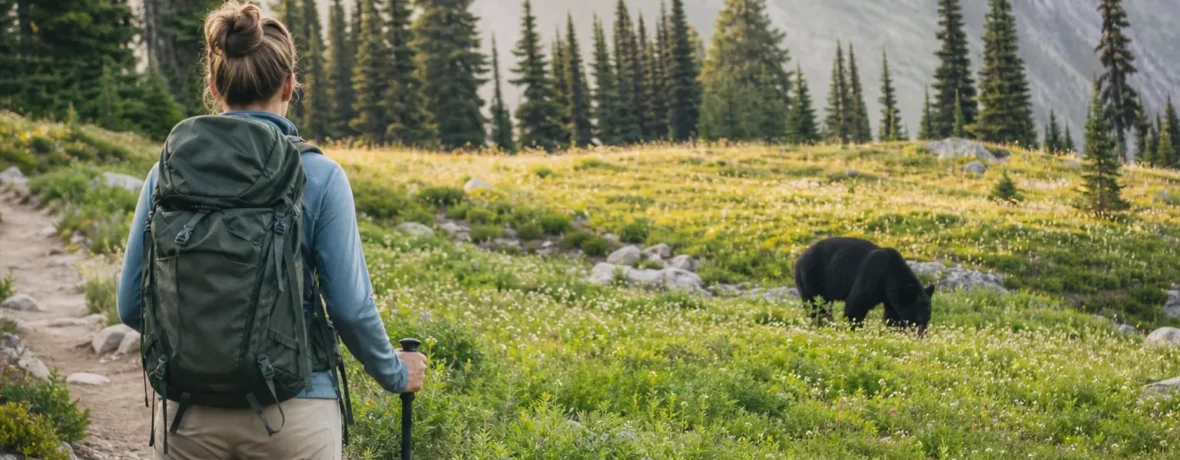
Bear attack statistics show the risk is very low for park visitors who keep distance, store food, and avoid surprise encounters. In Yellowstone, 45 people were injured by grizzly bears across more than 148 million visits since 1979: 1 injury per 3.3 million visits, as of November 2026.
What do bear attack statistics actually show?
They show that bear attacks are rare, but not random.
The cleanest official numbers come from parks that track human-bear conflicts closely. Yellowstone National Park reports that since 1979, more than 148 million visits produced 45 grizzly bear injuries, or 1 injury per 3.3 million visits. The risk changes fast when you leave roads and boardwalks: Yellowstone lists 1 grizzly bear injury per 69.7 million visits in developed areas, 1 per 30.2 million roadside campground overnight stays, 1 per 1.9 million backcountry overnight stays, and 1 per 275,000 backcountry hiking person-days, as of November 2026, on its official bear management page.
Those numbers are not a national promise. They are Yellowstone’s numbers. But they tell you the pattern that matters on trail: distance, food, group size, visibility, and surprise encounters drive risk.
| Activity in Yellowstone | Reported grizzly injury risk | What that means for you |
|---|---|---|
| Developed areas, roadsides, boardwalks | 1 in 69.7 million visits | Stay on route and keep your distance. |
| Roadside campground | 1 in 30.2 million overnight stays | Food storage is the big job. |
| Backcountry camping | 1 in 1.9 million overnight stays | Camp setup and cooking habits matter. |
| Backcountry hiking | 1 in 275,000 person travel days | Noise, group size, and bear spray move the needle. |
Are black bear attacks more common than grizzly attacks?
No single official source gives one simple U.S. total that covers every trail, forest, park, and state.
Black bears live across more of North America, so more hikers share space with them. That does not mean a black bear you see on a trail is likely to attack. In Yosemite, which has black bears but not grizzlies, the park reported 34 human-bear incidents in 2025; those incidents include property damage or bears getting human food, and injuries are described as fairly uncommon, as of November 2026, on Yosemite’s official park statistics page.
That distinction matters. A “bear incident” is not the same as a mauling. In many parks, the common problem is a bear getting into food, coolers, backpacks, vehicles, trash, or campsites. That is still serious. A food-rewarded bear becomes bolder, and a bolder bear can become dangerous for the next person.
What makes a bear attack more likely?
Surprise, food, cubs, carcasses, and close distance are the big triggers.
The National Park Service says most bear encounters end without injury, but attacks have happened and can cause serious injury or death. NPS also says most bears avoid humans when they hear them coming, which is why quiet solo hiking through brush, wind, water noise, or berry patches deserves extra caution, as of November 2026, on its official bear safety guidance.
Watch your habits. The risky ones are ordinary trail mistakes:
- Hiking alone or with one quiet partner in dense cover.
- Moving fast around blind corners, especially while running or biking.
- Wearing earbuds so you miss movement, huffs, or breaking branches.
- Cooking near your tent or sleeping with snacks, toothpaste, lip balm, or wrappers.
- Approaching a bear for a photo. Bad idea. Always.
- Walking near a carcass, fresh dig, cubs, or a bear feeding area.
How far should you stay from a bear?
In many major grizzly parks, the rule is 100 yards [91 m].
Yellowstone tells visitors to stay at least 100 yards [91 m] from bears, wolves, and cougars. Grand Teton gives the same 100-yard [91 m] distance for bears and wolves, as of November 2026, on its official Safety in Bear Country page. Denali is stricter for bears, telling visitors to stay at least 300 yards [275 m] away.
Park rules vary because terrain, species, bear behavior, and visitor patterns vary. Before you go, check the exact park or forest page, then follow the more conservative distance if signs, rangers, closures, or current bear activity call for it.
Does bear spray really help?
Yes, bear spray is one of the main tools recommended by bear-country parks.
Carry it where you can reach it in seconds. Not buried in your pack. Not in the side pocket under your rain jacket. On your belt, chest strap, or shoulder strap.
Grand Teton says bear spray should be used as a last resort on an aggressive or charging bear, not sprayed on tents, people, or backpacks. The park also says to choose an EPA-approved product made specifically for bears and check the expiration date, as of November 2026.
- Carry bear spray in a quick-draw holster.
- Remove the safety only when you may need to use it.
- Aim slightly downward toward the bear’s front legs.
- Spray a short burst when the bear is close enough according to the product label and park guidance.
- Leave the area after using it. Do not run.
Bear spray is not a force field. It works best when paired with boring, reliable habits: make noise, hike in a group, watch for sign, keep a clean camp, and give every bear a huge buffer.
What should you do if you see a bear on trail?
Stop, stay calm, and give the bear a way out.
Most bear encounters do not turn into attacks. Your job is to keep the scene from escalating.
- Talk calmly so the bear knows you are human.
- Pick up small children right away.
- Do not run. Running can trigger a chase response.
- Keep your pack on; it can protect your back.
- Back away slowly and sideways if the bear is not approaching.
- If the bear is on the trail, change your plan. Turn around if needed.
If a bear charges, follow the current guidance for that park. Some charges are defensive. Some are bluffs. Some are not. Your response can depend on species, behavior, and whether the bear is defending cubs, food, or space. That is why reading the local bear page before your hike is not optional in bear country.
How can you reduce your odds before the hike?
Plan like you expect to see a bear, then be happy if you do not.
- Check local alerts. Look for trail closures, carcass reports, food-storage orders, and recent bear activity.
- Hike in a group. Groups make more noise and are more intimidating to bears.
- Make human noise. Talk, clap, or call out near brush, rushing water, berry patches, and blind corners.
- Store food correctly. Use bear lockers, approved canisters, or required hangs where allowed. Treat trash and scented items like food.
- Keep a clean camp. Cook and eat away from your sleeping area where local rules require it.
- Carry bear spray. Practice removing it from the holster before the trip.
- Skip dawn, dusk, and night hiking in active bear areas. Visibility drops, and bears may be moving.
When to see a doctor
Get medical care after a bear bite, scratch, or serious contact.
The CDC says bites and scratches from wild animals can spread germs even when the wound does not look deep. Wash bites and scratches with warm soapy water immediately, then seek medical attention for serious wounds, signs of infection, unusual animal behavior, or tetanus and rabies questions, as of November 2026, on the CDC’s wildlife health guidance.
Call emergency services if there is uncontrolled bleeding, severe pain, loss of movement, exposed muscle or bone, a bite over a joint, or any injury that makes walking out unsafe. Do not try to self-diagnose a wildlife wound in the backcountry. Clean it, control bleeding if you can, get help, and report the incident to rangers or local authorities.
Related reading
- Is Bear Spray Legal in Canada?
- Is Bear Spray Legal in California?
- Is Bear Spray Legal in New York?
- Can You Fly With Bear Spray?
FAQ
How rare are bear attacks in national parks?
Very rare. In Yellowstone, grizzly bear injuries occurred at a rate of 1 per 3.3 million visits from 1979 through the current official data shown as of November 2026.
Which is more dangerous, a black bear or a grizzly bear?
Both can injure or kill a person, but grizzlies are generally treated with extra caution because of their size, strength, and defensive behavior. Your response should follow local park guidance, not guesswork from a quick look at fur color.
Should you play dead during a bear attack?
Sometimes. NPS guidance says playing dead is often the response for a defensive brown or grizzly bear contact, while fighting back is advised if an attack persists or if the bear appears predatory; park-specific guidance can vary.
Do bells prevent bear attacks?
Do not rely on bells alone. Human voices carry clearer information, and parks commonly recommend talking, calling out, hiking in groups, staying alert, and carrying bear spray.
Are bear attacks usually caused by food?
Food is a major driver of human-bear conflict, but not the only one. Surprise encounters, cubs, carcasses, and crowding a bear can also turn a normal sighting into a dangerous situation.
What is the safest thing to do if a bear is blocking the trail?
Back away and give it space. Do not push past, throw food, shout at a calm bear, or try for a closer photo; if it does not leave, turn around and change your route.