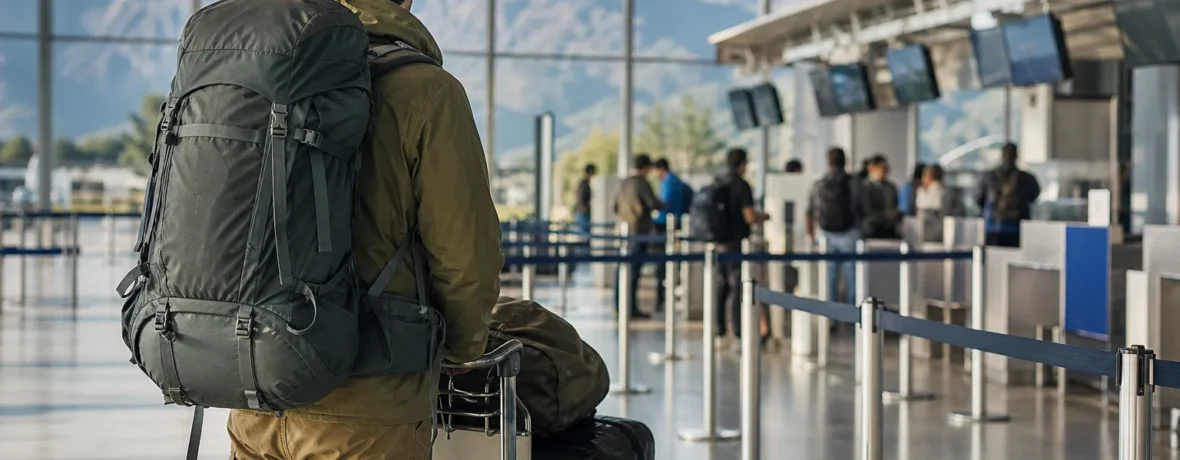
No for normal hiking cans. As of November 2026, TSA lists bear spray as not allowed in carry-on or checked bags, while FAA allows only one 4 fl oz [118 ml] self-defense spray in checked baggage if it meets strict limits and the airline accepts it. Standard bear spray is larger.
Can you fly with bear spray in checked luggage?
Usually, no. As of November 2026, the TSA bear spray page lists bear spray as not allowed in carry-on bags or checked bags, and the final call at the checkpoint belongs to the TSA officer.
The confusing part is the FAA’s hazardous-materials rule. As of November 2026, the FAA PackSafe sprays and repellents page says one self-defense spray may go in checked baggage only if it is 4 fl oz [118 ml] or smaller, has a safety feature that prevents accidental discharge, contains no more than 2% by mass of CS or CN tear gas, and meets the self-defense spray specifications. The same FAA page says most bear sprays are larger than 4 oz and therefore cannot be carried. (faa.gov)
Trail-sized bear spray is not tiny. Many EPA-registered bear sprays used by hikers are 7.6 oz [215 g] or larger, which puts them outside the FAA checked-bag exception. So don’t plan on packing your backcountry canister in luggage and arguing the fine print at the counter. That is a bad airport morning.
| Item | Carry-on | Checked bag | Best move |
|---|---|---|---|
| Standard bear spray | No | No in practice; TSA lists it as no | Buy, rent, or borrow at your destination |
| 4 fl oz [118 ml] self-defense spray | No | Only if it meets FAA limits and airline rules | Check FAA, TSA, and your airline first |
| Insect repellent for skin/clothing | Subject to liquid/aerosol limits | Allowed within FAA quantity limits | Pack normally, with caps protected |
Can you bring bear spray in a carry-on?
No. As of November 2026, bear spray is not allowed through TSA screening in carry-on baggage. It is a pressurized irritant aerosol, not a toiletry, and the 3.4 oz [100 ml] liquids rule does not make it okay.
Do not tuck it into a side pocket “just to see.” If TSA finds it, you can lose the canister, delay your trip, or create a messy situation for yourself and everyone behind you in line. Bear spray is made to blast a cloud of irritant. Airports do not appreciate surprises.
Why can’t normal bear spray fly?
Because it is a hazardous aerosol designed to incapacitate a large animal. As of November 2026, the FAA limits self-defense sprays to one 4 fl oz [118 ml] container in checked baggage only, and the device must have more than a recessed button as its safety feature. International aviation rules are stricter: the FAA says self-defense sprays are prohibited in both carry-on and checked baggage on international flights. (faa.gov)
Bear spray also has a real accidental-discharge problem. Heat, pressure changes, crushed bags, and damaged safety clips are all enemies here. The right place for bear spray is on your belt or chest holster in bear country, not in an airplane cargo hold.
What should you do if you’re flying to bear country?
Buy or rent bear spray after you land. That is the cleanest plan.
- Check the official page for the park, forest, or refuge you’re visiting.
- Confirm bear spray is allowed there; some parks restrict possession or use.
- Buy or rent EPA-approved bear spray near the park or in the gateway town.
- Check the expiration date before you leave the store.
- Carry it where your hand can reach it fast: belt holster, chest holster, or pack-strap holster.
- Before flying home, return, recycle, donate, or properly dispose of the canister locally.
As of November 2026, the National Park Service says hikers in bear country should carry bear spray where it is ready, not buried in a backpack, and should check park regulations because bear spray is not allowed in every park. The NPS also says to buy EPA-approved bear spray made for bears, not personal pepper spray. (home.nps.gov)
Can you buy bear spray in national parks?
Often, yes, but don’t assume every trailhead store has a can waiting for you. As of November 2026, Yellowstone says bear spray is sold at gift shops, outdoor stores, service stations, bookstores inside the park, and in nearby communities; Yellowstone also lists authorized rental locations and drop-off/recycling options. (nps.gov)
That pattern is common around big bear-country parks: gateway towns know hikers fly in empty-handed. Still, check before you go. If you land late, drive straight to a remote trailhead, and start hiking at dawn, “I’ll grab it somewhere” can turn into “I never found any.”
- Call a park visitor center or ranger station.
- Check official park pages for “bear safety” or “bear spray.”
- Look for rental kiosks or local outdoor stores.
- Ask your lodging if they know legal drop-off or recycling options.
- Never throw a full or partly full canister into regular trash unless local guidance says to do so.
What kind of bear spray should you get?
Get EPA-approved bear spray labeled for deterring bear attacks. As of November 2026, the NPS says personal protection sprays and law-enforcement sprays are not a substitute because bear spray is built to reach farther and create a cloud rather than a narrow stream. (home.nps.gov)
Before you pay, check three things:
- EPA registration: The label should show it is registered and intended for bears.
- Expiration date: An expired can may lose pressure or range.
- Holster: If it rides inside your pack, it may as well be back at the hotel.
Read the label. Practice drawing the canister and flipping the safety with an inert training can if one is available. Do not test-fire your real can “just a little.” You may lose pressure, contaminate gear, and shorten the useful life of the can.
How do parks want you to carry and use bear spray?
Carry it ready, and use it only on an aggressive or charging bear. As of November 2026, Yellowstone tells visitors to spray when a charging bear is 30–60 feet [9–18 m] away, aiming slightly downward to create a cloud between you and the bear. Yellowstone also tells each person in the group to carry a can where it can be reached quickly. (nps.gov)
Bear spray is not bug spray. Do not spray it on tents, packs, clothes, kids, dogs, or the outside of your cooler. The NPS says it is a deterrent, not a repellent, and pre-spraying gear is the wrong move.
What should you do with bear spray before flying home?
Leave it legally at your destination. Return a rental can, use an official recycling kiosk, ask a ranger about local options, or give an unused, unexpired can to another hiker only where that is legal and sensible.
Do not mail it home unless the carrier and hazardous-materials rules specifically allow that shipment. Do not hide it in checked baggage. And do not leave it in a hot rental car: Yellowstone warns that bear spray can explode at 120°F [49°C]. (nps.gov)
When to see a doctor
Get medical help right away for serious breathing trouble, chest pain, wheezing, severe eye pain, vision changes, or symptoms that do not improve after fresh air and flushing. Bear spray exposure is usually temporary, but it can still hurt you.
If you are exposed, move to fresh air, avoid touching contaminated clothing, and wash affected skin with soap and water. The CDC Yellow Book lists oleoresin capsicum as a common chemical irritant and advises exposed people to avoid spreading contamination, bag contaminated clothing, and wash affected skin. (cdc.gov)
Related reading
- Is Bear Spray Legal in Canada?
- Is Bear Spray Legal in California?
- Is Bear Spray Legal in New York?
- What Is Bear Spray and How Effective Is It?
FAQ
Can I fly with bear spray if it is unopened?
No for standard bear spray. An unopened safety seal does not override TSA and FAA hazardous-materials rules, and TSA lists bear spray as not allowed in carry-on or checked bags as of November 2026.
Can I bring bear spray on an international flight?
No. As of November 2026, the FAA says international aviation regulations prohibit self-defense sprays in both carry-on and checked baggage.
Is bear spray the same as pepper spray?
No. Bear spray is made for bears, with a larger canister and a wide cloud pattern; personal pepper spray is made for people and usually shoots a shorter stream. Parks recommend EPA-approved bear spray specifically labeled for deterring bear attacks.
Can I take bear spray across the Canadian border by car?
Rules differ from flying. U.S. Customs and Border Protection says bear spray is permitted in the United States when crossing by land, but travelers should check current border and airline rules before travel.
Should every hiker carry their own can?
Yes in serious bear country. If the only can is in someone else’s pack 40 feet [12 m] away, it may not help when a bear charges.
What is the safest plan if I’m flying to Yellowstone, Glacier, or Grand Teton?
Fly without bear spray, then buy or rent EPA-approved bear spray near the park. Before flying home, return it, recycle it, or dispose of it through a local option listed by the park or gateway community.