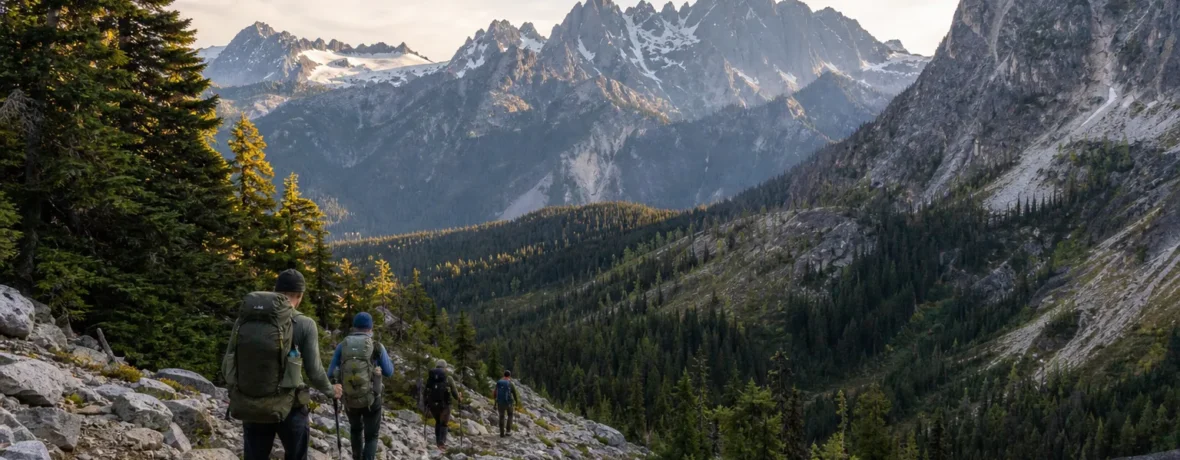
A north cascades backcountry permit is required year-round for every overnight trip inside North Cascades National Park Service Complex. As of November 2026, 2027 peak-season reservations run through Recreation.gov, cost $10 per adult plus a $6 non-refundable fee, and must be converted to a permit before you camp.
North Cascades makes you work for the good stuff. Glacier basins. Boat-in camps. Brushy river miles. Ridge walks that look like the Alps got dropped into Washington. The permit system is part of that deal: it spreads people out, protects small camps, and keeps fragile alpine ground from getting loved flat.
Do you need a permit to backpack in North Cascades?
Yes, you need one for every overnight backcountry trip in the park complex.
As of November 2026, the National Park Service says backcountry permits are required year-round for all overnight stays in the North Cascades National Park Service Complex, which includes North Cascades National Park, Ross Lake National Recreation Area, and Lake Chelan National Recreation Area. Day hikes do not need a backcountry camping permit, but sleeping out does. Check the official North Cascades backcountry permits page before you build your trip.
Your permit is not a loose permission slip. It names the trip leader, group size, camps or zones, and dates. You camp where the permit says, on the night it says. If you miss that, you can crowd another party out of a tiny site or damage ground that cannot take extra tents.
How do you get a North Cascades backcountry permit?
You either reserve ahead for peak season or try for a walk-up permit.
As of November 2026, all advance backcountry reservations are processed through Recreation.gov and reviewed by North Cascades wilderness rangers before the permit is issued. The reservation is not the same thing as the final permit. You still have to activate or pick up the permit through the park process before your trip.
- Pick your route using the park’s camp and zone information, not wishful thinking.
- Check availability on the official Recreation.gov North Cascades backcountry permits page.
- Reserve each night’s camp or zone for your actual itinerary.
- Watch for ranger review, required pickup instructions, and any closures or changes.
- Convert the reservation to a permit before the deadline listed by the park.
- Carry a signed copy of the permit in the backcountry.
Build a backup plan before you log in. Popular areas go fast, and a flexible hiker beats a perfect spreadsheet every time.
When do North Cascades backcountry permit reservations open?
For 2027 trips, the first lottery window opens March 1, 2027.
As of November 2026, the park has posted the 2027 reservation calendar on its official backcountry reservations page. The Early-Access Lottery application window is March 1 to March 12, 2027, with the deadline at 9 p.m. Pacific Time on March 12. Lottery results are scheduled for March 19, 2027.
Winners can make Early-Access reservations from March 23 to April 20, 2027. The general on-sale opens April 29, 2027, at 7 a.m. Pacific Time. The posted 2027 peak season for reservations is May 14 to October 9, 2027.
| Permit path | Best for | As of November 2026 |
|---|---|---|
| Early-Access Lottery | High-demand trips like Sahale, Copper Ridge, and Ross Lake | Applications March 1-12, 2027 |
| General On-Sale | Flexible planners who missed the lottery | Opens April 29, 2027, at 7 a.m. PT |
| Walk-up Permit | Hikers with backup routes and flexible dates | Available day of or day before, if space remains |
How much does a North Cascades backcountry permit cost?
As of November 2026, adults cost $10 per person plus a $6 non-refundable reservation fee.
The park lists adults as ages 16 and older. Youth ages 15 and under are free. The $6 fee applies when you enter the Early-Access Lottery, make a general on-sale reservation, or get a walk-up permit. The park says only debit and credit cards are accepted, with no cash.
The per-person recreation fee can be refunded if you cancel at least 3 days before your trip start date, as of November 2026. The $6 reservation fee is non-refundable. North Cascades has no entrance fee, but trailheads on adjacent U.S. Forest Service land may require a Northwest Forest Pass or federal recreation pass; the official North Cascades fees page lists those fee details.
Can you get a walk-up permit in North Cascades?
Yes, and roughly 40% of peak-season sites are held for walk-up permits.
As of November 2026, Recreation.gov says approximately 60% of backcountry sites are available for advance reservation during peak season, while the remaining 40% are issued through walk-up permits on a first-come, first-served basis. Walk-up permits can be picked up the day of or the day before your trip begins.
Do not show up blank. Rangers will not plan your trip from scratch while a line builds behind you. Bring a real itinerary, plus two or three backups in different parts of the park. If you want a July weekend in a marquee basin and nothing else will do, your odds shrink fast.
- Arrive before the permit office opens if your route is popular.
- Know your daily mileage and elevation limits.
- Bring alternate camps, alternate trailheads, and alternate dates.
- Check Recreation.gov for “W” walk-up availability before you go.
- Be ready to start the same day or the next day.
Where do you pick up a North Cascades backcountry permit?
Most permits run through the Wilderness Information Center in Marblemount.
As of November 2026, the Wilderness Information Center at 7280 Ranger Station Road in Marblemount is the main backcountry permit office for the park complex. The park also says no permit services are available in Sedro-Woolley or Stehekin.
For some Mt. Baker Highway access trips, summer permit service may be available at the Glacier Public Service Center on specific days. As of November 2026, the park lists in-person pickup there on Thursdays and Fridays between June 25 and September 25 for backcountry camps and cross-country zones accessed along the Mt. Baker Highway, including routes such as Copper Ridge, Whatcom Pass, and the Fisher Chimneys route on Mount Shuksan.
Some walk-up permits may be issued by email for listed areas, subject to conditions, availability, and closures. The park gives priority to people standing in line at permit stations, so email is not a magic shortcut.
What rules come with a North Cascades backcountry permit?
The big rule is simple: follow the exact itinerary on your permit.
As of November 2026, Recreation.gov states that camping is only allowed in the camp area listed on your permit, on the date listed. Permit holders are limited to 14 days in the backcountry per permit and 30 days per calendar year. Overlapping reservations for the same permit holder are not allowed.
Group limits depend on where you camp. The park’s Wilderness Trip Planner lists camp-by-camp limits, food storage, toilets, campfire rules, and notes. As of November 2026, established trail corridors and many camps use a 12-person maximum, while many cross-country zones are limited to 6. Some camps are smaller, with site limits of 4, 6, or 8 people. Match your group to the site capacity before booking.
Food storage is not optional. In designated camps, food, trash, and scented items must be hung, stored in a bear box, or secured in an approved animal-resistant canister. Some camps and alpine areas require canisters because there is no good place to hang food. The park says bear canisters may be borrowed for free at the Wilderness Information Center, as of November 2026.
- Camp only where your permit says.
- Use designated sites along trail corridors.
- In cross-country zones, camp on snow, rock, or bare ground.
- Hang food 12 feet [3.7 m] up and 5 feet [1.5 m] out from the trunk when hanging is allowed and practical.
- Use toilets where provided.
- Pack out all trash.
- Use a stove instead of a fire when possible.
- Do not have campfires in cross-country zones.
Are dogs allowed on North Cascades backcountry trips?
Sometimes, but not across the whole park.
As of November 2026, the park says pets are not allowed in North Cascades National Park except on the Pacific Crest Trail. Leashed dogs are allowed in Ross Lake National Recreation Area and Lake Chelan National Recreation Area. That boundary detail matters. A route can move between national park land and recreation area land faster than you expect on a map.
If your trip depends on bringing a dog, confirm the exact trail, camp, and land designation before you reserve. Do not assume “North Cascades” means one pet rule everywhere.
Which North Cascades permit areas are hardest to get?
Sahale, Copper Ridge, Ross Lake, and several climbing zones are the hot tickets.
As of November 2026, the park names Cascade Pass and Sahale Glacier Camp as highly competitive, with Ross Lake boat-in sites and the Copper Ridge area also popular. Recreation.gov also points high-demand users toward the Early-Access Lottery for areas such as Sahale, Copper Ridge, and Ross Lake.
Mountaineering adds another layer. Popular climbing areas such as Boston Basin, Eldorado, and Sulphide Glacier sit in cross-country zones. As of November 2026, only certain high-use cross-country zones can be reserved in advance; many others are walk-up only.
Snow controls the season more than the calendar. The park says Cascade Pass and Sahale campsites often melt out in early July and can become unreachable again in late September when snow returns. Copper Ridge camps can stay snow-covered into July. If you do not have steep-snow skills, wait for the route to be in shape.
What should you check before your trip?
Check conditions, closures, food storage rules, and your pickup deadline.
North Cascades is not a soft place. Roads wash out. Snow lingers. Creeks rise. Smoke can move in. A permit gives you permission to camp; it does not make the route safe or passable.
- Confirm road access to your trailhead.
- Check trail and camp closures.
- Verify whether your camp requires a bear canister.
- Print and sign your permit if instructed.
- Carry a map, headlamp, insulation, rain gear, and a water treatment method.
- Plan conservative mileage if your route includes snow, brush, fords, or rough tread.
- Tell someone your itinerary and exit date.
Also check your pickup deadline. As of November 2026, Recreation.gov says reserved permits must be picked up by 11 a.m. on the trip start date or the reservation will be canceled. That is a hard stop, not a suggestion.
Related reading
- Grand Canyon Backcountry Permits Explained
- Angels Landing Permit Lottery Explained
- Yosemite Wilderness Permits: How to Get One
- Mount Whitney Permit Lottery Explained
FAQ
Can I camp anywhere in North Cascades with a permit?
No. Your permit names specific camps or zones for specific dates. Along trail corridors, camp in designated sites; in cross-country zones, use durable surfaces such as snow, rock, or bare ground.
Is a reservation the same as a permit?
No. A reservation holds your itinerary, but the park still has to issue or activate the permit. As of November 2026, reserved permits must be picked up by 11 a.m. on your start date or they are canceled.
Do I need a permit for a day hike in North Cascades?
No backcountry camping permit is needed for a day hike. You need a backcountry permit when you sleep overnight in the backcountry inside the park complex.
Can Pacific Crest Trail hikers camp in North Cascades with a PCT permit?
Sometimes. As of November 2026, the park honors the PCTA long-distance permit for camping at Six Mile Camp and Bridge Creek Camp. Hikers without that long-distance permit, and Pacific Northwest Trail hikers, must get a park-issued backcountry permit for camping inside North Cascades National Park.
What happens if my route closes after I get a permit?
The park may adjust your itinerary if closures, snow, fire, wildlife activity, or other hazards affect your plan. Check conditions close to your start date and arrive with backup options.
Can I get a North Cascades permit outside peak season?
Yes. Permits are still required year-round. As of November 2026, when the Wilderness Information Center is closed for the winter season, the park allows self-issue permits outside the WIC in Marblemount or permit submission by email through the posted winter process.