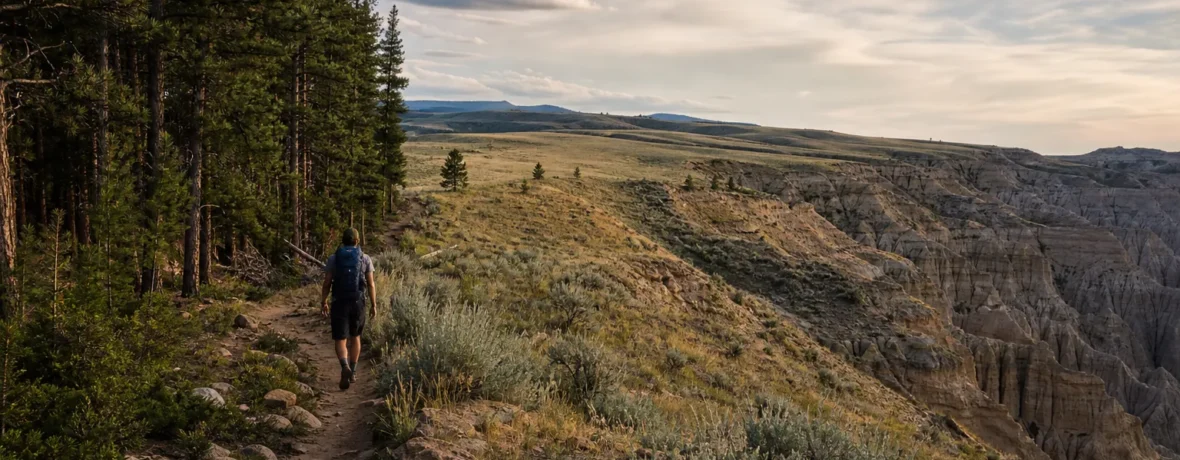
National park vs national forest: a national park is usually the strictest, most fee-and-permit-heavy choice, built around preservation; a national forest is multi-use land with looser camping and dog rules; BLM land is often the freest for dispersed camping. Yes, you can hike all three, but rules change at each boundary.
What is the difference between national park vs national forest land?
The short answer: national parks protect marquee natural and historic places, national forests balance recreation with timber, grazing, water, and wildlife, and BLM land is broad public land managed for multiple uses.
That difference sounds tidy. On the ground, it can feel messy. You might drive out of a national park, cross into a national forest, then camp on BLM land the same afternoon. Same mountains. Different agency. Different rules.
As of November 2026, the National Park Service manages 434 units covering more than 85 million acres [34 million hectares] across all 50 states, D.C., and U.S. territories, according to the National Park Service National Park System page. These include national parks, monuments, battlefields, historic sites, recreation areas, seashores, and more.
The U.S. Forest Service, part of the Department of Agriculture, stewards more than 193 million acres [78 million hectares] of national forests and grasslands, according to the Forest Service’s land management page. These lands often sit around mountain towns and high-country trail systems.
The Bureau of Land Management, part of the Department of the Interior, manages 245 million acres [99 million hectares] of public lands and 700 million acres [283 million hectares] of mineral estate, according to the BLM About page. BLM land is huge in the West. Think desert canyons, sagebrush basins, Badlands, climbing areas, OHV routes, and open camping country.
| Land type | Main purpose | Best for hikers who want | Typical rule feel |
|---|---|---|---|
| National Park Service land | Preservation and public enjoyment | Iconic scenery, signed trails, visitor centers, ranger programs | Most controlled |
| National Forest land | Multiple use: recreation, water, timber, grazing, wildlife | Big trail networks, backpacking, dispersed camping, dog-friendly hiking | Flexible, but local orders matter |
| BLM land | Multiple use and sustained yield | Desert routes, dispersed camping, solitude, road-trip freedom | Often loose, with strong site-specific exceptions |
Do national parks, national forests, and BLM land charge fees?
Sometimes, yes—but the fee pattern is different.
National parks are the most likely of the three to have entrance fees. As of November 2026, the National Park Service says parks that charge entrance require one of three things: a standard pass for that park, a park-specific annual pass, or an America the Beautiful pass. The resident America the Beautiful annual pass is $80, the non-resident annual pass is $250, the senior annual pass is $20, and the senior lifetime pass is $80, according to the NPS entrance passes page.
That pass is powerful, but not magic. As of November 2026, NPS says the America the Beautiful pass covers entrance fees and standard amenity day-use fees at federal recreation sites, including national parks. It does not automatically cover reservations, timed-entry tickets, many camping fees, concessionaire fees, or special recreation permits.
National forests usually do not have a blanket entrance gate. You may pay at developed trailheads, day-use sites, boat launches, ski areas, cabin rentals, campgrounds, or high-demand permit areas. Some places accept an America the Beautiful pass for standard amenity fees. Others do not. Read the sign at the trailhead before you toss your pack on.
BLM land is often free to enter, especially away from developed recreation sites. As of November 2026, Recreation.gov says more than 99 percent of BLM-managed public lands are available for no fee, while the BLM says some developed campgrounds, visitor centers, day-use areas, and National Conservation Areas charge fees. Check the local site page before you drive 60 miles [97 km] down a dirt road.
Can you camp for free on national forest or BLM land?
Often yes, but “free” does not mean “no rules.”
On national forests, dispersed camping means camping outside a developed campground. As of November 2026, Forest Service guidance says dispersed camping is free, has few or no facilities, and puts extra responsibility on you for water, trash, fire safety, and human waste; see the agency’s dispersed camping guidance.
On BLM land, dispersed camping is also common. As of November 2026, the BLM says most BLM lands allow dispersed camping unless the area is posted “Closed to Camping” or has specific restrictions. Many BLM areas generally limit dispersed camping to 14 days within a 28-day period, then require you to move to a new location, often at least 25 to 30 miles [40 to 48 km] away, according to the BLM camping page.
National parks are different. Do not assume you can pull off a road and sleep because the view is pretty. Frontcountry camping is usually limited to designated campgrounds. Backcountry camping often requires a wilderness or backcountry permit, with routes, zones, food storage, group size, and campsite rules set by that specific park.
If you want the simplest rule of thumb, use this: national parks tell you where you may camp; national forests and BLM areas often tell you where you may not camp.
- Use existing dispersed sites when you can.
- Do not block roads, gates, trailheads, or water access.
- Pack out trash, food scraps, foil, cans, and toilet paper.
- Check fire restrictions the day you arrive.
- Read the local forest, district, monument, or field office page before you commit.
Do you need permits or reservations?
Sometimes—and high-demand places are where hikers get burned.
As of November 2026, Recreation.gov describes itself as the federal government’s centralized travel planning and reservation platform for 14 federal agencies, but it also says agencies set the actual policies, fees, booking windows, and rules for their own sites. In plain English: Recreation.gov is the booking counter, not the rule-maker. See the Recreation.gov FAQ before assuming one permit works everywhere.
You may need a reservation or permit for:
- National park timed-entry systems
- Popular national park roads or corridors
- Backcountry or wilderness camping
- Quota trailheads in wilderness areas
- River trips
- Cave tours and ranger-led programs
- Commercial guiding, photography, or filming
- Large groups or organized events
The annoying part? Two places can share a boundary and use different systems. A national park trailhead may use one permit. A national forest wilderness trailhead next door may use another. A BLM canyon nearby may have a third set of rules.
How do you check the rules before a hike?
Check the managing agency first, then the local unit page, then current alerts.
Do not rely only on a map app label. Public-land boundaries can be thin, crooked, and easy to miss. A road shoulder may be legal on one side and closed on the other. A dog may be allowed for the first 2 miles [3.2 km], then banned at a national park boundary. A drone may be fine in open BLM country, then illegal once you step into wilderness.
- Find the agency: NPS, U.S. Forest Service, BLM, state, tribal, county, city, or private.
- Open the official local unit page, not just the national homepage.
- Read “Alerts,” “Closures,” “Fees,” “Permits,” “Pets,” “Fire,” and “Maps.”
- Check the date on fire restrictions and seasonal road closures.
- Download the map for offline use.
- Call the ranger district, park office, or BLM field office if the rule is unclear.
Are dogs allowed in national parks, national forests, and BLM land?
Dogs are most restricted in national parks and usually more welcome on national forest and BLM land.
As of November 2026, NPS pet rules vary by park, but the agency’s B.A.R.K. guidance says pets must be on a leash no longer than 6 feet [1.8 m], pet waste must be bagged and discarded properly, wildlife must be respected, and you are responsible for knowing where pets are allowed; see the NPS pets page. Many national park backcountry trails do not allow pets. Some paved paths, roads, campgrounds, and picnic areas do.
National forests are usually better for hiking with dogs. As of November 2026, Forest Service visitor rules say pets must be restrained or leashed in developed recreation sites, and pets are not allowed in swimming areas except guide dogs, according to the Forest Service visitor rules. Trail rules still vary by forest, wilderness area, wildlife closure, and local order.
BLM land is often dog-friendly, but not rule-free. Expect leash rules in developed recreation sites, seasonal wildlife closures in sensitive habitat, and strict cleanup expectations. If your dog chases wildlife, harasses livestock, or charges other hikers, the problem is not the agency. It is you.
Can you fly a drone?
In national parks, usually no; on national forest and BLM land, sometimes yes with limits.
As of November 2026, the National Park Service says launching, landing, or operating uncrewed aircraft from NPS lands and waters is prohibited unless an exception or written approval applies; see the NPS uncrewed aircraft page. That includes drones, model aircraft, and similar devices.
National forests are more open, but wilderness is a hard stop. As of November 2026, Forest Service drone guidance says recreational UAS use in wilderness is prohibited, drones may not fly in Temporary Flight Restriction areas such as wildfires, and recreational flyers must follow FAA rules, including visual line of sight and the 400-foot [122 m] limit in Class G airspace; see the Forest Service drone guidance.
BLM land can allow recreational drone use, but special designations change the answer fast. As of November 2026, BLM drone guidance says not to launch or land in designated wilderness, not to fly near wildfires, not to harass wildlife, and to check local land managers before flying; see the BLM drone fact sheet.
What about guns, hunting, and target shooting?
The rules swing hard by agency, state, season, and exact location.
As of November 2026, the National Park Service says firearm possession in national parks follows the law of the state where the park is located, but federal law generally prohibits firearms in NPS facilities, and use or discharge of a firearm in a park is prohibited unless authorized; see the NPS firearms page.
On national forests, hunting may be allowed under state seasons and regulations, but shooting is not allowed in unsafe places. As of November 2026, Forest Service visitor rules prohibit firing a gun in or within 150 yards [137 m] of a residence, building, campsite, developed recreation site, or occupied area; across or on a road or body of water; or where a person may be injured or property damaged.
On BLM land, target shooting is generally allowed where it is safe and not closed. As of November 2026, BLM says discharging or using firearms, weapons, or fireworks is not allowed on developed recreation sites and areas except at designated sites, and you must check local restrictions; see the BLM recreational shooting page.
Which land is best for hiking?
Pick the land type that matches the trip you actually want.
Choose a national park when you want a classic route, reliable signage, visitor services, shuttles, ranger information, and scenery that made Congress draw a line around it. You will probably share the trail. You may need a reservation. You may pay. The trade-off is access to some of the most famous landscapes in the country.
Choose a national forest when you want room to roam. These are often the hiker’s sweet spot: longer trail systems, backpacking loops, dog-friendly routes, dispersed camping, alpine lakes, fire lookouts, and fewer entrance gates. The catch is that rules change by forest, ranger district, wilderness area, and season.
Choose BLM land when you want desert space, dispersed camping, rougher roads, open views, and fewer signs telling you what to do. The catch is that services can be thin. Bring water, a real map, a spare tire, and a plan. BLM country can feel casual until weather, mud, heat, or distance turns serious.
Quick checklist before you go
Run this before every public-land hike.
- Agency confirmed: NPS, Forest Service, BLM, or other.
- Entrance fee checked as of your trip month.
- Permit or reservation checked on the official site.
- Fire restrictions checked the same week.
- Dog rules checked for the exact trail.
- Drone rules checked before packing one.
- Road status checked, especially dirt roads and seasonal gates.
- Offline map downloaded.
- Water plan set: carry enough, treat natural sources, or cache legally where allowed.
- Camp plan legal for that agency and location.
Related reading
- National Monument vs National Park
- Park Ranger vs Forest Ranger: What's the Difference?
- National Park Pass Changes for 2026
- How Big Is Yellowstone National Park?
FAQ
Is BLM land the same as national forest?
No. BLM land is managed by the Bureau of Land Management, while national forests are managed by the U.S. Forest Service. Both are multiple-use public lands, but their local camping, road, shooting, grazing, fire, and permit rules can differ.
Can you camp anywhere in a national forest?
No. Dispersed camping is often allowed in national forests, but not everywhere. As of November 2026, Forest Service guidance says local motor-vehicle rules vary by forest, and posted closures, developed sites, water sources, wilderness rules, and fire restrictions can all limit where you camp.
Is BLM land free to camp on?
Often yes. As of November 2026, BLM says most BLM lands allow dispersed camping unless posted closed or restricted, but developed campgrounds may charge fees and many areas have stay limits, commonly 14 days within 28 days.
Are national forests less crowded than national parks?
Often, but not always. A famous national forest trailhead near a ski town can be packed, while a remote national park trail can be quiet. National forests usually give you more room to spread out because they cover larger working landscapes with more access points.
Does an America the Beautiful pass cover national forests and BLM land?
Sometimes. As of November 2026, NPS says the America the Beautiful pass covers entrance fees and standard amenity day-use fees at federal recreation sites, including national parks; it does not automatically cover every campground, reservation, special permit, or concessionaire fee.
Which is better for backpacking: national park or national forest?
National forests are usually easier for flexible backpacking, while national parks are better for tightly managed iconic routes. If you want famous scenery and maintained systems, pick the park; if you want fewer quotas and more route options, start with the forest.