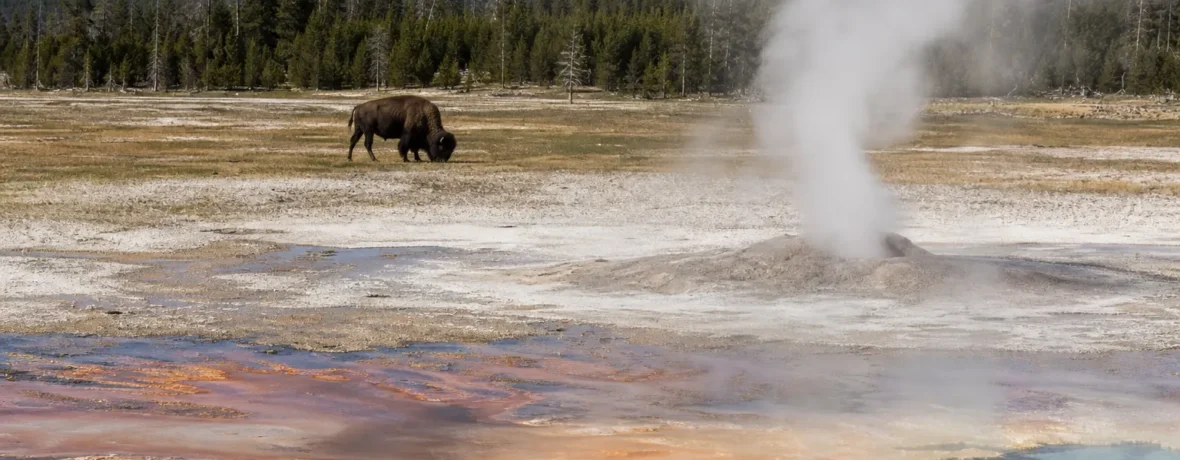
Yellowstone National Park is known for more than 10,000 hydrothermal features, more than 500 active geysers, an active volcano, 67 mammal species, giant waterfalls, Yellowstone Lake, and its 1872 designation as the world’s first national park. The short answer to what is Yellowstone national park known for: wild geology, wild animals, and strict safety rules.
What is Yellowstone National Park known for?
Yellowstone is best known for geysers, hot springs, wildlife, waterfalls, and its place in national park history.
The park was established on March 1, 1872, and the National Park Service identifies it as the world’s first national park. It covers 3,472 square miles (8,991 square km), with 96% in Wyoming, 3% in Montana, and 1% in Idaho. The official park facts page lists more than 10,000 hydrothermal features, more than 500 active geysers, 290 waterfalls, 392 miles (636 km) of paved roads, more than 15 miles (24 km) of boardwalk, and roughly 1,114 miles (1,792 km) of hiking trails. See the current Yellowstone National Park facts from NPS.
That is the headline. But the real pull is how close these pieces sit together. You can watch Old Faithful throw boiling water into the sky, then drive into Hayden Valley or Lamar Valley and see bison, elk, pronghorn, coyotes, wolves, or bears from a safe distance. It feels ancient. It is also heavily managed, because this park can hurt you fast if you treat it like a theme park.
Why is Yellowstone famous for geysers and hot springs?
Yellowstone is famous for geysers because it holds more than half of the world’s geysers.
The park sits on top of an active volcanic system. Heat below the surface warms groundwater, pressure builds, and the park’s geysers, hot springs, fumaroles, mudpots, and travertine terraces do the visible work. The Upper Geyser Basin alone is one of the densest geyser areas you can visit on foot, using boardwalks and designated paths.
Old Faithful gets the spotlight because rangers can predict it more reliably than most geysers. As of January 2025, NPS lists Old Faithful’s median eruption interval at 102 minutes, plus or minus 10 minutes, with intervals ranging from 54 to 118 minutes. Eruptions usually last 1.5 to 5 minutes and reach 106 to more than 180 feet (32 to 55 m). Check the official NPS Old Faithful page for current prediction guidance before you build your day around it.
Short version: stay on the boardwalk. Always. As of November 2026, NPS says burns from thermal features are a common cause of serious injury and death in the park, and swimming or bathing in water entirely of thermal origin is illegal. Even thin-looking runoff can burn you.
What animals is Yellowstone known for?
Yellowstone is known for bison, elk, wolves, grizzly bears, black bears, pronghorn, bighorn sheep, and moose.
NPS lists 67 mammal species in the park, including seven native ungulate species and two bear species. That makes Yellowstone one of the strongest wildlife-watching parks in the Lower 48. The bison are the easiest to underestimate. They look slow until they are not.
As of November 2026, the official safety rule is clear: stay at least 100 yards (91 m) from bears, wolves, and cougars, and at least 25 yards (23 m) from all other wildlife, including bison and elk. If an animal moves closer, you move back. Use binoculars or a long lens. Do not feed wildlife, leave food unattended, or step toward an animal for a photo. Read the current Yellowstone safety rules from NPS before you hike.
| Yellowstone icon | What makes it special | Smart visitor move |
|---|---|---|
| Old Faithful | One of the park’s predictable geysers | Check the posted prediction and arrive early |
| Grand Prismatic Spring | Yellowstone’s largest hot spring | Stay on boardwalks and use the overlook trail when open |
| Lamar Valley | Prime wildlife-watching country | Bring binoculars and keep legal distance |
| Lower Falls | 308-foot (94 m) waterfall near a road | Use designated overlooks and expect crowds |
Is Yellowstone a volcano?
Yes, Yellowstone sits on an active volcano.
NPS lists the Yellowstone Caldera as 45 by 30 miles (72 by 48 km), one of the world’s largest calderas. The park also records 1,000 to 3,000 earthquakes annually. That does not mean you should expect movie-style disaster on your visit. It means the heat, pressure, mineral-rich water, and shifting ground are the forces behind the park’s geysers and hot springs.
For hikers, the practical takeaway is simple. Thermal ground can be thin. A crust that looks solid can hide superheated water. Trails and boardwalks are not suggestions. They are the safe route through unstable terrain.
Do you need a reservation or permit to visit Yellowstone?
You need an entrance pass, but you do not need a vehicle reservation to enter Yellowstone.
As of November 2026, NPS says a vehicle reservation is not required for Yellowstone, but an entrance pass is required. Standard entrance passes run $20 to $35, with a private vehicle pass listed at $35 for seven consecutive days. Non-U.S. residents age 16 and older must pay an additional $100 per person unless admitted with an Annual Pass or America the Beautiful Pass. Verify fees before you go on the official Yellowstone fees and passes page.
Camping is different. As of November 2026, NPS says Yellowstone has 11 campgrounds with more than 2,000 established campsites, and overnight vehicle parking or car camping is not allowed in pullouts, parking areas, picnic grounds, or anywhere outside a designated campground. Beginning with the 2027 summer camping season, NPS says all campground reservations will be handled through Recreation.gov. Check the official Yellowstone camping page before planning a night in the park.
What rules should you know before visiting Yellowstone?
The big rules are simple: stay on boardwalks, keep your distance from wildlife, store food securely, and sleep only where overnight use is allowed.
Here is the fast checklist to keep your trip clean and legal, as of November 2026:
- Stay on boardwalks and designated trails in thermal areas.
- Do not swim or soak in hot springs or thermal water.
- Stay 100 yards (91 m) from bears, wolves, and cougars.
- Stay 25 yards (23 m) from bison, elk, and all other wildlife.
- Carry bear spray on hikes and keep it reachable, not buried in your pack.
- Do not feed wildlife, including birds and squirrels.
- Do not leave packs, coolers, or food unattended.
- Keep pets out of thermal areas, boardwalks, hiking trails, and the backcountry.
- Camp only in designated campgrounds or permitted backcountry sites.
Pets are especially limited here. As of November 2026, NPS allows pets only in developed areas, within 100 feet (30.5 m) of roads, parking areas, and campgrounds, and they must be controlled in a vehicle, crate, or on a leash no longer than 6 feet (1.8 m). Carried pets are still not allowed on boardwalks, trails, thermal areas, or in the backcountry.
How should you plan a first trip to Yellowstone?
Plan Yellowstone like a big mountain park, not a quick roadside stop.
Distances are long, roads can close, and weather can flip the day. As of November 2026, NPS says Yellowstone has five entrance stations, and it takes several hours to drive between them. The only road generally open year-round to regular vehicles runs from the North Entrance at Gardiner, Montana, through the park to Cooke City, Montana, via Tower Junction. Most other park roads close to regular vehicles from early November to late April and shift to limited oversnow travel in winter. Check the official Yellowstone park roads page before committing to a route.
- Pick your entrance first. West, North, Northeast, East, and South entrances can create very different drives.
- Choose two anchor areas per day. Old Faithful plus Grand Prismatic works. Old Faithful plus Lamar Valley is a very long day.
- Start early. Wildlife moves better in cooler hours, and parking fills near famous basins.
- Pack layers, water, snacks, a paper map, and bear spray for hikes.
- Check road status the morning you drive. Conditions can change quickly.
- Build in dead time. Bison jams, construction, snow, and full parking lots are part of the Yellowstone deal.
Related reading
- How Big Is Yellowstone National Park?
- What to Do in Yellowstone: Best Hikes and Sights
- Glacier to Yellowstone Road Trip: Distance and Route
- National Park Pass Changes for 2026
FAQ
What is Yellowstone most famous for?
Yellowstone is most famous for Old Faithful, its geysers, colorful hot springs, bison, bears, wolves, and its status as the world’s first national park. The park has more than 10,000 hydrothermal features and more than 500 active geysers.
Is Old Faithful the biggest geyser in Yellowstone?
No. Old Faithful is famous because it is relatively predictable, not because it is the biggest. Steamboat Geyser is taller when it has a major eruption, but it is not predictable like Old Faithful.
Can you see wildlife from the road in Yellowstone?
Yes. Many visitors see bison, elk, pronghorn, coyotes, and sometimes bears or wolves from roadsides and pullouts. Stay in your vehicle when traffic and safety allow, use binoculars, and keep the required distance from all animals.
Do you need a timed-entry reservation for Yellowstone?
No. As of November 2026, NPS says vehicle reservations are not required to enter Yellowstone. You still need an entrance pass, and campgrounds or lodging may require separate reservations.
Can you bring a dog to Yellowstone?
Yes, but dogs are tightly restricted. As of November 2026, pets are allowed only in developed areas within 100 feet (30.5 m) of roads, parking areas, and campgrounds, and they are not allowed on boardwalks, hiking trails, thermal areas, or in the backcountry.
What is the best thing to do on a first visit to Yellowstone?
See one geyser basin, one waterfall area, and one wildlife valley instead of trying to cover the whole park in one day. A strong first-timer plan pairs Old Faithful and Grand Prismatic with either the Grand Canyon of the Yellowstone or a wildlife drive through Hayden or Lamar Valley.