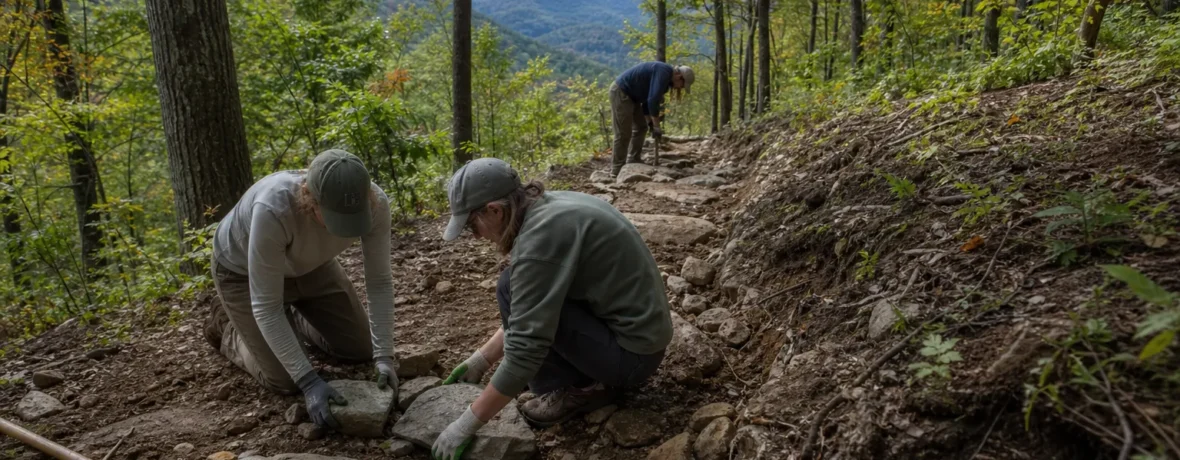
An Appalachian Trail Conservancy volunteer helps protect the 2,197.9-mile [3,537 km] A.T. through trail repair, shelter work, invasive plant removal, visitor outreach, boundary monitoring, and remote support. As of November 2026, ATC works with 30 A.T. Clubs; in fiscal year 2026, 4,712 volunteers logged 164,186 hours.
What does an Appalachian Trail Conservancy volunteer do?
You help keep the Appalachian Trail open, safer, and more resilient for hikers. The work can be muddy, social, quiet, technical, creative, or all of those in the same season.
The Appalachian Trail Conservancy volunteer program includes classic field work like cutting back brush, digging drainage, building steps, repairing shelters, clearing blowdowns, removing invasive plants, painting blazes, and checking boundary lines. It also includes people-facing work: greeting hikers, answering questions, helping at events, sharing Leave No Trace habits, and supporting local clubs.
Not every job needs a hard hat. ATC also lists behind-the-scenes roles such as data entry, writing, photography, graphic design, planning, communications, and other support tasks. That matters. A trail that runs from Georgia to Maine takes more than shovels.
As of November 2026, ATC says the A.T. requires roughly 200,000 volunteer hours each year to keep the footpath, facilities, and access points open, connected, and maintained. In fiscal year 2026, volunteers gave 164,186 hours, equal to $5.9 million in labor, according to ATC’s 2026 volunteer impact report.
How do you become an Appalachian Trail Conservancy volunteer?
You start by picking a real opening, not by sending a vague “I want to help” note into the woods. The cleanest path is ATC’s online Volunteer Engagement Platform.
- Go to the volunteer listings. Use the A.T. Volunteer Engagement Platform to search by location, interest, and availability.
- Read the full description. Look for the meeting place, expected duration, physical demands, tools, training, and age or group notes.
- Choose a job that fits your body and schedule. A half-day local work trip is a smart first move. A multi-day crew is a bigger bite.
- Register or apply as directed. Some projects are simple sign-ups. Some crew roles ask for more information before acceptance.
- Watch your email. Trip leaders usually send details closer to the event, including the exact meeting spot and what to bring.
- Show up on time and ready to work. Trail crews run on daylight, weather windows, and shared effort. Late arrivals slow everyone down.
- Try more than one role. Brushing corridor, greeting hikers, moving rock, and helping a club with communications all feel different. Sample the menu.
If you are brand new, you do not need to fake expertise. ATC states that training and resources are provided, and volunteer opportunities include information on duration and expectations. Your job is to choose honestly and listen well.
What volunteer jobs can you choose on the Appalachian Trail?
You can choose field work, visitor support, stewardship, club support, or multi-day crew work. The best role is the one you can do safely and repeat.
| Volunteer role | Best fit | What the work feels like |
|---|---|---|
| Trail maintenance | People who like tools, dirt, and clear tasks | Brushing, drainage, tread repair, step work, erosion control |
| Structures work | Handy volunteers and patient learners | Shelters, bridges, privies, bear boxes, signs, and campsite projects |
| Boundary or corridor monitoring | Detail-minded hikers who can follow maps | Checking protected lands, walking lines, spotting encroachments |
| Visitor outreach | Friendly people who can give clear advice | Greeting hikers, answering questions, sharing low-impact habits |
| Remote or administrative support | People with writing, design, data, planning, or tech skills | Helping the Trail without swinging a tool |
Do not overthink your first choice. If you can hike a few miles, carry water, take direction, and keep a good attitude when the bugs find you, you already have useful trail-crew traits.
Do you need trail-work experience to volunteer with ATC?
No, beginners can volunteer with ATC and A.T. Clubs. You just need to pick beginner-friendly work and follow the crew leader’s instructions.
Trail work has its own language. Tread. Corridor. Drain dip. Sidehill. Crush. Cribbing. You will learn it by doing the work, often with a Pulaski, loppers, rock bar, shovel, or McLeod in hand. Nobody expects a first-timer to walk in as a stone mason.
What leaders do expect is simpler:
- Read the project description before signing up.
- Tell the truth about your hiking ability and medical limits.
- Wear sturdy footwear and weather-ready clothing.
- Bring enough water and food for the day.
- Use personal protective equipment when told.
- Ask before using unfamiliar tools.
- Stop working if something feels unsafe.
For online prep, ATC announced free Learning Pathways courses in 2026 for people interested in trail work and A.T. stewardship. The courses cover volunteer basics, trail maintenance, digital map use, field leadership, and organizational skills through short modules, readings, and quizzes.
What is an ATC trail crew like?
An ATC trail crew is a multi-day, hands-on work trip with hard labor, shared camp life, and experienced leadership. It is not a casual guided hike with a little cleanup tacked on.
ATC’s trail crew program includes crews such as Konnarock, Mid-Atlantic, and Rocky Top. These crews tackle larger projects: trail relocations, sustainable tread, stone steps, bridge work, shelter repairs, privies, and other heavy jobs that one Saturday crew may not finish.
Expect long days. ATC describes trail crew work as eight- or nine-hour days in rain or shine, with bugs, dirt, hand tools, and full participation in camp chores. Volunteers may help cook, clean, care for tools, set up camp, haul materials, and work closely with people of different ages and backgrounds.
That is the charm. Also the challenge.
As of November 2026, ATC says beginners are welcome on A.T. crews, training and tools are provided, food is provided, and gear may be available for volunteers who need to borrow items such as a tent or sleeping bag. Project accommodations vary. Some sites are rustic. Some are campground-based. Some have no showers, bathrooms, or running water during the crew session.
Can groups volunteer with the Appalachian Trail Conservancy?
Yes, groups can volunteer, but larger groups should plan early. ATC recommends starting the planning phase one year before the desired group service date, as of November 2026.
That long lead time makes sense. A good group project needs a safe worksite, trained leadership, tools, parking, land-manager approval, and a task that matches the group’s size and skills. A dozen excited coworkers cannot simply arrive at a trailhead and start cutting things. Please do not be that crew.
ATC’s group volunteering guidance says service activities are coordinated by one of the 30 A.T. Maintaining Clubs, by ATC, or by a land management partner. Many events are run by volunteer club leaders, and many participants live locally and go home after one workday.
For a small group, scan the Volunteer Engagement Platform first. For a larger school, church, scout, corporate, or community group, use ATC’s group interest process and give the staff room to match you with the right club or crew.
What should you pack for an Appalachian Trail volunteer day?
Pack like you are going on a rough day hike where the hike stops and the work begins. Your gear should keep you safe, dry, fed, and useful.
- Sturdy closed-toe boots or trail shoes; leather work boots are better for tool-heavy days.
- Long pants that can take abrasion from rocks, brush, and mud.
- Work gloves that fit your hands.
- Rain jacket and warm layer, even for a short project.
- Sun hat, warm hat, or both, depending on season.
- Eye protection if the project involves swinging, clipping, or flying debris.
- Lunch, snacks, and more water than you think you will drink.
- Personal medications and allergy items you normally carry.
- Small first-aid kit for your own minor needs.
- Headlamp, especially in fall and winter.
- Trash bag or zip bag for muddy clothing.
- Notebook or phone for directions, contacts, and follow-up notes.
Leave the earbuds out during tool work. You need to hear the leader, the person carrying a log behind you, the warning before a rock moves, and the weather changing over the ridge.
How much time do you need to volunteer on the Appalachian Trail?
You can give one day, several days, a full crew session, or an ongoing local commitment. The right amount is the amount you can give without burning out.
A single day can clear a corridor, repaint blazes, fix drainage, or help a club finish a project before peak hiking season. A multi-day crew lets you learn deeper skills and see a project change under your hands. An ongoing club role can turn you into one of the people who knows a section the way others know their backyard.
If your schedule is tight, start with a posted event near home. If you want immersion, look at trail crews. If you have professional skills, search for remote or organizational roles. If you are retired, between jobs, working seasonally, or craving a useful reset, an A.T. crew can fill a week with honest sweat and good company.
One caution: do not sign up for a major project because you like the idea of being helpful. Sign up because the dates, travel, weather, physical work, and camping style fit your real life.
How do you volunteer safely and respectfully?
Follow the crew leader, use the right protective gear, and work at a pace you can sustain. Trail work rewards steady effort, not hero moves.
The Appalachian Trail crosses national parks, national forests, state lands, towns, private easements, and protected corridors. That patchwork is one reason volunteers work through ATC, A.T. Clubs, and land-management partners. They know who owns the land, what is allowed, what permits apply, and what work needs approval.
On the ground, safe and respectful work looks plain:
- Sign in and sign out so leaders know who is on the project.
- Stay inside the assigned work zone.
- Carry tools downhill and sharp ends low unless told otherwise.
- Keep spacing between people swinging tools.
- Drink water before you feel cooked.
- Take breaks before fatigue turns sloppy.
- Do not cut vegetation, move rocks, build steps, or alter campsites outside the project plan.
- Give hikers room to pass and keep tools off the walking line.
- Pack out trash, food scraps, flagging, and personal gear.
As of November 2026, ATC states that some parts of the A.T. require entrance fees, permits, or camping fees. Your volunteer leader or project listing should tell you what applies to the work event. If you add personal hiking or camping before or after the project, check that section’s current rules yourself.
Who is a good fit for ATC volunteer work?
A good fit is someone who can take direction, work safely, and care more about the Trail than their own ego. Fitness helps, but attitude carries the day.
You do not need to be a thru-hiker. You do not need ultralight gear. You do not need a trail name. Some excellent volunteers live near the A.T. and hike short sections. Some are former thru-hikers giving back. Some are students, retirees, office workers, carpenters, birders, map nerds, photographers, and people who simply like useful work outside.
You may love ATC volunteering if you want:
- Practical conservation work with visible results.
- A reason to spend time on the A.T. without chasing miles.
- New outdoor skills taught by patient people.
- A local trail community that meets more than once.
- A way to give back after a thru-hike or section hike.
- A physical challenge that ends with dinner tasting better than usual.
You may want a gentler first step if you dislike bugs, mud, shared chores, early starts, vague weather, or being told to redo something because water will not drain the way you hoped. Trail work is satisfying because it is real. Real work pushes back.
Related reading
- Youngest and Oldest Appalachian Trail Thru-Hikers
- Who Built the Appalachian Trail?
- How Long Is the Appalachian Trail? Miles, States and Time
- Where Does the Appalachian Trail Start and End?
FAQ
Is Appalachian Trail Conservancy volunteering free?
Many volunteer opportunities do not list a participation fee, but costs can vary by project, travel, food, lodging, and crew setup. Check the specific ATC or club listing before you commit, because the project description is the source that matters.
Can I volunteer for one day on the Appalachian Trail?
Yes, many A.T. volunteer events are single-day projects. Look for local club work trips, visitor outreach events, invasive plant pulls, corridor brushing days, and seasonal maintenance events on the Volunteer Engagement Platform.
Do I have to join an A.T. Club to volunteer?
No, you can start with posted ATC or club opportunities without making a long-term commitment. Joining a local A.T. Club is smart if you want steady work, deeper training, and a regular crew near home.
Are ATC trail crews beginner-friendly?
Yes, ATC says beginners are welcome on A.T. crews and that training, tools, and food are provided. You still need to read the crew description carefully, because multi-day trail work can mean long hours, rustic camping, and no showers or running water at the project site.
Can kids volunteer with the Appalachian Trail Conservancy?
Sometimes, but age rules depend on the project, tools, location, and supervising organization. Families should look for youth-friendly listings or contact the project organizer before registering.
What is the best first volunteer job on the A.T.?
The best first job is a short, local, beginner-friendly workday with clear meeting details and a trained leader. Brushing, light tread work, invasive plant removal, or visitor outreach can teach you how A.T. volunteering works without asking for a full week right away.