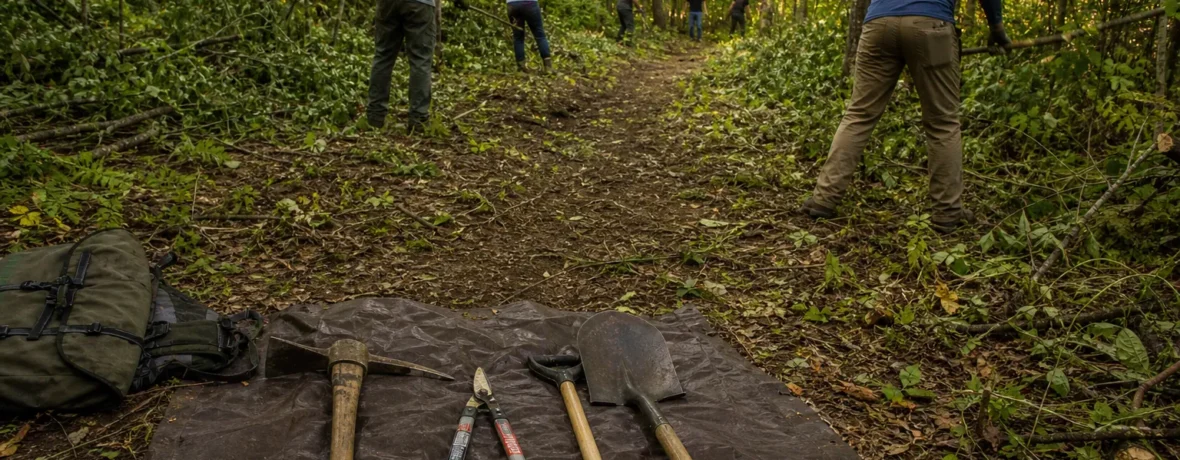
Who maintains a hiking trail depends on who manages the land. In the U.S., federal, state, county, city, tribal, and private land managers set the rules, while paid crews, nonprofit partners, conservation corps, contractors, and trained volunteers do much of the cutting, digging, brushing, drainage work, and repairs.
Who maintains hiking trails on public land?
Land managers are responsible, but they rarely work alone.
On public land, the agency or park system in charge of that ground is the starting point. A trail in a national forest is usually managed by the U.S. Forest Service. A trail in a national park is managed by the National Park Service. A desert route on BLM land falls under the Bureau of Land Management. State parks, county open-space districts, city park departments, and local recreation agencies handle their own trail systems.
Then comes the bigger, messier truth: the person swinging the Pulaski may not be an agency employee. It could be a volunteer from a local trail club, a seasonal trail crew member, a youth corps member, a contractor, or a nonprofit partner working under an agreement.
The National Park Service says park staff and volunteers work to keep trails safe, and many parks use friends groups, cooperating associations, corps crews, and local nonprofits to support trail upkeep through its trail management and maintenance work. The Forest Service’s Trail Maintenance and Construction Notebook also describes partners and volunteers as a regular part of trail work on National Forest System lands.
Are hiking trails maintained by volunteers or paid crews?
Both, and the mix changes from trail to trail.
Busy frontcountry trails near visitor centers may get regular attention from agency maintenance staff. Remote backcountry trails may depend heavily on volunteers and nonprofit partners. Technical repairs—rock walls, bridges, drainage structures, reroutes, hazard-tree work—often require trained crew leaders, agency approval, and sometimes professional contractors.
| Maintainer | Typical work | Where you’ll see them |
|---|---|---|
| Agency trail crews | Planning, inspections, drainage, structures, emergency repairs | National parks, forests, state parks, local parks |
| Volunteer trail clubs | Brushing, drainage clearing, tread repair, blazing, reporting damage | Long-distance trails, local preserves, adopted trail sections |
| Conservation corps | Heavy labor, restoration, reroutes, multi-day projects | Public lands with partner funding |
| Contractors | Bridges, engineered structures, major rebuilds, specialty work | High-use or damaged trail systems |
Look at the Appalachian Trail and Pacific Crest Trail for two famous examples. The National Park Service identifies the Appalachian Trail Conservancy as a partner connected with 31 local maintaining organizations on the A.T. through its Appalachian Trail partners page. On the PCT, the Pacific Crest Trail Association coordinates volunteers, staff, corps crews, and agency partners for trail maintenance and reconstruction.
What does trail maintenance actually include?
Trail maintenance is water management first, walking surface second, and everything else after that.
That may surprise you. Most hikers notice blowdowns, brush, mud, loose rocks, missing signs, and washed-out bridges. Trail crews notice water. If water runs down the trail instead of off it, the tread turns into a trench. Then boots widen the damage. Then the hillside starts moving. Fast.
Common trail maintenance jobs include:
- Cutting back brush so hikers stay on the intended path
- Clearing fallen limbs and trees, when crews are trained and allowed to do so
- Cleaning drains, dips, culverts, and water bars
- Repairing tread that has become cupped, rutted, loose, or dangerously sloped
- Building or repairing rock steps, crib walls, turnpikes, puncheon, and bridges
- Replacing signs, blazes, posts, and trailhead information
- Closing social trails that damage plants, soils, dunes, wetlands, or cultural sites
- Reporting hazards, illegal dumping, vandalism, and storm damage
A good trail does not always look “groomed.” In wilderness areas, crews may use hand tools instead of power tools. In fragile alpine or desert terrain, the goal may be a narrow, tough-to-see route that keeps people off sensitive ground without turning the place into a sidewalk.
Who decides when a trail gets fixed?
The land manager decides, usually with input from rangers, trail crews, partners, and public reports.
Trail repairs compete with every other land-management need: search and rescue, bathrooms, roads, campgrounds, fire damage, invasive plants, law enforcement, visitor centers, and staff time. That is why one trail gets fresh drainage work while another sits brushy for a season.
Managers usually weigh:
- Safety: Is there a bridge failure, rockslide, washout, or dangerous tree?
- Use level: How many hikers, riders, runners, or cyclists depend on the route?
- Resource damage: Is erosion dumping sediment into a stream or spreading into habitat?
- Access: Can crews reach the problem with tools, stock animals, vehicles, or only on foot?
- Season: Is the trail under snow, in fire season, in a nesting closure, or too wet to repair without more damage?
- Funding and people: Is there a trained crew, agreement, material, and supervisor ready?
This is why a tiny local path can be immaculate while a big-name backcountry route has logs across it. Easy access and a strong volunteer club can beat fame.
How can you report trail damage?
Report it to the agency, park office, or trail organization that manages that specific trail.
A useful report saves crews time. “Tree down somewhere after the creek” is better than silence, but not by much. Send clean, specific details.
- Record the location. Use a GPS point, map screenshot, trail name, junction, mile marker, or distance from the trailhead in miles and kilometers.
- Describe the problem. Say “12-inch [30 cm] log across trail,” “bridge deck broken,” “water running down tread,” or “sign missing at fork.”
- Add a photo. Include a person, trekking pole, or pack for scale if it is safe.
- Note urgency. A muddy patch is different from a washed-out bridge over fast water.
- Send it to the right place. Use the park website, ranger district office, state park contact, local trail club, or official reporting form.
If the problem is life-threatening, call local emergency services or the managing agency’s emergency number. Do not post only on social media and hope someone official sees it. Trail crews are strong. They are not mind readers.
How can you help maintain hiking trails?
The best way to help is to join an official work day or adopt-a-trail program.
Do not take a saw, shovel, paint, screws, or your own “better idea” onto public land and start fixing things. Unauthorized work can damage habitat, wreck drainage, create liability problems, disturb archaeology, or make a route harder to maintain later. Good intentions still cut the wrong switchback.
Start here:
- Search the trail name plus “volunteer trail maintenance.”
- Check the website for the park, forest, preserve, or open-space district.
- Look for local chapters of hiking clubs, mountain clubs, equestrian groups, mountain bike groups, or watershed groups.
- Use official volunteer pages, such as the BLM’s volunteer program, when the trail is on federal public land.
- Ask whether beginners are welcome. Many projects need people to carry tools, lop brush, move rock, clean drains, or record conditions.
For your first work day, bring sturdy boots, long pants, eye protection if requested, leather or work gloves, lunch, snacks, and more water than you think you need. Follow the crew leader. Ask before cutting anything. Stop when tired. Trail work is satisfying, but it is also real labor, often in heat, cold, rain, bugs, and awkward footing.
Why are some trails in bad shape?
Usually because water, weather, use, and limited crew capacity are winning that season.
A trail can be in rough condition for several honest reasons. A winter storm drops trees faster than crews can clear them. A wildfire burns signs and weakens slopes. A wet spring keeps crews off muddy tread. A bridge needs engineering, funding, materials, permits, and pack support. A low-use trail may sit lower on the list than the one getting hundreds of boots every weekend.
Some trails are also intentionally primitive. If you are on a wilderness route, faint tread, deadfall, and slower travel may be part of the management setting. That does not mean nobody cares. It means the place is not managed like a city greenway.
What should hikers do to make trail crews’ jobs easier?
Stay on the trail, respect closures, and stop creating extra work.
Most damage starts small. One hiker walks around a puddle. Then ten hikers do it. Then the trail is 8 feet [2.4 m] wide, the plants are gone, and a volunteer crew spends a weekend fixing a problem that could have stayed the size of a bootprint.
- Walk through mud, not around it, unless doing so is unsafe.
- Do not cut switchbacks.
- Step over water bars and drains instead of kicking rocks into them.
- Pack out orange peels, pistachio shells, dog waste bags, and tape.
- Keep dogs leashed where required and away from restoration areas.
- Read trailhead signs before you head out.
- Turn around at closures. Fresh trail work, fire damage, blasting, floods, and bridge failures are not invitations.
The quiet payoff is huge. A hiker who stays on durable tread and sends a sharp damage report may help a crew save hours. That is real trail stewardship, even without a hard hat.
Related reading
- The People Who Build Trails: Inside Volunteer Path Work
- Who Was John Muir?
- Who Built the Appalachian Trail?
- Wheelchair-Accessible Trails in US National Parks
FAQ
Who pays for hiking trail maintenance?
Trail maintenance is paid for through a mix of public budgets, grants, donations, partner funding, and volunteer labor. The exact source depends on the land manager and the trail.
Can anyone volunteer to maintain trails?
Yes, beginners can often volunteer, but you need to join an approved project. Many groups welcome first-timers for brushing, drainage clearing, litter pickup, and tread repair under a trained leader.
Can I clear a fallen tree from a trail myself?
Usually, no—not on public land unless you are authorized and trained. Report the tree with its location, size, and a photo so the right crew can handle it safely.
Why do trail crews close trails while working?
Closures protect hikers and crews from falling trees, rolling rocks, tools, unstable tread, helicopters, stock animals, or machinery. A short closure can prevent injuries and help the repair last.
Who maintains long-distance trails like the Appalachian Trail?
Long-distance trails are usually maintained through partnerships. Federal agencies, nonprofit conservancies, local clubs, volunteers, staff crews, corps crews, and landowners may all share pieces of the job.
How do I find out who manages a specific trail?
Start with the trailhead sign, official map, or the land agency website. If those do not say, search the trail name with the nearest park, forest, county, or town, then contact that office before reporting damage or volunteering.