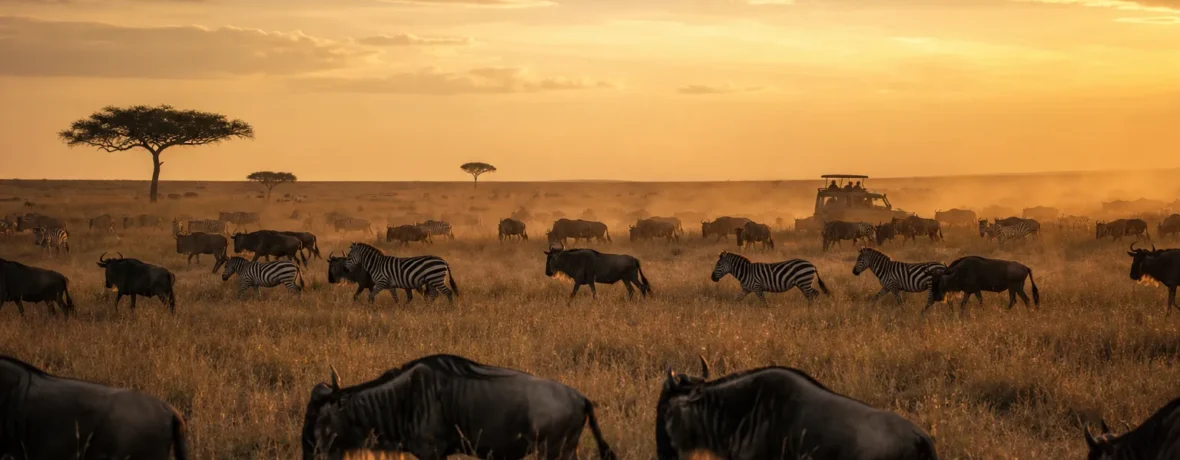
Serengeti National Park is in northern Tanzania, East Africa, south of Kenya’s Maasai Mara and west of the Ngorongoro highlands. The UNESCO-listed park covers 5,700 square miles [14,763 sq km], with headquarters in Seronera Valley in the central plains.
Where is the Serengeti National Park on a map?
Serengeti National Park sits in northern Tanzania, close to the Kenya border. On a map, look for the broad sweep of protected land west of Ngorongoro Conservation Area and south of the Maasai Mara National Reserve.
The official UNESCO World Heritage map for Serengeti National Park places the property at coordinates S2 41 27.6, E34 48 36 and lists its area as 1,476,300 hectares, which converts to 5,700 square miles [14,763 sq km]. That is the cleanest way to pin it down without safari-brochure fog.
The park headquarters are in Seronera Valley, according to the official Tanzania National Parks contact and location page. Seronera is also the name you will see again and again when planning flights, lodges, and central Serengeti game drives.
Is the Serengeti in Kenya or Tanzania?
The Serengeti National Park is in Tanzania. Kenya has the Maasai Mara, which touches the same cross-border ecosystem but is not the same protected area.
This is where travelers get tangled. Wildlife does not care about national borders, and the migration moves through a wider Serengeti-Mara landscape. But your park entry, rules, permits, guides, and payments depend on which side of the border you are visiting. Serengeti National Park is managed by Tanzania National Parks, known as TANAPA.
Think of it this way: Serengeti is the Tanzanian national park. Maasai Mara is the Kenyan reserve to the north. Together, they form one of the most famous wildlife landscapes on Earth, but you cannot treat them as one ticketed park.
How big is Serengeti National Park?
Serengeti National Park covers 5,700 square miles [14,763 sq km]. UNESCO lists the property as 1,476,300 hectares, and TANAPA describes the park as part of the larger Serengeti-Mara ecosystem.
| Place | Country | What it means for you |
|---|---|---|
| Serengeti National Park | Tanzania | The main Tanzanian national park, managed by TANAPA. |
| Serengeti-Mara ecosystem | Tanzania and Kenya | The wider migration landscape, not one single ticketed park. |
| Maasai Mara National Reserve | Kenya | The Kenyan reserve adjoining the Serengeti landscape. |
The official TANAPA Serengeti brochure describes the wider ecosystem as 11,583 square miles [30,000 sq km], including Serengeti National Park, parts of Ngorongoro Conservation Area, several game reserves, controlled areas, and Kenya’s Maasai Mara National Reserve. Use that ecosystem figure for geography, not for park-entry planning.
How do you get to Serengeti National Park?
You can reach Serengeti National Park by road or by air. TANAPA lists both options, with road access through official entry and exit points and air access through several all-weather airstrips.
- Start with your base city. Arusha is the common northern Tanzania safari hub, but TANAPA also lists scheduled and private charter links from places including Mwanza, Kilimanjaro, Musoma, Dar es Salaam, and Zanzibar.
- Choose road or air. Road safaris let you connect Serengeti with Ngorongoro and other northern parks. Flights cut down travel time and usually land at an airstrip near your camp or lodge.
- Match your entry point to your route. TANAPA’s Serengeti materials list road gates and access points including Naabi Hill, Ndutu, Handajega, Ikoma, Tabora B, Lamai, Ndabaka, Machochwe, and Kleins.
- Check your overnight location before booking. Serengeti is huge. A camp in the north near Lamai is not a quick hop from a central Seronera lodge.
- Confirm payments and permits through official channels. As of November 2026, TANAPA tells visitors to pay at official gates or designated payment points, and it publishes fee information through its official visitor pages.
For air access, TANAPA lists all-weather airstrips in the center at Seronera, in the south at Kusini, in the east at Lobo, in the west at Kirawira, and in the north at Kogatende and Lamai in its official Serengeti visitor brochure.
What is Serengeti National Park famous for?
Serengeti National Park is famous for the Great Migration, open savanna plains, big cats, and year-round wildlife viewing. TANAPA calls it home to the world’s last remaining large mammal migration.
The official TANAPA Serengeti National Park page highlights wildebeest, zebras, predators, lions, the Big Five, birdlife, game drives, hot-air balloon safaris, and walking safaris. UNESCO also recognizes Serengeti National Park as a World Heritage Site, citing the vast plains and the annual movement of wildebeest, gazelles, and zebras followed by predators.
For hikers, the draw is not summit-bagging. It is scale. Big sky. Dust. Granite kopjes. Long horizons. You come here to read the land with your eyes, not to wander off alone with a daypack.
Can you hike in Serengeti National Park?
You cannot treat Serengeti like a free-roam hiking park. Walking safaris are listed as a visitor activity, but you should expect guided, controlled, wildlife-aware movement rather than independent trail hiking.
The official TANAPA visitor guide tells visitors to respect park rules, stay in designated areas, avoid feeding wildlife, follow speed limits, and travel with a guide or tour operator. Its attractions page also lists walking safaris among official visitor activities. That means the right question is not, “Can I hike wherever I want?” It is, “Can my operator arrange an authorized walking safari?”
Ask these questions before you book:
- Is the walk inside Serengeti National Park or on nearby private or community land?
- Who is the licensed guide?
- What safety briefing is included?
- What footwear, clothing, and water do you need?
- Are there seasonal restrictions in the area you want to visit?
What rules should you know before visiting Serengeti National Park?
The core rules are simple: stay in designated areas, do not feed wildlife, obey speed limits, and do not drive at night. As of November 2026, TANAPA’s official Serengeti visitor guidance and park rules materials are the sources to use, not old forum posts or copied safari PDFs.
Here is the practical trailhead-style checklist:
- Stay on roads and tracks. TANAPA rules say to stay on roads or tracks except where off-road driving is specifically allowed.
- Respect the speed limit. TANAPA’s Serengeti rules state a 50 kph speed limit, which is 31 mph.
- No night driving. TANAPA’s Serengeti rules state that night driving is not allowed from 7 p.m. to 6 a.m.
- Do not feed, harass, or interfere with wildlife. That includes crowding animals for photos.
- Stay in the vehicle near animals. TANAPA rules warn visitors not to get out, stand on, or hang out of vehicles near wildlife.
- Leave natural objects in place. Plants, animals, skulls, bones, rocks, and other objects belong in the park.
- Pack out or dispose of trash properly. Cigarette butts and food scraps are not harmless here.
- Use fire only where authorized. TANAPA rules allow fires only at authorized camps.
As of November 2026, TANAPA’s Serengeti page also says the park is open year-round and that gates close at 6 p.m. The simplest move: plan your game drive so you are not rushing the gate at dusk.
When is the best time to visit Serengeti National Park?
Serengeti is a year-round destination, but your best timing depends on what you want to see. TANAPA highlights June through October for dry-season migration viewing and January through February for calving season.
Do not plan the whole trip around a single wildlife rumor. The migration is a living movement shaped by grass, rain, water, and pressure from predators. If you want river crossings, you will look at different areas and dates than someone who wants green-season photography or newborn wildebeest on the southern plains.
For most visitors, the better strategy is to pick a region first, then a season:
- Central Serengeti: Strong all-around choice for first-time visitors and year-round predator sightings.
- Southern Serengeti and Ndutu area: Often associated with calving-season itineraries.
- Western Corridor: Useful for migration-focused trips during specific seasonal windows.
- Northern Serengeti: Often paired with Mara River migration viewing when herds are in that zone.
Related reading
- Where to Buy a National Park Pass
- Where to Stay in Yosemite for Hikers
- Where to Stay in Glacier National Park
- Closest Airports to Glacier National Park
FAQ
Where is the Serengeti National Park located?
Serengeti National Park is located in northern Tanzania, East Africa. It lies south of Kenya’s Maasai Mara and west of the Ngorongoro highlands.
What country is Serengeti National Park in?
Serengeti National Park is in Tanzania. The Maasai Mara is in Kenya, and the two areas are part of the wider Serengeti-Mara ecosystem.
What is the nearest main safari hub to Serengeti?
Arusha is the main northern Tanzania safari hub for many Serengeti trips. TANAPA also lists air access from several Tanzanian cities and tourism centers, depending on scheduled flights and charter routes.
Can you visit Serengeti without a guide?
You should plan to visit with a guide or tour operator. TANAPA’s visitor guidance tells visitors to travel with a guide or operator, follow ranger instructions, and stay in designated areas.
Is Serengeti National Park open year-round?
Yes, TANAPA describes Serengeti as open year-round. As of November 2026, its official Serengeti page says gates close at 6 p.m., so plan drives and transfers around daylight and gate timing.
Is Serengeti the same as Maasai Mara?
No. Serengeti National Park is in Tanzania, while Maasai Mara National Reserve is in Kenya. They adjoin the same wildlife ecosystem, but they have separate management, rules, entry systems, and travel logistics.