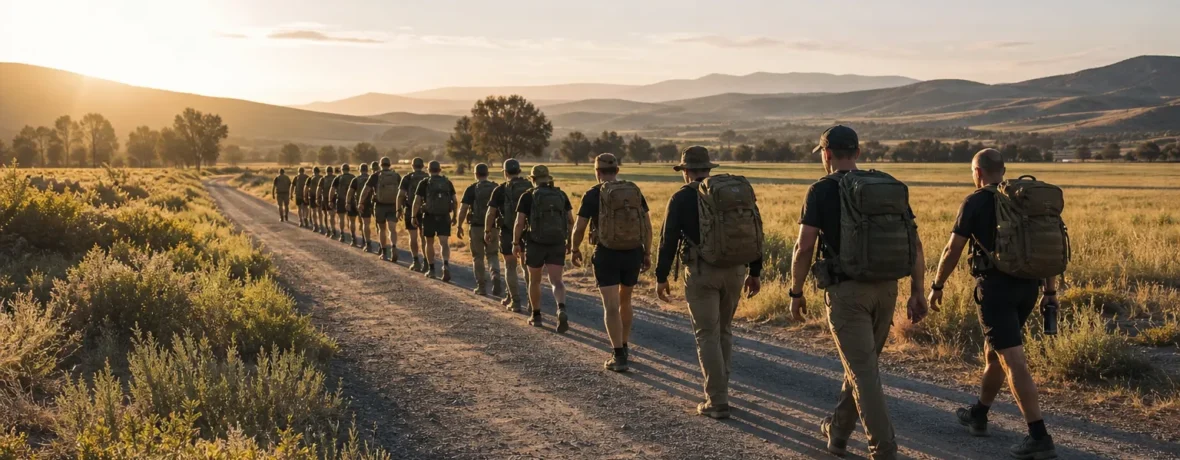
What is rucking in the military? It is walking fast under load, usually with a weighted backpack, boots, uniform, water, and mission gear. A common benchmark is 12 miles [19.3 km] with a 35-pound [15.9 kg] dry ruck in 3 hours, but real distances and loads change by unit, school, job, and terrain.
What is rucking in the military?
Rucking is loaded walking used to build and test soldier readiness.
Think hiking with consequences. The pack is not there for fitness fashion. It carries the equipment a soldier needs to move, work, fight, communicate, treat injuries, sleep, and survive. The “ruck” is the backpack. “Rucking” is the act of moving with it.
For hikers, the movement looks familiar: upright posture, steady cadence, foot care, hydration, and pacing. The military version is stricter. Soldiers may move in formation, follow a set route, carry a required packing list, and finish inside a time standard.
What is a ruck march?
A ruck march is a timed or tactical foot movement while carrying a loaded rucksack.
Some events are fitness tests. Others are training movements. Others are real operational travel when vehicles cannot go where people can. In Army doctrine, foot marches are planned around terrain, visibility, load, rest halts, and how ready the unit must be when it arrives; the Army’s foot-march manual lists a daylight road movement rate of 4.8 kilometers per hour, with an overall rate of 4 kilometers per hour after rest time, in ATP 3-21.18 Foot Marches.
The hard part is not only the distance. It is the mix: weight on your shoulders, repetitive impact, heat or cold, boots, pace pressure, and the need to keep moving when your feet start barking.
| Term | Plain meaning | Hiker translation |
|---|---|---|
| Ruck | A military backpack | Your pack, but often heavier and less forgiving |
| Rucking | Walking under load | Loaded hiking or fast backpack walking |
| Foot march | Organized movement by foot | A planned group hike with standards |
| Forced march | Longer or harder movement under pressure | A sufferfest pace or distance day |
How far do soldiers ruck in the military?
Soldiers may ruck short training distances or long qualification routes.
A widely recognized Army benchmark is the 12-mile [19.3 km] event. The official Expert Infantryman Badge site says candidates must complete the 12-mile route in 3 hours or less, and the Expert Field Medical Badge site lists a 12-mile road march within 3 hours while carrying individual field equipment, with the ruck weighed to meet a 35-pound dry-weight requirement. See the Expert Infantryman Badge standard and the Expert Field Medical Badge requirements.
That does not mean every military movement is 12 miles. Units train with shorter routes too: 2 miles [3.2 km], 4 miles [6.4 km], 6 miles [9.7 km], and 8 miles [12.9 km] are common stepping stones because tendons, bones, and feet need time to adapt.
How heavy is a military ruck?
A military ruck can range from light training weight to loads that feel brutally heavy.
The 35-pound [15.9 kg] dry ruck is a known qualification standard, but “dry” usually means without water and sometimes without extra worn equipment. Add water, helmet, body armor, weapon, cold-weather gear, radios, batteries, food, or mission equipment, and the total carried load climbs fast.
For civilian training, do not copy the heaviest soldier load. Start lighter. A smart hiking target is often a pack you can carry with good posture, quiet feet, and no sharp pain. If your gait turns into a limp, the load is already too heavy for that day.
How fast do you have to ruck?
For the 12-mile Army badge-style benchmark, the pace is 15 minutes per mile [9:19 per km].
That is brisk. You are not strolling, and you are not full-on running. Most people use a power-walk stride on flats, short efficient steps on hills, and controlled downhill movement to protect knees and toenails.
Here is the math:
- 12 miles [19.3 km] in 3 hours equals 4 miles per hour [6.4 km/h].
- That equals 15 minutes per mile [9:19 per km].
- A 6-mile [9.7 km] training event at the same pace takes 1 hour 30 minutes.
- A 4-mile [6.4 km] training event at the same pace takes 1 hour.
Doctrine-based tactical movement may be slower because the goal is not a race result. It is arriving with people intact and useful.
What gear do soldiers carry on a ruck?
Soldiers carry the gear required by the event, school, unit, weather, and mission.
A packing list might include more than the backpack itself. The exact list changes, but the categories are easy to understand if you hike.
- Rucksack or assault pack
- Water and hydration system
- Food or field rations
- Rain gear or warming layers
- First aid and foot-care items
- Navigation tools
- Mission equipment such as radios, batteries, or protective gear
- Boots already broken in, with socks that manage sweat
How do you train for military-style rucking?
Train it like hiking with load, not like punishment.
Your goal is durable legs, tough feet, and an engine that can hold pace without falling apart. Progress slowly. The pack does not care how motivated you are.
- Start with walking fitness. Build a base with unloaded walks of 30 to 60 minutes before adding serious weight.
- Add light load. Begin with 10 to 20 pounds [4.5 to 9.1 kg] if you are new to loaded walking.
- Use short routes first. Try 2 to 3 miles [3.2 to 4.8 km] and finish feeling like you could do more.
- Increase one variable at a time. Add distance, weight, or pace, not all three in the same week.
- Practice hills. Uphills build legs; downhills test braking strength and foot fit.
- Dial in your socks and footwear. Stop early for hot spots. Tape, adjust laces, or change socks before a blister blooms.
- Keep strength work simple. Squats, step-ups, lunges, calf raises, planks, and farmer carries all support loaded movement.
- Recover on purpose. Sleep, easy walks, and rest days are training tools, not weakness.
Is rucking bad for your knees or back?
Rucking is not automatically bad, but poor progression can beat you up.
Loaded walking adds stress to your feet, ankles, knees, hips, and spine. That stress can make you stronger when the load, distance, and pace match your current fitness. It can also expose weak links fast.
Use this quick check before adding weight:
- You can walk the same route unloaded without pain.
- Your pack rides high and close, not swinging low behind you.
- Your shoes or boots do not crush toes on descents.
- You can breathe in steady sentences at training pace.
- You wake up the next day with normal soreness, not joint pain that changes your walk.
Heat adds another risk. The CDC lists heat stroke signs such as confusion, altered mental status, and slurred speech, and also describes rhabdomyolysis as a condition linked with heat stress and prolonged physical exertion; read the CDC’s heat-related illness guidance before training hard in hot weather.
When to see a doctor
See a doctor when pain is sharp, worsening, persistent, or paired with warning signs.
Do not try to “ruck through” symptoms that change your stride or keep returning in the same spot. Mayo Clinic says stress-fracture pain may be barely noticeable at first, then worsen with time, and advises medical care if pain becomes severe or persists even at rest; see Mayo Clinic’s stress fracture guidance.
Get medical help quickly for confusion, fainting, chest pain, severe shortness of breath, dark urine after extreme exertion, numbness, swelling that does not settle, or a blister with spreading redness, warmth, pus, or increasing pain. Mayo Clinic’s blister first-aid advice also flags infection signs that need care.
Related reading
- What Is Rucking? A Beginner's Guide
- Is Rucking Good for You? Benefits and Risks
- Does Rucking Build Muscle?
- How to Start Rucking: Weight, Distance and Progression
FAQ
Is rucking the same as hiking?
No. Rucking is loaded walking with a training or military purpose, while hiking can be recreational and self-paced. The movement overlaps, but rucking usually puts more emphasis on weight, pace, and standards.
Can civilians train with a military ruck?
Yes, civilians can train with a ruck if they progress gradually. You do not need to copy military loads to get stronger for hiking; lighter, consistent training works better than one heroic suffer session.
Should you run during a ruck?
Usually, no. Fast walking is safer for most people under load and is closer to the skill you need for sustained movement. If you are training for a specific selection or school, follow that program’s coaching and medical guidance.
What is a good beginner ruck distance?
Start with 2 to 3 miles [3.2 to 4.8 km]. Keep the pack light, finish with good form, and repeat until the route feels controlled before adding weight or speed.
What should I put in a ruck for training?
Use stable, soft weight that will not bounce or jab your back. Water bladders, sandbags, towels, and tightly packed gear work better than loose dumbbells or sharp objects.
How often should you ruck?
One to two rucks per week is plenty for most hikers starting out. Fill the rest of the week with walking, strength work, mobility, and recovery so your feet and joints have time to adapt.