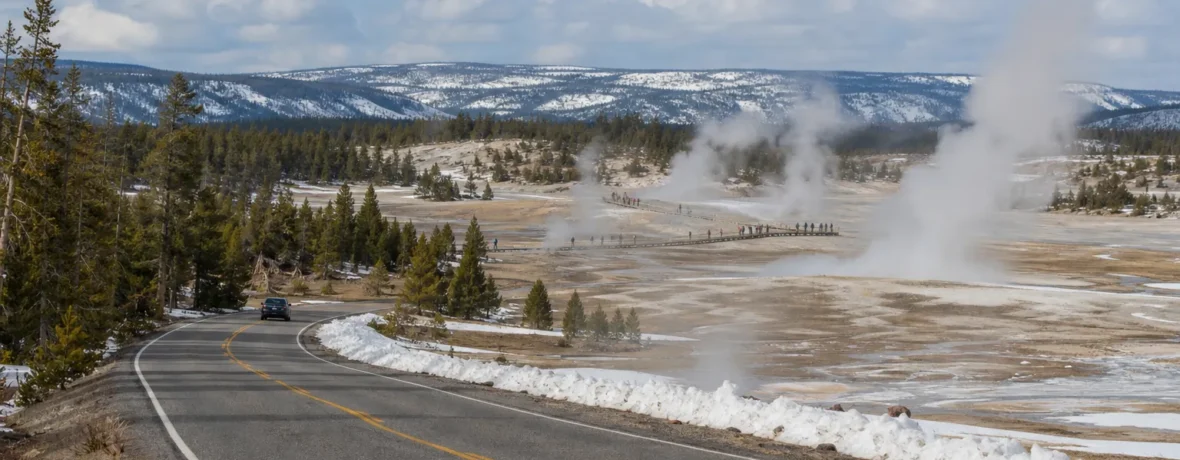
Yes. The park is open 24 hours a day, 365 days a year. The catch: most roads close to regular cars from early November to late April. As of November 2026, regular vehicle access is mainly the North-to-Northeast Entrance road, weather permitting.
Is Yellowstone open year-round?
Yes, Yellowstone National Park is open year-round. As of November 2026, the National Park Service says the park itself stays open 24 hours per day, 365 days per year, but roads, entrances, campgrounds, lodges, stores, and visitor services run on seasonal schedules.
That means “open” can mean very different things depending on when you go. In July, you may be able to drive the Grand Loop, walk geyser boardwalks, book campgrounds, and reach major trailheads. In November, you may find the park legally open but most interior roads closed to regular vehicles while crews prepare for winter travel.
So don’t plan Yellowstone by the word “open” alone. Plan by entrance, road segment, vehicle type, and the exact date you’ll arrive.
Which Yellowstone entrances are open in winter?
The North Entrance to the Northeast Entrance is the regular winter car route. As of November 2026, the NPS park roads page lists the North Entrance to Northeast Entrance route as open year-round, while other roads are seasonal and weather-dependent.
For a winter road trip, that usually means entering at Gardiner, Montana, driving through Mammoth Hot Springs and Tower Junction, and continuing toward Cooke City and Silver Gate, Montana. This is the practical route for regular cars when the rest of Yellowstone is buttoned up for snow.
The West, South, and East entrances are not winter car shortcuts. During the winter season, they are used for limited oversnow travel—snowcoaches and snowmobiles—on scheduled dates, not for regular passenger vehicles.
What Yellowstone closures should you check before you go?
Check road status first, then trails, services, and weather. Yellowstone closures can happen seasonally, daily, or suddenly because of snow, construction, wildlife activity, fire, flooding, or unsafe thermal areas.
- Open the official NPS Yellowstone roads page before you leave home.
- Confirm the entrance you plan to use, not just the park’s general status.
- Check the road segment between your entrance and your destination.
- Look at campground, lodge, fuel, food, and visitor center operating dates.
- Recheck conditions the morning you drive in. Yellowstone weather can flip fast.
As of November 2026, NPS also warns that short-term road closures and delays may not always show on the map right away. That’s your cue to build slack into your day. A tight Yellowstone itinerary is fragile. A flexible one actually works.
When do Yellowstone roads open and close for regular cars?
Most interior roads open in stages from mid-April through late May and close by late October or early November. As of November 2026, NPS lists these projected 2026 regular vehicle dates, with all dates subject to weather and conditions.
| Road segment or area | Regular vehicle season, as of November 2026 | Best planning note |
|---|---|---|
| North Entrance to Northeast Entrance | Open year-round | Main winter car access, weather permitting |
| West Entrance, Madison, Old Faithful, Norris, Mammoth to Norris, Norris to Canyon | April 17–October 31, 2026 | Core spring-to-fall driving route |
| East Entrance to Fishing Bridge; Canyon to Bridge Bay | May 1–October 31, 2026 | Higher, colder access; check Sylvan Pass |
| South Entrance, West Thumb, Lake Village, Craig Pass, Tower Fall | May 8–October 31, 2026 | Useful for Grand Teton connections |
| Dunraven Pass: Canyon Village to Tower Fall | May 22–October 12, 2026 | High-elevation road; early snow is common |
Roads typically open at 8:00 a.m. on the first listed day, as of November 2026, according to NPS. Treat those dates as planning targets, not promises. A storm can erase your clean little schedule overnight.
Can you visit Yellowstone in winter without a snowmobile?
Yes, but your access is limited unless you book oversnow transportation. As of November 2026, regular cars can use the North-to-Northeast route when conditions allow; interior winter travel is mainly by commercially guided snowcoach or snowmobile during the oversnow season.
For winter 2026–27, NPS lists oversnow access beginning December 15, 2026, on multiple groomed routes, with closing dates in March 2027 depending on the segment. West, South, and East entrance oversnow access, plus remaining groomed roads, is listed for December 15, 2026, through March 15, 2027, as of November 2026.
That makes winter Yellowstone gorgeous but specialized. You need warm layers, traction, conservative plans, and a real respect for distance. Services are thin. Daylight is short. The park feels huge.
Do you need a reservation or permit to enter Yellowstone?
No vehicle reservation is required to enter Yellowstone, as of November 2026. You do need an entrance pass, and NPS lists the standard entrance pass range at $20–$35, with a private vehicle pass at $35 for seven consecutive days on the official Yellowstone fees and passes page.
Permits depend on what you’re doing. Day hiking does not require a backcountry permit, as of November 2026. Overnight backcountry camping does. NPS states that a backcountry permit is required year-round for all overnight stays in Yellowstone’s backcountry, and reservations are available through Recreation.gov via the official backcountry camping page.
- Day hiking: no backcountry permit required, as of November 2026.
- Overnight backcountry camping: permit required year-round, as of November 2026.
- Standard entrance pass: required for park entry, as of November 2026.
- Snowmobile travel: must follow NPS winter travel rules and permit or guided-tour requirements.
Are trails and boardwalks open when roads are closed?
Sometimes, but access is the hard part. A trail can be legally open while the road to its trailhead is closed to your vehicle.
In shoulder season, that’s where people get tripped up. You see a trail on the map. It looks close. Then you realize the gate is closed miles away, the road is snow-covered, and daylight is draining out of the sky. Don’t wing it.
If you’re hiking, pack for Yellowstone rather than for the weather at breakfast. Carry insulation, shell layers, water, food, a headlamp, navigation, and traction when snow or ice is possible. In bear country, keep bear spray reachable—not buried in your pack.
What rules matter most for hikers in Yellowstone?
Wildlife distance rules matter every day. As of November 2026, NPS tells visitors to stay at least 100 yards [91 m] from bears, wolves, and cougars, and at least 25 yards [23 m] from all other wildlife, including bison and elk, on the official Yellowstone safety page.
Thermal areas are another hard line. Stay on boardwalks and maintained trails around geysers, hot springs, mudpots, and fumaroles. Thin crust can break. Hot water can kill. The signs are not decoration.
For a cleaner, safer trip, keep this short checklist in your head:
- Stay back from wildlife, even when everyone else is creeping closer.
- Use pullouts for wildlife watching; don’t stop in the lane.
- Carry bear spray where you can grab it fast.
- Stay on boardwalks in thermal areas.
- Check road status before committing to a trailhead.
- Pack layers for wind, snow, rain, and cold even in mild seasons.
What is the best season to visit Yellowstone?
Summer gives you the most access. Most roads, services, campgrounds, and trailheads are available in summer, though crowds and wildlife traffic jams can slow everything down.
Spring is raw and beautiful, with staged road openings and lingering snow. Fall brings bugling elk, cold mornings, quieter trails, and earlier road closures. Winter is the quietest and most restricted season, built around the North-to-Northeast car corridor and oversnow travel.
If hiking is your main goal, aim for the period when your target trailheads are reachable and snow conditions fit your skills. If geysers and wildlife viewing matter more than big miles, shoulder season can be excellent—just keep your plans loose.
Related reading
- How Big Is Yellowstone National Park?
- Is Yosemite Open? Roads, Passes and Closures
- Is the Grand Canyon Open? Rims, Trails and Seasons
- Is Sequoia National Park Open? Seasonal Closures
FAQ
Is Yellowstone open today?
Yes, the park is open 24 hours a day, 365 days a year, as of November 2026. Road access changes by season and weather, so check the official NPS road status before driving.
Can you drive through Yellowstone in November?
Usually only on the North Entrance to Northeast Entrance route for regular vehicles. As of November 2026, most interior roads close to wheeled vehicles starting November 1 for winter preparations.
Are Yellowstone’s West, South, and East entrances open in winter?
Not for regular cars. As of November 2026, those entrances are scheduled for limited oversnow travel starting December 15, 2026, weather and conditions permitting.
Do I need a permit to hike in Yellowstone?
No permit is required for day hiking, as of November 2026. A backcountry permit is required year-round if you camp overnight in Yellowstone’s backcountry.
How far should I stay from animals in Yellowstone?
Stay at least 100 yards [91 m] from bears, wolves, and cougars, and at least 25 yards [23 m] from bison, elk, and other wildlife, as of November 2026. If an animal changes behavior because of you, back up.
What is the safest way to plan around road closures?
Plan by exact entrance and road segment, not just by destination. Recheck the NPS road page the day before and the morning of your visit, then keep a backup hike or viewpoint in your pocket.