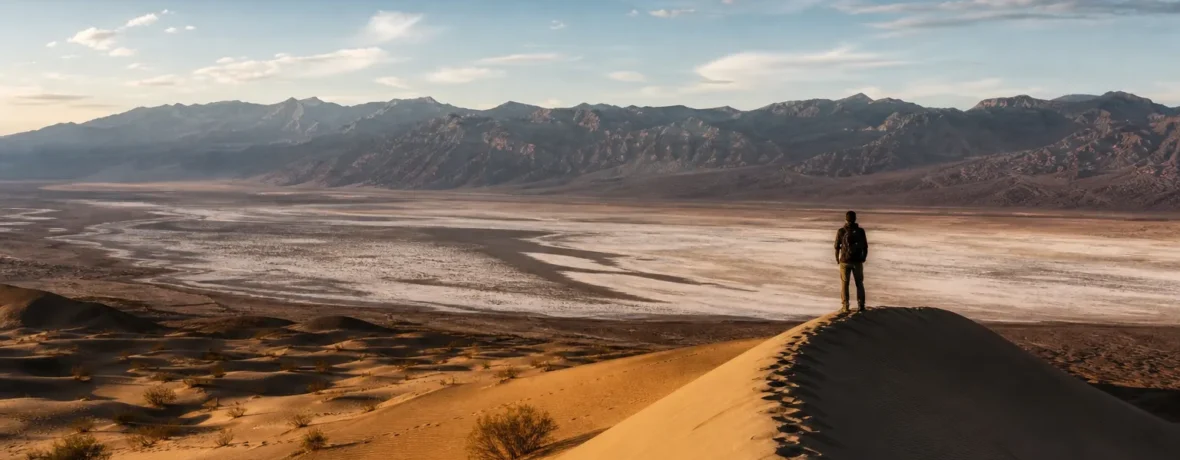
Yes. Death Valley is a U.S. national park in California and Nevada, open year-round and 24 hours a day. It covers more than 3.4 million acres, making it the largest national park in the lower 48 states. NPS Basic Information (nps.gov)
Is Death Valley a National Park?
Yes, Death Valley is a national park, not just a desert basin or scenic drive.
Congress designated Death Valley as a national park on October 31, 1994, when the California Desert Protection Act converted the earlier Death Valley National Monument into Death Valley National Park. The monument itself dated to February 11, 1933, so the place has had federal protection for generations, but the “national park” name came in 1994. NPS General Management Plan (nps.gov)
That matters for you on the ground. National park rules apply. Entrance fees apply. Backcountry camping rules apply. You are not rolling into empty desert where anything goes.
Where is Death Valley National Park?
Death Valley National Park sits in eastern California and western Nevada.
Most visitors reach it by road from California’s Owens Valley, Las Vegas, Pahrump, Beatty, or the Mojave Desert. The park has multiple entrances, and it is huge enough that “just driving across” can eat half a day if you misjudge distances.
Death Valley is also a place of extremes. Badwater Basin sits 282 feet [86 m] below sea level, the lowest point in North America, while higher peaks rise far above the valley floor. The park is also famous for heat: the NPS lists the 134°F [57°C] Furnace Creek reading from July 10, 1913, as the world-record highest air temperature. NPS Weather and Climate (home.nps.gov)
Was Death Valley always a national park?
No, Death Valley was a national monument before it became a national park.
| Year | Status | What changed |
|---|---|---|
| 1933 | Death Valley National Monument | Federal protection began under the Antiquities Act. |
| 1994 | Death Valley National Park | Congress redesignated and expanded the protected area. |
| Today | National park | NPS manages more than 3.4 million acres across California and Nevada. |
The short version: Death Valley earned national monument status first, then national park status later. For hikers, the modern result is simple. You are visiting a full National Park Service unit with visitor centers, campgrounds, paved viewpoints, backcountry roads, wilderness, and strict resource-protection rules.
How much does it cost to enter Death Valley National Park?
As of November 2026, every visitor needs an entrance pass unless covered by a valid federal pass.
The NPS lists Death Valley standard entrance passes at $15–$30, with a private vehicle pass at $30 and a per-person pass at $15 for visitors entering on foot or bicycle. The Death Valley annual pass is $55. The park is cashless, so plan on debit, credit, or digital payment. NPS Death Valley Fees & Passes (home.nps.gov)
- Private vehicle: $30, valid for 7 days, as of November 2026.
- Per person on foot or bicycle: $15, valid for 7 days, as of November 2026.
- Death Valley annual pass: $55, as of November 2026.
- America the Beautiful pass: accepted for entrance, as of November 2026.
Do you need permits in Death Valley National Park?
Sometimes, yes.
As of November 2026, the NPS requires permits for roadside camping along Greenwater Valley Road, Echo Canyon Road, Hole in the Wall Road, Cottonwood Canyon Road, and Marble Canyon Road. A permit is also required for overnight backpacking on the Cottonwood-Marble Loop. For other backpacking, roadside camping, backcountry cabins, and canyoneering, the NPS says permits are recommended but not required. NPS Wilderness and Backcountry Use Permits (nps.gov)
Here is the clean way to handle permits before you go:
- Pick your exact route, road, or canyon.
- Check whether that location falls into a mandatory-permit area.
- Use Recreation.gov for the mandatory roadside and Cottonwood-Marble permits listed by the NPS.
- For voluntary permits, submit your itinerary through the NPS options or stop at a ranger station when available.
- Tell someone outside your group where you are going and when you expect to return. A permit does not start a search if you are overdue.
Can you camp anywhere in Death Valley National Park?
No, camping is limited by location and rule set.
Death Valley feels wide open, but the NPS does not treat it like a blank map. As of November 2026, the park rules limit camping to designated campgrounds and allowed backcountry or roadside areas. The park also limits camping to 14 days per calendar year in Furnace Creek Campground and 30 days per calendar year for the rest of Death Valley National Park. NPS Rules and Regulations (nps.gov)
Fires are also tightly controlled. As of November 2026, the NPS allows fires only in approved locations and receptacles, bans construction of fire rings, and prohibits gathering firewood inside the park. Bring your own firewood if fires are allowed where you are staying, and expect seasonal fire limits in higher areas.
Are dogs allowed in Death Valley National Park?
Yes, but dogs are heavily restricted.
As of November 2026, Death Valley rules prohibit pets more than 50 feet [15 m] from roads or developed areas unless a special rule allows it. Pets are also prohibited on trails and in wilderness areas. That means your dog can join a scenic road trip, but not a backcountry hike, canyon walk, or summit day. The NPS also prohibits leaving a pet unattended in a vehicle under dangerous heat conditions. (nps.gov)
- Good plan: paved viewpoints, campgrounds, picnic areas, and short stops near roads.
- Bad plan: Golden Canyon, Mosaic Canyon, Badwater boardwalk, dunes, or wilderness routes with a dog.
- Heat rule: never treat the car as a kennel in Death Valley.
Can you fly a drone in Death Valley National Park?
No, recreational drone use is prohibited.
As of November 2026, the NPS prohibits launching, landing, or operating drones and other unmanned aircraft from lands and waters administered by the National Park Service inside Death Valley National Park unless the superintendent approves it in writing. For a normal hiking trip, leave the drone at home. (nps.gov)
When is the best time to hike in Death Valley National Park?
For most hikers, November through March is the best window.
The NPS hiking guidance says low-elevation summer temperatures can be dangerous, and even spring and autumn heat can be brutal. Winter gives you cooler valley days, better light, and a wider safety margin. Summer hiking belongs mostly in the higher mountains, and even then you need a hard look at heat, roads, water, and your exit plan. (nps.gov)
Pack like the desert is trying to edit your plans:
- More water than you think you need.
- Electrolytes and real food, not just candy.
- Sun hat, sunglasses, sunscreen, and long sleeves.
- Paper map plus offline maps.
- Full-size spare tire if you are driving rough roads.
- A turnaround time you will actually obey.
When to see a doctor
Get medical help fast if heat symptoms are severe, worsening, or not improving.
Heat illness is the main health risk hikers underestimate in Death Valley. The CDC says heat stroke is a medical emergency; warning signs can include confusion, slurred speech, loss of consciousness, hot skin, and high body temperature. Call 911 right away for suspected heat stroke. For heat exhaustion, the CDC advises medical help if symptoms get worse, vomiting occurs, or symptoms last longer than 1 hour. CDC Heat-Related Illnesses (cdc.gov)
Do not try to “walk it off” in Death Valley heat. Stop, cool down, get out of sun, and seek help when red flags show up.
Related reading
- National Park Pass Changes for 2026
- How Big Is Yellowstone National Park?
- Every Kid Outdoors: The Free 4th Grade National Park Pass
- How Big Is Yosemite National Park?
FAQ
Is Death Valley a national park or a state park?
Death Valley is a national park. It is managed by the National Park Service, not by California or Nevada state park agencies.
What state is Death Valley National Park in?
Death Valley National Park is in California and Nevada. Most of the park lies in California, with portions extending into Nevada.
Is Death Valley open all year?
Yes, the park is open daily year-round and 24 hours a day, as of November 2026. Roads, campgrounds, and facilities can close because of storms, heat damage, flooding, fire, maintenance, or seasonal operations.
Do you need a reservation to enter Death Valley National Park?
No entrance reservation is listed by the NPS as a general requirement as of November 2026. You still need an entrance pass, and you may need reservations or permits for certain camping and backcountry plans.
Can you hike in Death Valley in summer?
You can, but low-elevation summer hiking is a bad bet and the NPS does not recommend it. If you hike in hot weather, choose cooler higher elevations, start early, carry serious water, and turn around before heat symptoms start.
Why is Death Valley famous?
Death Valley is famous for being hot, dry, low, and vast. It has the lowest point in North America at Badwater Basin, extreme recorded heat at Furnace Creek, huge desert landscapes, salt flats, dunes, canyons, old mining sites, and more than 3.4 million acres of protected land.