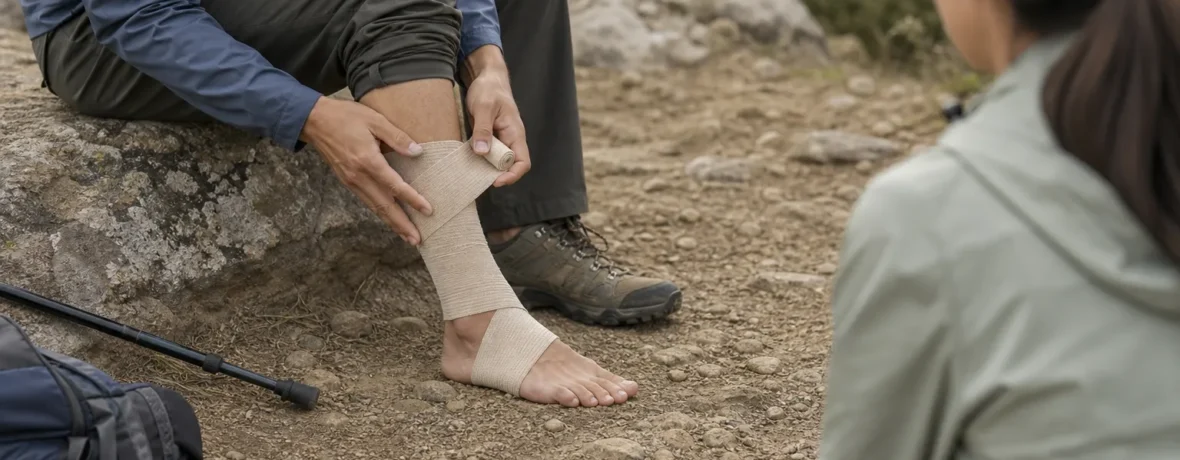
Here’s how to wrap a sprained ankle on the trail: use a 3–4 in [7.6–10 cm] elastic bandage, start at the ball of the foot, make two anchor turns, wrap figure-eights around foot and ankle, finish 4–6 in [10–15 cm] above the ankle, and check toe color, warmth, and feeling.
A rolled ankle can turn a good hiking day sideways fast. One bad step on loose rock, one slick root, one tired stumble near the end of the descent, and now your boot feels like it belongs to someone else. The wrap is not magic. It will not “fix” torn tissue, prove the injury is minor, or make a sketchy exit safe. What it can do is support the ankle, limit swelling, reduce painful wobble, and help you make a smarter decision: walk out, wait, or call for help.
This guide is trail first aid, not a diagnosis. Medical sources such as Mayo Clinic sprain first aid, MedlinePlus ankle sprain aftercare, and NIH guidance on sports injury treatment all point to the same early-care pattern: protect the injury, rest it, use cold when you can, add compression, and elevate it. On the trail, your job is simpler. Control what you can. Don’t make the injury worse.
What should you do before wrapping a sprained ankle?
Stop, sit down, and check the ankle before you wrap it.
Do not tighten a bandage over a boot and call it good. Take off the pack first. Then loosen or remove the shoe carefully if swelling is not already trapping the foot inside. If the ankle is ballooning fast, you may decide to leave the shoe on until help arrives, because getting it back on can be impossible. Use judgment. Keep the foot still while you look.
- Look: Check for deformity, heavy swelling, bruising, bleeding, or a wound.
- Ask: Where is the pain sharpest? Did the hiker hear a snap or pop? Can they move the toes?
- Feel: Compare warmth, color, and sensation with the uninjured foot.
- Test gently: Can the hiker put weight on it for a step or two without severe pain?
If the foot is numb, blue, cold, badly deformed, or the hiker cannot bear weight, do not push through. Splint the ankle in the position found, keep the person warm, and plan an evacuation. Wilderness medicine training often separates injuries into “usable” and “unusable” rather than trying to name the exact damage in the field. A useful ankle may be wrapped and supported. An unusable ankle needs immobilization and help.
How to wrap a sprained ankle on the trail?
Use a figure-eight wrap that supports the foot and ankle without cutting circulation.
You need an elastic bandage, ideally 3–4 in [7.6–10 cm] wide. A 2 in [5 cm] bandage can work on a smaller foot, but it takes more passes and tends to bunch. If the hiker is wearing thick socks, smooth the sock first so wrinkles do not dig into the skin. Keep the foot close to a neutral 90-degree angle, like it would sit in a boot.
- Start at the ball of the foot. Place the loose end of the bandage on top of the foot, just behind the toes. Leave the toes visible so you can keep checking circulation.
- Make two anchor wraps. Wrap around the ball of the foot twice. The bandage should feel snug, not biting.
- Move toward the arch. Angle the bandage across the top of the foot toward the inside of the ankle.
- Circle behind the ankle. Bring the bandage around the back of the ankle, just above the heel.
- Make a figure eight. Cross down over the top of the foot, under the arch, and back up around the ankle. Each pass should overlap the previous layer by half the bandage width.
- Repeat the figure eight 2–3 times. Cover the ankle evenly. Avoid leaving gaps that let swelling bulge between layers.
- Finish above the ankle. End 4–6 in [10–15 cm] above the ankle joint, not on top of the sorest spot.
- Secure the end. Use the clips, tape, or a safety pin from your kit. Keep sharp ends away from the skin.
- Check the toes. Press a toenail until it turns pale, then release. Color should return quickly. Ask about tingling, numbness, or increasing pain.
- Recheck after 10 minutes. Swelling changes fast. A wrap that felt fine at first can become too tight during the next rest break.
Wrap from the foot upward toward the calf, not from the calf down. That direction helps control swelling rather than trapping it in the foot. Mayo Clinic gives the same basic compression advice for sprains: start farthest from the heart and avoid wrapping so tightly that blood flow is affected.
How tight should an ankle wrap be?
The wrap should feel supportive, never numb, throbbing, or sharp.
Good compression feels like a firm handshake. Bad compression feels like a vise. You should be able to slide one finger under the upper edge of the wrap. The toes should stay warm and normal in color. The hiker should be able to wiggle them.
| Wrap check | Good sign | Bad sign |
|---|---|---|
| Toe color | Normal color returns quickly after pressing a nail | Toes look blue, gray, or very pale |
| Sensation | Pressure but no tingling | Numbness, pins and needles, burning |
| Pain | Same or slightly improved | Pain increases after wrapping |
| Swelling | Contained evenly | Bulging above, below, or between wrap layers |
If any bad sign shows up, unwrap it and start again with less tension. Do not loosen only the top edge and keep hiking. That can leave pressure bands lower on the foot.
Should you use an elastic bandage, tape, or an ankle brace?
Use the support you have, but an elastic bandage is the most forgiving trail option.
A brace gives better repeatable support if you already carry one. Athletic tape can be strong, but it is less adjustable once swelling changes. A rigid tape job also takes practice. An elastic bandage is easy to loosen, rewrap, and share between hikers.
| Trail option | Best use | Watch out for |
|---|---|---|
| Elastic bandage | Fresh sprain, changing swelling, most first-aid kits | Can slip or bunch inside a boot |
| Athletic tape | Extra support when swelling is mild and skin is dry | Harder to adjust; can irritate skin |
| Lace-up brace | Known weak ankle or previous sprain history | Bulky; may not fit every boot |
| Trekking poles | Reducing load while walking out | Not a substitute for ankle support |
If you use tape over an elastic wrap, keep it light. The wrap still needs to expand and breathe. If you tape directly on skin, avoid wrapping all the way around the ankle with hard, non-stretch tape in a tight circle. That can pinch as swelling builds.
Can you hike out with a wrapped ankle?
You can hike out only if the ankle is usable and symptoms stay controlled.
That means the hiker can stand, take careful steps, and keep pain from escalating. The goal is exit, not finishing the route. Turn around. Shorten the plan. Split group gear so the injured hiker carries the lightest safe load. Use trekking poles or a sturdy stick on the opposite side of the injury. Move slowly. Rest often.
Before walking, try this quick trail check:
- The hiker can take several steps on flat ground without severe pain.
- The ankle does not feel unstable or like it will fold again.
- Toe color, warmth, and feeling are normal after wrapping.
- Swelling is not rapidly increasing.
- The route out avoids scrambling, creek crossings, steep snow, and loose talus when possible.
If the trail is technical, darkness is coming, weather is dropping, or the group is far from the trailhead, the same ankle becomes a bigger problem. The Wilderness Medical Society’s remote pain management discussion treats musculoskeletal injuries as common backcountry pain problems, which is exactly why your plan should include warmth, support, communication, and a conservative exit.
What should you do after the ankle is wrapped?
Rest, cool, elevate, and reassess instead of charging ahead.
If you have cold water, a cold pack, or snow sealed in a bag, cool the ankle through a cloth layer. Do not put ice or snow directly on skin. Keep cold sessions limited and check the skin often. When stopped, raise the ankle above the heart if terrain allows. Even a pack under the calf helps.
Keep the boot laced firmly but not brutally tight. A boot can add support, especially over a low-bulk wrap, but it can also hide swelling. Check the ankle at every break. If you remove the boot, loosen the wrap first and inspect the skin.
For pain relief, use only medications the hiker can safely take and follow the label or their clinician’s advice. Do not give someone a medication if they have an allergy, a medical reason to avoid it, or uncertainty about whether it is safe for them.
When to see a doctor
Get medical care if pain, swelling, instability, or walking trouble is more than mild.
Mayo Clinic and MedlinePlus both advise medical evaluation when symptoms do not improve with self-care or when walking remains difficult. On trail, lean conservative. A fracture, tendon injury, or severe sprain can look like “just a rolled ankle” during the first hour.
- Call emergency services or activate your emergency device if the ankle is deformed, the foot is cold or numb, there is an open wound over the injury, or the hiker cannot move toes.
- Seek prompt care if the hiker cannot bear weight, pain is severe, swelling is rapid, or the ankle feels unstable.
- Arrange medical evaluation if swelling, bruising, or pain continues after the hike, even if the person managed to walk out.
- Do not continue the trip if each mile makes pain worse or the hiker starts compensating enough to risk a fall.
The NIH notes that many minor sports injuries can start with home care, but symptoms that persist or worsen should be checked by a health care provider. That is a good trail rule too. If the ankle is not clearly improving, stop guessing.
What should you carry to wrap an ankle on a hike?
Carry one elastic bandage and a few small support items in every hiking first-aid kit.
A sprained ankle is exactly the kind of injury that turns “quick day hike” into a slow exit. The gear is small. The payoff is big.
- One 3–4 in [7.6–10 cm] elastic bandage
- Athletic tape or medical tape
- Blister pads or moleskin to prevent rubbing under a wrap
- A few safety pins or wrap clips
- A triangular bandage, which can help secure a splint
- Lightweight emergency blanket for warmth during a long stop
- Trekking poles, especially on steep or rocky hikes
- Satellite messenger or PLB for remote routes without cell service
If someone in the group has a history of ankle sprains, a lace-up brace belongs in that person’s kit, not buried at home in a closet. Previous injury can make another sprain more likely, and tired legs are sloppy legs.
What mistakes make a sprained ankle worse?
The biggest mistake is using the wrap to justify a bad decision.
A wrap is support. It is not permission. If the hiker cannot walk normally enough to stay balanced, pushing onward can turn one injury into two: the ankle and the fall that follows.
- Wrapping too tight: Numb toes mean stop and rewrap.
- Covering the toes: You need to see them for circulation checks.
- Skipping reassessment: Swelling changes the fit every few minutes early on.
- Continuing uphill or deeper into the route: Exit beats summit.
- Ignoring boot fit: A bulky wrap can create pressure points and blisters.
- Assuming it is “only a sprain”: You cannot reliably rule out a fracture on the trail.
If the wrap slips, redo it. If the bandage gets wet, check the skin and tension. If the hiker starts limping harder, stop. Trail pride is cheap. Ankles are not.
Related reading
- How to Heal a Sprained Ankle Fast: What Really Works
- How Long Does a Sprained Ankle Take to Heal?
- When to Worry About a Sprained Ankle
- How Long Does a Sprained Ankle Stay Swollen?
FAQ
Can I wrap a sprained ankle over a sock?
Yes, you can wrap over a smooth, clean sock if it helps protect the skin. Avoid wrinkles, seams, and bunched fabric because they can dig into the foot once the boot is back on.
Should I take the boot off before wrapping?
Usually yes, if you can do it without causing severe pain or trapping the foot out of the boot. If swelling is already extreme or help is on the way, leaving the boot in place may be safer until trained responders arrive.
How long should the ankle stay wrapped?
Keep it wrapped while you need support, but remove or loosen it for skin and circulation checks. On trail, recheck after 10 minutes, then at every rest stop and anytime pain, numbness, or swelling changes.
Is it better to ice or wrap a sprained ankle first?
On trail, wrap first if support is needed for safety, then cool and elevate during rest. If you are stopped in a safe place, cold plus compression can both help control swelling, as long as skin and circulation stay normal.
Can a tight hiking boot replace an ankle wrap?
No, a boot can add support but should not replace a proper wrap when the ankle needs compression. Over-tightening laces can create pressure, numbness, and circulation problems.
When should I stop hiking after a sprained ankle?
Stop hiking if pain is severe, the ankle feels unstable, the hiker cannot bear weight, toes become numb or discolored, or the route out is unsafe. In those cases, immobilize the ankle, keep the person warm, and get medical help.