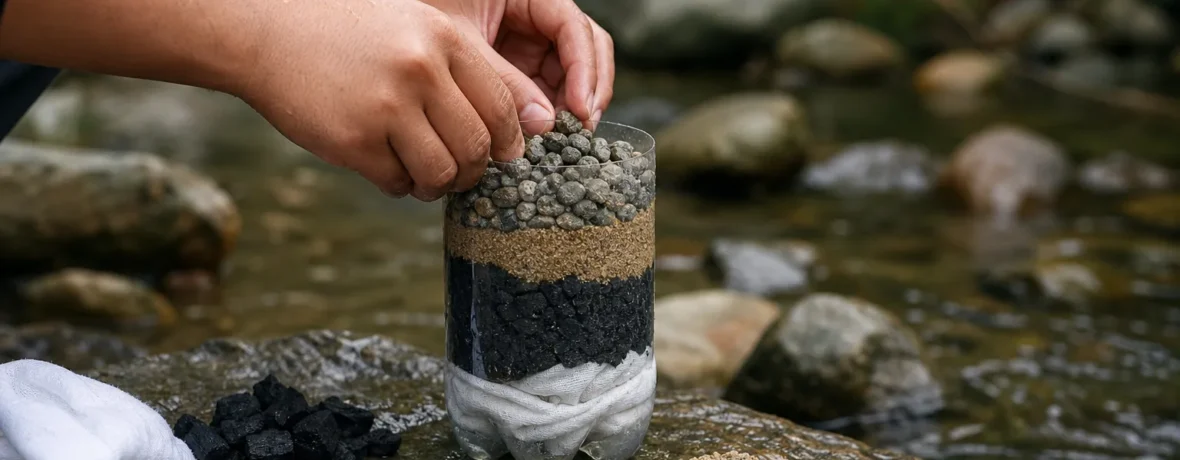
To make a water filter in the wild, build a layered filter with cloth, charcoal, sand, and gravel, then run water through it slowly at least 2 times. Yes, it can remove grit and improve clarity, but you still must boil or disinfect the water before drinking.
How to make a water filter in the wild?
Use layers that catch debris from large to fine, then treat the filtered water.
A wild-made filter is not a magic straw. It is a pre-filter. Its job is to turn cloudy, silty, leaf-stained water into clearer water so boiling, chemical treatment, UV, or a real backpacking filter can work better. The CDC’s hiking and camping water treatment guidance says boiling kills viruses, bacteria, and parasites, and when boiling is not possible, filtering followed by disinfection gives better protection than either step alone.
Here is the straight trail answer: the homemade filter handles dirt. Heat or disinfectant handles germs.
Supplies you need
- One empty plastic bottle, stuff sack, bark cone, or hollow container
- Clean cloth, bandana, coffee filter, or tightly woven shirt fabric
- Charcoal from a dead, untreated hardwood fire
- Fine sand
- Small gravel or pebbles
- Larger gravel or small stones
- A clean catch bottle or pot
- A way to boil or disinfect the water afterward
Step-by-step emergency filter
- Choose the cleanest water source you can find. Moving water from a clear stream beats stagnant pond water. Avoid water with an oily sheen, chemical smell, dead animals nearby, mine runoff, heavy algae scum, or obvious human waste upstream.
- Let muddy water settle. Fill a pot or bottle and let it sit for 20 to 30 minutes. Heavy sediment drops to the bottom. Pour the clearer water off the top without stirring up the sludge.
- Make the filter body. Cut the bottom off a plastic bottle and remove the cap. Turn the bottle upside down. If you have no bottle, roll stiff bark into a cone or use a small stuff sack lined with cloth.
- Plug the outlet with cloth. Stuff a bandana, sock, or shirt fabric into the bottle neck. This keeps the sand and charcoal from dumping into your clean container.
- Add crushed charcoal. Break charcoal into pea-size bits and rinse it if you can. Add a 2 to 3 inch [5 to 8 cm] layer. Charcoal can reduce some taste and odor, but campfire charcoal is not the same as lab-grade activated carbon.
- Add fine sand. Pour in a 3 to 4 inch [8 to 10 cm] layer of sand. This catches smaller suspended particles.
- Add small gravel. Add 2 inches [5 cm] of pea-size gravel. This spreads the water so it does not punch one channel through the sand.
- Add larger gravel on top. Add 2 inches [5 cm] of larger stones. This catches leaves, pine needles, and grit before they clog the finer layers.
- Flush the filter. Run the first batch of water through and dump it away. The first flow usually carries charcoal dust and loose sand.
- Filter slowly. Pour water in a little at a time. A slower drip usually means better sediment removal. If water blasts through, your layers are too loose.
- Run it through again. For cloudy water, filter it twice or three times. Rebuild the sand layer if it plugs up.
- Boil or disinfect before drinking. Bring filtered water to a rolling boil for 1 minute, or 3 minutes above 6,500 feet [1,981 m], following CDC boil-water guidance. If you cannot boil, use a proper disinfectant and follow the product label.
How to filter water naturally when you have no gear?
Start with settling, then strain, then use sand and charcoal if you can build a filter.
Natural filtering means using gravity, fabric, soil-like layers, and time. It does not mean the water becomes safe just because it looks clean. Clear mountain water can still carry Giardia, Cryptosporidium, bacteria, or viruses, especially near popular campsites, grazing land, trail crossings, or shallow lakes where people swim.
If you have no manufactured filter, work in stages:
- Settle: Let muddy water sit until grit drops out.
- Skim: Pour the clearer top water into another container.
- Strain: Pass it through cloth to catch floating bits.
- Filter: Run it through gravel, sand, and charcoal layers.
- Treat: Boil, chemically disinfect, or use a working UV purifier if you have one.
Do not scoop from the bank if you can avoid it. Wade in safely or use a pot on a stick to reach cleaner flow away from churned-up mud. In a lake, collect water away from shore, below the surface, and away from floating algae mats.
What materials work best in a homemade water filter?
The best emergency layers are cloth, charcoal, sand, and gravel in that order from bottom to top.
Think of the filter as a stack of gates. Big stones stop big junk. Gravel slows the flow. Sand catches fine particles. Cloth keeps the whole mess out of your clean bottle. Charcoal can improve taste and reduce some organic compounds, but it should never be treated as a stand-alone purifier.
| Material | What it does well | What it does not do reliably |
|---|---|---|
| Cloth | Catches leaves, bugs, ash, and larger particles | Removes bacteria, viruses, or parasites |
| Sand | Removes fine sediment and cloudiness | Guarantees germ-free drinking water |
| Gravel | Spreads flow and blocks larger debris | Removes microscopic pathogens |
| Charcoal | Improves taste and reduces some odors | Replaces boiling, disinfection, or a certified filter |
Can you drink water from a homemade survival filter?
No, not safely unless you boil or disinfect it after filtering.
This is where people get in trouble. A homemade filter can make ugly water look better. Your eyes are not a lab. The tiny stuff that can wreck your trip is invisible.
The CDC Yellow Book water disinfection guidance explains that portable filters vary by pore size and treatment ability. Many backpacking microfilters are built to remove protozoa and bacteria, but not all remove viruses. A pile of sand in a cut bottle is far less controlled than a tested filter cartridge.
If you have fuel, boil. If you have chemical tablets or drops, read the label and give them the full contact time, especially in cold or cloudy water. If you have a real backpacking filter, use the homemade filter first on silty water to protect the cartridge from clogging, then use the real filter.
Does boiling filtered water make it safe?
Yes, boiling properly treated filtered water is the strongest field option for most hikers.
Filtering first removes the grit that makes water unpleasant and can interfere with other treatment methods. Boiling then kills germs. The CDC recommends a rolling boil for 1 minute, or 3 minutes at elevations above 6,500 feet [1,981 m]. That elevation rule matters on high routes in the Rockies, Sierra, Cascades, and many desert ranges.
Boiling has tradeoffs. It takes fuel. It takes time. Hot water must cool before you can drink much of it. Still, when your filter is broken, your tablets are gone, and you are staring at questionable creek water, fire and a metal pot are hard to beat.
What is the safest emergency water treatment order?
The safest order is collect clean-looking water, settle it, pre-filter it, then boil or disinfect it.
Use this order when you have choices:
- Pick the best source. Clear, moving water beats warm, stagnant water.
- Avoid obvious hazards. Skip water near dead animals, algae blooms, mine tailings, farms, heavy livestock use, and camp toilet zones.
- Settle the water. Give sediment time to drop.
- Pre-filter through cloth. Remove floating junk and grit.
- Use a homemade filter if water is cloudy. Sand, gravel, and charcoal help clarify it.
- Use your main treatment. Boil, use a proper backpacking filter, chemically disinfect, or combine methods.
- Keep clean water clean. Do not dip dirty hands, dirty bottle threads, or untreated caps into treated water.
The Wilderness Medical Society’s water treatment guidelines for wilderness and austere settings support a multi-step approach when water quality is uncertain, because different methods handle different threats. That is the key. No single improvised layer handles everything.
What water sources should you avoid in the wild?
Avoid water that shows signs of chemical contamination, heavy algae, sewage, or animal waste.
Some water is not worth the gamble unless your alternative is severe dehydration and you have no other option. Homemade filters do not remove many chemicals, fuel residues, heavy metals, or toxins from harmful algal blooms. Boiling can kill germs, but it does not remove fuel, pesticides, or heavy metals.
Walk farther if you can and avoid:
- Water with rainbow sheen, fuel smell, or chemical odor
- Bright green, blue-green, or paint-like algae scum
- Pools below mines, industrial sites, roads, or agricultural runoff
- Water directly below a campsite, privy, or popular crossing
- Warm stagnant ponds with animal tracks and droppings all around
- Floodwater in developed areas
If the only available source is questionable, filter and boil if you can, then move toward a better source or a trailhead. Do not let a tidy-looking homemade filter give you false confidence.
What should you carry so you do not need to improvise?
Carry a real filter or purifier, plus a backup treatment method.
This is a gear review category, so here is the practical gear angle: an emergency bottle filter is a last-ditch move, not your main plan. A small hollow-fiber filter, chlorine dioxide tablets, and a metal pot weigh less than the misery of a gut infection miles from the car.
A strong water kit for day hikes and backpacking includes:
- A tested backpacking filter or purifier
- Chemical backup tablets or drops in sealed packaging
- A metal pot or stove setup for boiling
- A clean-water bottle and a dirty-water bag
- A bandana or coffee filter for silty water
- A small repair part or gasket if your filter uses one
- Hand sanitizer or soap for bathroom breaks before handling bottles
For most US backcountry trips, hikers commonly choose a lightweight microfilter and carry chemical treatment as backup. For international travel, flood response, or areas with heavy human waste contamination, look harder at purifiers or combined treatment because viruses become a bigger concern.
When to see a doctor
Get medical help if symptoms are severe, persistent, or point to dehydration.
Waterborne illness can look like many stomach bugs: diarrhea, cramps, vomiting, nausea, and fever. Do not try to diagnose the cause on the trail. Focus on hydration, getting to safety, and knowing when to call for help.
The CDC’s guidance on severe gastrointestinal symptoms says to seek medical help for bloody diarrhea, diarrhea lasting more than 3 days, fever over 102°F [38.9°C], frequent vomiting that prevents keeping liquids down, or signs of dehydration such as little urination, dry mouth or throat, or dizziness when standing. Mayo Clinic also advises urgent care for signs of serious dehydration, including extreme weakness or poor responsiveness, in its dehydration treatment guidance.
Children, older adults, pregnant hikers, and people with weakened immune systems should be more cautious and seek care sooner. If you are deep in the backcountry and someone cannot keep fluids down, becomes confused, stops urinating, or gets worse fast, treat it as an emergency and start evacuation or contact rescue.
Related reading
- How to Filter Water in the Wild: Filters, Tablets and Boiling
- Does Boiling Water Purify It? What Boiling Does and Doesn't Remove
- How to Filter Rainwater to Drink Safely
- What Is Wild Camping and Where Is It Legal?
FAQ
Can sand and charcoal make water safe to drink?
No, sand and charcoal alone do not make water reliably safe to drink. They can reduce sediment, taste, and odor, but you still need boiling, chemical disinfection, UV treatment, or a tested filter or purifier.
How many times should you run water through a homemade filter?
Run cloudy water through at least 2 times, and 3 times if it still looks dirty. More passes can improve clarity, but extra filtering does not replace disinfection.
Can you use campfire charcoal in a water filter?
Yes, you can use clean hardwood charcoal as an emergency filter layer. Do not use charcoal from treated wood, painted wood, trash fires, lighter-fluid-soaked coals, or briquettes with additives.
Is a homemade water filter better than water purification tablets?
It does a different job. A homemade filter removes debris and cloudiness, while purification tablets disinfect water when used correctly; in rough water, filter first and disinfect second.
What is the fastest way to make wild water safer?
The fastest reliable field method is to choose the cleanest source, strain visible debris, then use a proven treatment you already carry. If you have a stove and pot, boiling filtered water is a strong emergency choice.
Can boiling remove chemicals from wild water?
No, boiling does not reliably remove chemical contamination and can concentrate some contaminants as water evaporates. Avoid water with fuel smell, chemical odor, mine runoff, heavy algae, or agricultural runoff whenever possible.