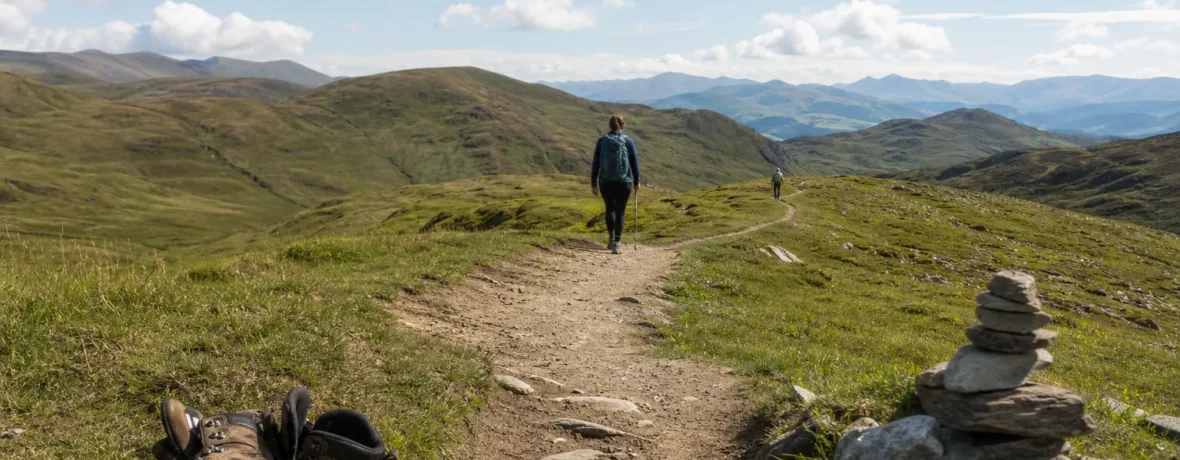
How long does it take to hike 4 miles? Most hikers need 1 hour 20 minutes to 2 hours on an easy trail, using a 2–3 mph [3.2–4.8 km/h] pace. Add 30–60 minutes for steep climbs, rough footing, heat, altitude, heavy packs, photos, or breaks; beginners may take 2.5–3 hours.
How long does it take to hike 4 miles?
A 4-mile [6.4 km] hike usually takes 1 hour 20 minutes to 2 hours on a mellow trail.
That assumes you’re walking steadily, the trail is clear, and the elevation gain stays modest. If the route climbs hard, crosses rocks or roots, or includes long viewpoint stops, plan closer to 2.5–3 hours. If you are new to hiking, that extra cushion keeps the day relaxed instead of rushed.
Use this quick calculator:
- Start with your distance: 4 miles [6.4 km].
- Divide by your trail pace: 2 mph [3.2 km/h] is relaxed; 3 mph [4.8 km/h] is brisk.
- Add 30 minutes for every 1,000 feet [305 m] of elevation gain.
- Add 10–20 minutes per hour for water, snacks, photos, layers, and route checks.
What is a simple hiking time calculator for 4, 7, 8, and 20 miles?
Multiply distance by your pace, then add time for climbing and breaks.
| Distance | Brisk pace: 3 mph [4.8 km/h] | Steady pace: 2.5 mph [4 km/h] | Relaxed pace: 2 mph [3.2 km/h] |
|---|---|---|---|
| 4 miles [6.4 km] | 1 hr 20 min | 1 hr 36 min | 2 hr |
| 7 miles [11.3 km] | 2 hr 20 min | 2 hr 48 min | 3 hr 30 min |
| 8 miles [12.9 km] | 2 hr 40 min | 3 hr 12 min | 4 hr |
| 20 miles [32.2 km] | 6 hr 40 min | 8 hr | 10 hr |
Those are moving-time estimates. Real trail time is longer. A rocky 7-mile [11.3 km] loop with 2,000 feet [610 m] of gain can take longer than a flat 10-mile [16.1 km] rail trail. Terrain beats mileage. Every time.
How long does it take to hike 8 miles?
Most hikers need 2 hours 40 minutes to 4 hours of moving time for an 8-mile [12.9 km] hike.
With breaks, climbing, route checks, and snack stops, a normal day-hike estimate is 3.5–5.5 hours. If the trail gains 2,000 feet [610 m], add roughly 1 hour. If you’re hiking in sand, snow, mud, or talus, add more. Your legs can move at a clean 3 mph [4.8 km/h] on smooth dirt, then crawl at 1 mph [1.6 km/h] on boulders.
How long does it take to hike 20 miles?
A 20-mile [32.2 km] hike usually takes 8–12 hours for fit day hikers once breaks and terrain are included.
The raw math says 6 hours 40 minutes at 3 mph [4.8 km/h] or 10 hours at 2 mph [3.2 km/h]. But a 20-mile day is not just four 5-mile walks. Feet swell. Fuel matters. Small hot spots turn into blisters. Downhills beat up knees. Sunset becomes a real deadline.
For a 20-mile route, check the total elevation gain, bailout options, water sources, weather, and daylight before you commit. The National Park Service Ten Essentials list is a smart baseline for longer hikes, especially if the route leaves busy front-country trails.
What slows down your hiking pace?
Elevation, footing, heat, pack weight, and fitness slow you down fastest.
Distance is only one piece. A 4-mile [6.4 km] trail can be easy before lunch or a slow grind if it climbs straight up a ridge. Watch these pace-killers:
- Elevation gain: Add 30 minutes per 1,000 feet [305 m] of climbing.
- Technical footing: Rocks, roots, scree, stream crossings, and snow force shorter steps.
- Heat and humidity: You’ll need more pauses and a lower effort level.
- Altitude: Thin air can make a normal pace feel spicy.
- Pack weight: Extra water, camera gear, winter layers, or overnight gear costs time.
- Group size: A group moves at the speed of the person having the hardest day.
How hard should you hike during training?
You should be able to talk in short sentences on most training hikes.
The CDC talk test is a clean way to manage effort: at moderate intensity, you can talk but not sing; at vigorous intensity, you can only say a few words before pausing for breath. Use that on climbs. If you’re gasping early, slow down before the trail forces you to.
For a 4-mile [6.4 km] goal, train with two shorter walks during the week and one longer walk or hike on the weekend. Build up in small steps: 2 miles [3.2 km], then 3 miles [4.8 km], then 4 miles [6.4 km]. Add hills after the distance feels comfortable.
How do you plan a 4-mile hike without overpacking?
Bring enough to handle delay, weather, thirst, and minor injuries.
For a 4-mile [6.4 km] hike near town, you do not need an expedition pack. You do need the basics. The National Park Service also recommends planning your route and leaving your itinerary with someone you trust in its trip planning guide.
- Water, plus extra in hot weather
- Snacks with salt and carbohydrates
- Map or downloaded offline map
- Sun protection
- Rain shell or warm layer
- Headlamp, even for afternoon hikes
- Small first-aid kit and blister care
- Fully charged phone
When to see a doctor
Get medical help right away for severe heat symptoms, chest pain, fainting, confusion, or injuries that stop you from walking.
Do not try to “push through” warning signs. The CDC heat illness guidance lists heat stroke as a medical emergency, with signs such as confusion, loss of consciousness, and very high body temperature. Move to shade, cool the person, and call emergency services if severe symptoms appear.
For dehydration, the Mayo Clinic dehydration guide flags extreme thirst, very dark urine, dizziness, and confusion as symptoms that need attention. For sprains, sharp joint pain, swelling, deformity, numbness, or inability to bear weight, stop the hike and get medical evaluation. No trail summit is worth turning a small problem into a long rescue.
Related reading
- How Long Does It Take to Hike 10 Miles?
- How Long Does It Take to Hike 3 Miles?
- How Long Does a 5-Mile Hike Take?
- How Long Does It Take to Hike 6 Miles?
FAQ
Is 4 miles a long hike for a beginner?
Yes, 4 miles [6.4 km] can feel long for a beginner, especially with hills. Pick an easy trail, start early, carry water, and plan 2–3 hours so you never feel chased by the clock.
What is a good hiking pace?
A good hiking pace is 2–3 mph [3.2–4.8 km/h] on moderate terrain. Beginners often sit closer to 2 mph [3.2 km/h], while fit hikers on smooth trails may hold 3 mph [4.8 km/h].
How much time should I add for elevation gain?
Add 30 minutes for every 1,000 feet [305 m] of climbing. Add more if the trail is steep, loose, exposed, snowy, or if you are carrying a heavy pack.
Can I hike 20 miles without training?
No, not safely for most people. A 20-mile [32.2 km] day demands strong feet, steady fueling, daylight planning, and comfort walking for many hours.
How many breaks should I take on a 4-mile hike?
Plan one or two short breaks. Drink before you feel thirsty, check your feet if you feel rubbing, and pause longer if heat, altitude, or steep climbing pushes your effort too high.