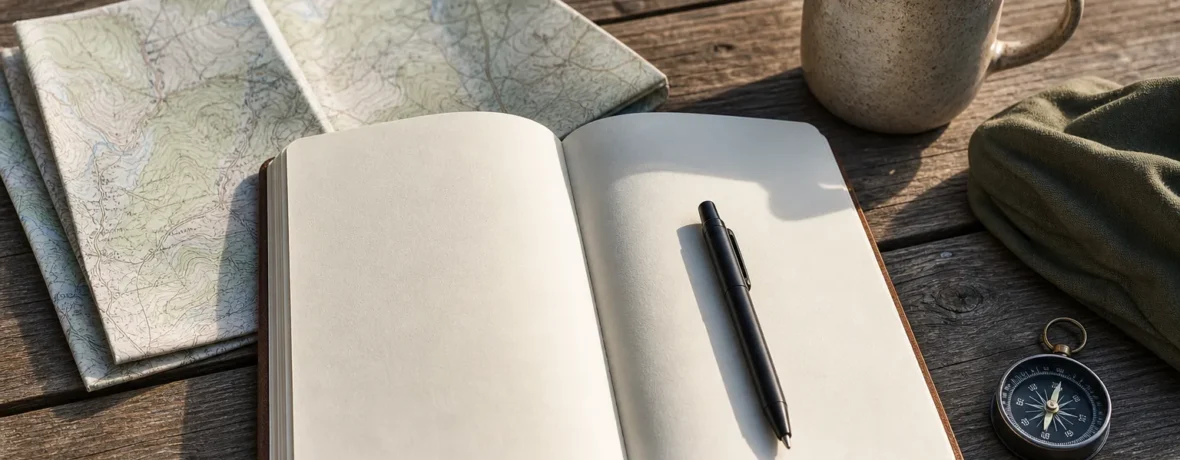
Keep a hiking journal by recording four things after every trip: where you went, conditions, what your body did, and what you learned. Use one page or five minutes, but write before sleep. Add date, route, mileage, weather, gear notes, wildlife, and one honest sentence.
Why should you keep a hiking journal?
Because memory is a sloppy trail partner.
You think you will remember the good campsites, the creek that ran dry, the shoes that rubbed your heel raw, and the ridge where the wind nearly knocked your hat into another county. You will not. Give it three weeks, then ask yourself which water source was reliable, which layer stayed damp, and which turnoff had the faded sign. The details will blur.
A hiking journal fixes that. It turns a walk into usable knowledge. It helps you plan smarter, pack lighter, repeat the best parts, and avoid repeating the dumb parts. It also gives you a record of who you were on the trail, not just where you went.
That last part matters. Hiking is physical, yes. It is also one of the few places where your brain finally stops shouting over itself. If you only track distance and elevation, you miss half the trip. The point is not to write pretty. The point is to write true.
Here is the position: every regular hiker should keep some kind of trail record. Not because it is cute. Not because a leather notebook looks good beside a tin mug. Because the trail teaches in specifics, and specifics disappear unless you catch them.
What should you write in a hiking journal?
Write the facts first, then the meaning.
Start with the unromantic details. They are the bones of the entry. Without them, your future self has to guess. With them, you can compare trips, spot patterns, and make better decisions next time.
- Date: Use the full date, not “last Saturday.”
- Trail or route: Include trailhead, loop direction, side trips, and turnaround points.
- Distance: Record miles [kilometers] from your map, GPS device, or trail sign.
- Elevation: Add gain and high point if you have them.
- Weather: Note temperature range, wind, storms, cloud cover, snow, humidity, or heat.
- Trail conditions: Mud, blowdowns, snowfields, water crossings, bugs, loose rock, exposure, shade.
- Water: Which sources were flowing, dry, silty, frozen, or easy to reach.
- Gear: What worked, what failed, what stayed unused, what you wished you packed.
- Body: Hot spots, knee pain, pace, energy, appetite, sleep, hydration, mood.
- Highlights: Views, wildlife, plants, people, sounds, smells, silence.
- One lesson: The single thing you would do differently next time.
Then write the human part. This is where most hikers chicken out. Do not. A journal that only says “6.8 miles, cloudy, good views” is useful, but thin. Add one sentence that would make sense only to you: “The climb felt harder than it should have because I started angry.” Or: “The best moment was taking my boots off beside the creek.”
That sentence is the hook. Years later, it will bring the whole day back.
How do you keep a hiking journal without making it feel like homework?
Make it small enough that you will actually do it.
The enemy is not laziness. The enemy is overdesign. People quit because they build a system that requires perfect handwriting, full paragraphs, color-coded symbols, printed photos, and deep thoughts under headlamp light after 14 miles [22.5 km]. No thanks.
Use this simple method:
- Pick one format. Use a pocket notebook, notes app, spreadsheet, or printed template. Do not keep switching every trip.
- Write the facts on trail or at the car. Date, route, distance, weather, water, and one gear note take 90 seconds.
- Add the feeling later the same day. Before sleep, write three to six sentences while the trip still has texture.
- Use prompts when tired. Try: “Best part,” “Hardest part,” “Next time,” and “One thing I noticed.”
- Review it before your next hike. A journal earns its keep when it changes what goes in your pack or how you plan the route.
Set a low bar. A five-line entry beats a blank page. Every time.
If you want a safety-minded planning source to pair with your notes, the National Park Service has a clear hiking safety guide. For weather, check forecasts through the National Weather Service before you leave, then record what actually happened. The mismatch between forecast and trail reality is gold for future planning.
What is the best format for a hiking log?
The best format is the one you will use after a hard day.
Some hikers love a notebook. Some prefer a phone. Some want a spreadsheet with filters for season, region, mileage, and elevation gain. None of these is morally superior. The question is not “What looks good?” The question is “What survives rain, fatigue, dead batteries, and your actual habits?”
| Format | Best for | Tradeoff |
|---|---|---|
| Pocket notebook | Fast notes, sketches, campsite details, low-tech reliability | Can get wet, harder to search later |
| Phone notes app | Photos, voice notes, GPS screenshots, quick editing | Battery, cold weather, and wet screens can get in the way |
| Spreadsheet | Tracking mileage, gear use, locations, seasons, patterns | Less emotional, easy to turn into admin work |
| Printed template | Consistent entries and family or group trips | Less flexible when the day does not fit the boxes |
A strong system often uses two layers: quick field notes, then a cleaner entry at home. The field note catches raw facts. The home entry adds context.
Do not let the tool steal the trip. If you spend more time formatting your notes than reading the sky, you have built the wrong system.
How detailed should your trail notes be?
Detailed enough to help future you make a better call.
That is the standard. Not literary. Not exhaustive. Useful.
“Creek flowing” is better than nothing. “Creek flowing strong at the bridge, dry at the upper crossing, filtered 2 liters [1.9 L] at 3:10 p.m.” is better if you might return in the same season. “Boots uncomfortable” is weak. “Right heel hot spot after mile 4 [6.4 km] on downhill gravel; thin socks slipped” is useful.
The same goes for weather. “Cold” does not help much. “Started in fleece at 42°F [6°C], comfortable in sun, wind on ridge made gloves necessary” tells you what clothing worked.
Here is a good rule: write one level more specific than your first instinct.
If your first instinct is “bugs bad,” write “mosquitoes heavy near lake at dusk; head net would have helped.” If your first instinct is “trail hard,” write “last 1.5 miles [2.4 km] climbed steep loose rock with little shade.” Specifics turn complaint into intelligence.
What should you track for gear and planning?
Track what changes your next packing list.
A journal is the best gear reviewer you will ever have because it does not care what was on sale or what looked good online. It records what happened under your feet, on your back, and in bad weather.
After each hike, ask:
- What did you carry and never touch?
- What did you need and not have?
- What failed, leaked, tore, rubbed, froze, clogged, or annoyed you?
- What food tasted good when you were tired?
- How much water did you carry, and was it enough?
- Which layer went on first when the wind came up?
- Did your footwear match the terrain?
Be blunt. “Packed rain shell, no rain” is not the same as “Packed rain shell, kept it because thunderheads built by 2 p.m.” A piece of unused gear can be dead weight, or it can be insurance. Your notes should tell you which.
This is also where ethics belong. If you camp, cook, wash, or travel through fragile places, tie your observations to the Leave No Trace Seven Principles. Did you find durable surfaces? Did you keep food secure? Did a crowded trail change your plan? Write that down. Good hikers are not just strong walkers. They pay attention to impact.
How do you make a hiking journal more personal?
Add sensory details and one honest judgment.
The facts help you plan. The personal notes help you remember. You need both.
Try writing what a camera misses:
- The smell of sun-warmed pine needles
- The sound of talus shifting underfoot
- The taste of a crushed sandwich at the summit
- The way fog erased the next ridge
- The mood in the car before the hike
- The exact moment the day turned good
Then make a call. Was the route worth repeating? Would you bring a friend there? Was it harder than the map suggested? Did solitude help, or did the quiet feel heavy?
This is where a column has to say the plain thing: sterile trail records are overrated. Yes, track distance. Yes, track weather. But if your journal never admits joy, fear, boredom, pride, irritation, or awe, you are flattening the experience into a receipt.
Write like a person. Short sentences are allowed. Mess is allowed. A crossed-out line can carry more life than a polished paragraph.
What are the best prompts for a hiking journal?
The best prompts are short, specific, and hard to dodge.
Use these when you are tired and words feel heavy:
- Route: Where did I start, turn, stop, and finish?
- Conditions: What changed from the forecast?
- Body: When did I feel strongest, and when did I fade?
- Gear: What earned its place?
- Food and water: What worked, and what did I avoid eating?
- Decision: What choice shaped the day?
- Moment: What image keeps coming back?
- Lesson: What will I do differently next time?
If you want to build map awareness, add a small sketch. Not art. Just a crude line showing trailhead, water, climb, pass, campsite, view, or problem spot. For map research, the U.S. Geological Survey’s topographic map viewer is a solid place to study terrain before or after a trip.
Prompts should not trap you. If the day gave you one huge thing, write that thing. If the day gave you ten small things, list them. A journal is a tool, not a teacher with a red pen.
How often should you update your hiking journal?
Update it the same day, every time.
That sounds strict because it is. Waiting kills detail. By tomorrow, the little things are already fading. By next week, you are reconstructing the day from photos and vibes.
The best rhythm is simple:
- During the hike: Note water, hazards, weather shifts, and route oddities.
- At the trailhead: Record finish time, mileage, and immediate gear thoughts.
- At home: Add the fuller entry, photo labels, and lessons.
- Before the next trip: Read the last similar entry.
That final step is where most people fail. They collect information and never use it. Do not make a museum. Make a tool. If last October’s notes say the north-facing slope held ice, bring traction or pick another route. If your spring notes say the approach road was rutted, do not pretend your low-clearance sedan has grown taller.
What mistakes should you avoid?
Avoid perfection, vagueness, and pretending every hike was profound.
Perfection makes you quit. Vague notes waste your time. Fake profundity is worse than silence.
Watch for these common mistakes:
- Writing only when the hike is epic: Ordinary days teach patterns. Record them.
- Skipping bad trips: Bad trips have the best lessons.
- Using only photos: Photos show views, not decisions.
- Leaving out discomfort: Blisters, fear, heat, and low energy are planning data.
- Trusting memory for route details: Write turns, junctions, and water notes while fresh.
- Turning it into a performance: The journal is for you first.
The last one matters most. If you share entries online, fine. But do not write every line for strangers. Public writing often sands down the weird edges. A private notebook can say, “I was scared on the ledge,” or “I hated the first half and loved the last mile [1.6 km].” That is better than a caption.
What is a simple hiking journal template?
Use a template with facts, conditions, gear, and one reflection.
Copy this structure into a notebook or notes app:
- Date:
- Trail/route:
- Start and finish:
- Distance:
- Elevation gain:
- Weather:
- Trail conditions:
- Water sources:
- Wildlife/plants:
- Gear notes:
- Food and water notes:
- Body notes:
- Best moment:
- Hardest moment:
- Lesson for next time:
If that feels too long, cut it to four lines:
- Route and distance
- Weather and trail conditions
- Gear/body notes
- Best moment and next-time lesson
That is enough. The habit matters more than the template.
Related reading
- Type 2 Fun: Why Hard Hikes Feel Good Later
- The Seven Summits Explained
- What Is Geocaching?
- What Is Hiking, Really? A Definition Worth Arguing About
FAQ
Do I need a special notebook for a hiking journal?
No. Any notebook, notes app, or printed sheet works if you use it consistently. If you hike in wet conditions, choose paper and a writing tool that can handle moisture, or make quick phone notes when your hands are dry.
Should I write during the hike or after it?
Do both, but keep trail notes short. Record facts during the hike, then write the fuller entry later the same day when you are warm, fed, and less likely to skip the human details.
How long should each entry be?
One page is plenty, and five lines can be enough. A useful entry should include route, conditions, gear or body notes, and one lesson you can act on next time.
Should I include photos in my hiking journal?
Yes, if they help you remember or plan. Label photos with route names, dates, viewpoints, water sources, campsites, or confusing junctions so they become more than scenery.
Can a hiking journal help me become a better hiker?
Yes. It shows patterns in pacing, packing, weather decisions, footwear, food, hydration, and route choice. The trail gives feedback every trip; the journal keeps you from losing it.