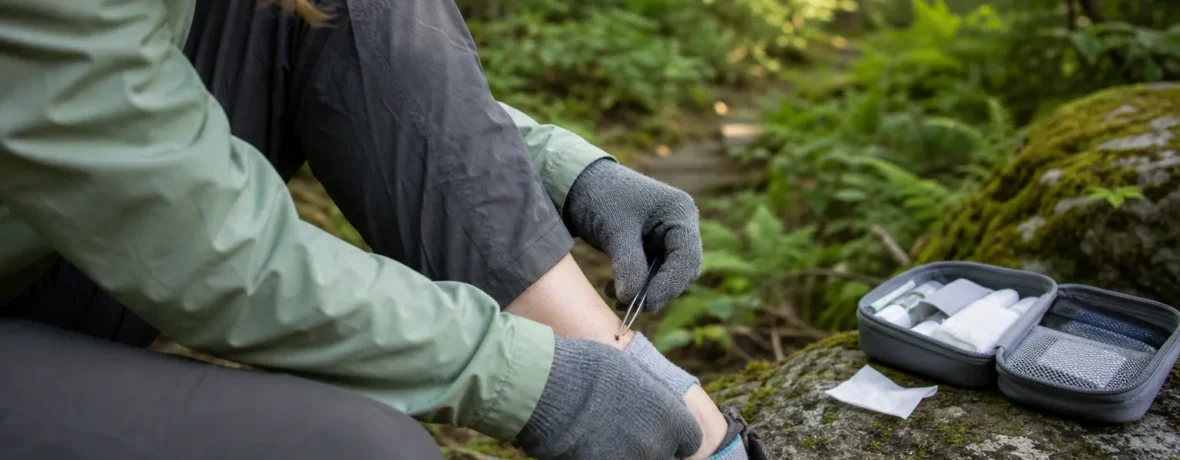
Remove the tick right away with fine-tipped tweezers, clean the bite and your hands, save the tick or take a photo, then watch for rash, fever, aches, or flu-like symptoms for several weeks. Call a doctor sooner if symptoms appear.
What should you do first after finding a tick attached?
Remove it now; don’t wait for a clinic visit just to pull it out.
A tick is not a splinter you can ignore until after dinner. The longer it stays attached, the more chance there is for disease transmission. The CDC’s tick bite guidance says to remove an attached tick as soon as possible and not to delay removal while waiting for a healthcare provider.
Take a breath. Get good light. Sit down if the tick is in an awkward spot. If you’re on trail, ask a hiking partner to help with places you can’t see: scalp, back of the knees, waistband, armpits, behind the ears, and along the sock line.
- Use fine-tipped tweezers if you have them.
- If you don’t, use regular tweezers or a tick removal tool.
- Do not burn the tick.
- Do not coat it in petroleum jelly, nail polish, sunscreen, alcohol, or essential oils while it is attached.
- Do not crush the tick body with your fingers.
That old “make the tick back out” advice belongs in the campfire trash. Your job is simple: grip close, pull steady, clean up.
How to remove a tick safely?
Grab the tick close to your skin and pull straight out with steady, even pressure.
Here is the clean trail-ready method, based on CDC and NIH MedlinePlus tick bite guidance:
- Wash or sanitize your hands if you can. If you’re in the backcountry, use hand sanitizer before handling the bite area.
- Grip the tick as close to the skin as possible. Aim for the mouthparts, not the swollen body.
- Pull upward with steady pressure. Don’t twist. Don’t jerk. A slow, firm pull gives you the best shot at removing it in one piece.
- If the mouthparts break off, don’t dig aggressively. If you can lift them out easily with clean tweezers, do that. If not, leave them alone and let the skin work them out as it heals.
- Clean the bite and your hands. Use soap and water, rubbing alcohol, or hand sanitizer.
- Save the tick or take a clear photo. Put it in a sealed bag or container, wrap it in tape, or drop it in alcohol. A photo helps with ID if symptoms show up later.
- Write down the date and location. Note where you were hiking and where the tick was attached on your body.
If you’re using a tick key or tick hook, follow the tool’s instructions and keep the same goal: remove the tick promptly without squeezing the body. Fine-tipped tweezers still deserve a permanent spot in your first-aid kit. They weigh next to nothing and do more than pull ticks.
What should you do after removing the tick?
Clean the skin, document the bite, and check the rest of your body.
After the tick is out, don’t just slap the bite and hike on. Take 2 minutes to reset. That tiny pause can save you a messy guessing game later.
- Clean the bite site: Soap and water are great. Alcohol wipes work well in a trail kit.
- Clean your hands and tweezers: You just handled a blood-feeding parasite. Enough said.
- Take a photo: Photograph the bite and the tick if you have it.
- Mark your calendar: Record the removal date. Symptoms can show up days to weeks later.
- Do a full tick check: One tick can mean more ticks. Check scalp, ears, armpits, belly button, groin, waistband, sock line, and behind knees.
- Check your dog: Look under the collar, between toes, around ears, under the tail, and in the armpit area.
A small red bump at the bite site can happen and does not automatically mean Lyme disease or another infection. Watch it. If redness spreads, the area becomes painful, or fluid drains from the site, contact a healthcare professional.
Should you save the tick or throw it away?
Save it or photograph it if you can, then dispose of it safely.
You don’t need to carry a dead tick around like a cursed souvenir for months. But saving it for a short time, or at least getting a clear photo, can help a clinician identify the tick type if you get sick. The Mayo Clinic’s tick bite first-aid advice also recommends securing the tick or taking a photo to help with identification.
| Option | Best for | How to do it |
|---|---|---|
| Sealed bag or container | Possible later identification | Place the tick inside, label with date and location, and keep it out of reach of kids and pets. |
| Clear photo | Fast documentation | Photograph the top and underside next to a coin or ruler for scale. |
| Tape | Simple disposal | Fold tape over the tick and throw it away. |
| Alcohol | Killing and preserving | Drop the tick into a small container with rubbing alcohol. |
Do not crush a live tick with your fingers. If you don’t save it, kill it in alcohol, seal it in tape, place it in a sealed container, or flush it.
What symptoms should you watch for after a tick bite?
Watch for rash, fever, chills, headache, fatigue, muscle aches, joint pain, or swollen lymph nodes.
Many tick-borne illnesses start like a bad flu, which is exactly why hikers miss them. You may not feel sick right away. You may feel fine for days. Keep an eye on your body for several weeks after the bite, especially if you were hiking through tall grass, brush, leaf litter, or wooded edges.
Call a healthcare professional if any of these show up:
- A spreading rash near the bite or anywhere else on your body
- A bull’s-eye-like rash, though not every Lyme rash looks like a bull’s-eye
- Fever or chills
- Headache that feels unusual for you
- Deep fatigue that doesn’t match your effort level
- Muscle or joint aches
- Swollen lymph nodes
- Neck stiffness
- New weakness, numbness, dizziness, shortness of breath, fainting, or heart palpitations
Take photos of any rash once a day with the same lighting and a ruler or coin for scale. Do not try to diagnose yourself from rash photos online. Patterns vary, skin tones vary, and different tick-borne diseases can overlap in ugly ways.
When to see a doctor
See a doctor if symptoms appear, if you can’t remove the tick, or if the bite may qualify for preventive treatment.
Most tick bites do not turn into a medical emergency. Still, there are times when “wait and see” is the wrong move. The CDC says to see a doctor if you develop a rash or fever within days to weeks after removing a tick. MedlinePlus gives the same general warning for fever, chills, aches, pains, and rash after a tick bite.
Contact a healthcare professional if:
- You develop a rash, fever, chills, headache, joint pain, muscle pain, or flu-like symptoms.
- The bite area becomes increasingly painful, swollen, warm, red, or starts oozing.
- You cannot remove the tick completely and part of the tick is still firmly embedded.
- The tick was attached for 36 hours or longer, or it looked swollen with blood.
- You removed a blacklegged tick in a Lyme disease area within the last 72 hours.
- You are pregnant, immunocompromised, or caring for a young child with a tick bite.
- You develop severe headache, trouble breathing, weakness, paralysis, fainting, confusion, or heart palpitations. For severe symptoms, seek urgent care or call emergency services.
In certain cases, a clinician may discuss a preventive antibiotic after a high-risk bite. Do not start leftover antibiotics from a cabinet, and do not take someone else’s prescription. Tick-borne diseases are not all treated the same way, and the decision depends on the tick, timing, location, attachment time, symptoms, medical history, and local disease risk.
Do you need antibiotics after every tick bite?
No, antibiotics are not needed after every tick bite.
This is where many hikers get twitchy. Fair. Lyme disease is scary, and nobody wants to gamble with their joints, heart, or nervous system. But antibiotics are a medical decision, not a trail snack.
According to CDC clinician materials, preventive treatment may be considered only under specific circumstances, such as a high-risk blacklegged tick bite in an area where Lyme disease is common, with the tick attached long enough to raise concern, and care started soon after removal. The CDC’s guidance for clinicians after a tick bite lays out those criteria for healthcare professionals.
If you’re unsure, call your doctor, an urgent care clinic, or a nurse line. Be ready with the useful facts:
- Date and time you found the tick
- Best guess for how long it was attached
- Where you were hiking: state, county, trail, or park
- Where the tick was attached on your body
- Whether the tick looked flat or engorged
- Photo of the tick and bite site
- Any symptoms, even mild ones
What should you pack for tick removal on hikes?
Carry a tiny tick kit every time you hike in brush, grass, or woods.
Ticks don’t care if you’re doing a 1-mile [1.6 km] nature loop or a 16-mile [25.7 km] ridge day. Your kit can be smaller than a granola bar and still handle the job.
- Fine-tipped tweezers
- Alcohol wipes
- Hand sanitizer
- Small zip-top bag or tiny screw-top container
- A few inches of tape wrapped around a card
- Mini permanent marker
- Small card with your emergency contact and medical conditions
For prevention, the Wilderness Medical Society’s clinical practice guidelines for tick-borne illness support proven bite-prevention basics for people spending time outdoors. Use EPA-registered repellent on exposed skin, treat clothing and gear with permethrin when appropriate, wear long pants in tick habitat, and do a real tick check after the hike. “Real” means shoes off, socks off, waistband checked, hairline checked, mirror used.
What should you not do after a tick bite?
Do not squeeze, burn, smother, or ignore the tick.
Bad tick advice travels fast because it sounds clever. The problem is that clever can cost you time. Skip these moves:
- Do not use a hot match. You can burn yourself and delay removal.
- Do not cover the tick with petroleum jelly or nail polish. Remove it mechanically instead.
- Do not twist hard. Twisting can break off mouthparts.
- Do not squeeze the swollen body. Grip close to the skin.
- Do not scratch the bite open. Clean it and leave it alone.
- Do not send the tick for testing and use that result as your only plan. Symptoms and clinical judgment matter more than waiting on a lab report.
- Do not ignore symptoms because the bite “looked fine.” Tick-borne illness can start away from the bite site.
The best move is boring and effective: remove, clean, document, monitor, call if symptoms show.
Related reading
- What Does a Tick Bite Look Like? Photos and Warning Signs
- When to Worry About a Tick Bite
- Tick Bites on Dogs After a Hike: What to Look For
- Can You Feel a Tick Bite?
FAQ
How long after a tick bite can symptoms appear?
Symptoms can appear within days to weeks after a tick bite. Watch for rash, fever, chills, headache, fatigue, muscle aches, and joint pain, and contact a healthcare professional if they show up.
Is a small red bump after a tick bite normal?
Yes, a small bump or mild irritation can happen after a tick bite. If the redness spreads, forms a larger rash, becomes painful, oozes, or comes with fever or aches, call a doctor.
What if the tick head stays in my skin?
If mouthparts remain, try to remove them only if they come out easily with clean tweezers. If they do not come out easily, leave them alone and let the skin heal, but call a clinician if the area worsens.
Can you get Lyme disease if the tick was attached for less than 24 hours?
The risk is lower when a tick is removed quickly, but no bite is something to brag about ignoring. Remove the tick as soon as you find it, document the bite, and watch for symptoms over the next several weeks.
Should I go to urgent care after every tick bite?
No, not every tick bite needs urgent care. Go or call promptly if you have symptoms, cannot remove the tick, develop a spreading rash, or think the tick was a blacklegged tick attached for 36 hours or longer.
Can I keep hiking after removing a tick?
Yes, if you feel well and the tick is fully removed, you can usually keep hiking. Clean the bite, do a full-body tick check at the next good stop, and write down the date and location when you get back to your car or camp.