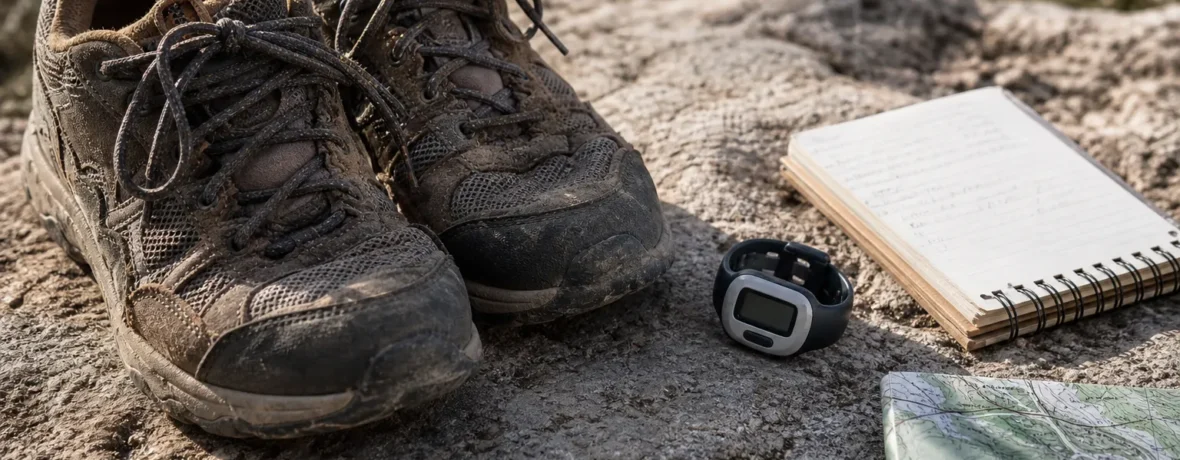
How many steps in a mile? Most walkers take 2,000 to 2,500 steps in a mile. On hiking trails, expect 2,300 to 3,200 steps per mile because climbs, rocks, mud, and switchbacks shorten your stride. A tall hiker cruising smooth trail may be near 2,100; a shorter hiker grinding uphill may pass 3,000.
How many steps in a mile for walking?
A flat walking mile usually takes 2,000 to 2,500 steps.
That range covers most adults walking on pavement, gravel paths, park loops, and smooth sidewalks. Your exact number depends on stride length, pace, height, fatigue, footwear, and how much you stop and start.
Here is the simple math: one mile is 5,280 feet [1,609 m]. If your average step is 2.5 feet [0.76 m], you take 2,112 steps per mile. If your step is 2.1 feet [0.64 m], you take 2,514 steps per mile.
| Activity | Typical steps per mile | Why it changes |
|---|---|---|
| Brisk road walk | 1,900-2,300 | Longer, smoother stride |
| Easy neighborhood walk | 2,000-2,500 | Normal pace, flat surface |
| Smooth hiking trail | 2,200-2,700 | Shorter stride, uneven tread |
| Steep or rocky hiking trail | 2,700-3,500 | Climbing, braking, careful foot placement |
How many steps are in a mile of hiking?
A hiking mile usually takes 2,300 to 3,200 steps.
Trail miles are not road miles for your legs. Your GPS may show the same distance, but your feet are doing different work. On a trail, you shorten your stride to step over roots, plant your feet on rocks, balance on loose dirt, and brake on descents. Add a pack, and your stride often gets shorter again.
Uphill hiking can push your step count higher because you take small, powerful steps. Downhill hiking can also raise the count when the grade is steep or slippery. You may take quick braking steps instead of long, easy ones.
On mellow dirt, use 2,400 steps per mile as a clean planning number. On rough mountain trail, use 3,000 steps per mile. If the trail is brutally steep, muddy, snowy, or full of boulder hopping, your real number can climb past that.
How many steps is a 5 mile hike?
A 5 mile hike is usually 11,500 to 16,000 steps.
For a smooth trail, multiply 5 miles by 2,300 to 2,700 steps per mile. That gives you 11,500 to 13,500 steps. For a steeper or rockier trail, multiply by 2,700 to 3,200 steps per mile. That gives you 13,500 to 16,000 steps.
If you are asking “how many steps is a 5 mile hike” because you are training, use the high end. It is better to be ready for 16,000 choppy trail steps than surprised when your step counter says your “short” hike felt like leg day.
Why do hikers take more steps per mile than walkers?
Hikers take more steps because trails shorten your stride.
Walking on pavement lets you swing through cleanly. Hiking does not. Your foot lands where the trail allows, not where your perfect stride wants to land.
- Climbing: You take shorter steps to keep power under your hips.
- Descending: You take extra braking steps to control speed.
- Rocks and roots: You adjust foot placement constantly.
- Mud, sand, or snow: You lose push-off and shorten your stride.
- Switchbacks: Turns break your rhythm.
- A loaded pack: Extra weight often makes steps shorter and more deliberate.
How do you calculate your own steps per mile?
Walk or hike a measured mile and count your steps.
This gives you a better number than any chart. Do it on the kind of surface you actually care about: pavement for walking, dirt for hiking, hills for mountain training.
- Choose a measured 1-mile route [1.6 km], track, or GPS route with reliable distance.
- Start your watch, phone, or step counter at the same time you begin walking.
- Move at your normal pace, not your fastest pace.
- Stop at exactly 1 mile and record the step count.
- Repeat it two more times on different days.
- Add the three results and divide by three.
That average is your personal steps-per-mile number. For hiking, repeat the same test on an easy trail and a steep trail. You will likely get two different answers, and both are useful.
Does pace change how many steps you take in a mile?
Yes, pace can change your step count.
When you walk faster, you may lengthen your stride, increase cadence, or do both. If your stride gets longer, your steps per mile drop. If you only move your feet faster without much stride change, your steps per mile stay closer to normal.
On trails, pace is less predictable. A faster hiker on steep terrain may still take short steps. A slower hiker on smooth trail may take long, relaxed steps. That is why terrain beats pace when you are estimating hiking steps.
Is counting steps useful for hiking training?
Yes, step counting is useful, but mileage and elevation still matter.
Steps help you track consistency. If you are building hiking fitness, a 9,000-step weekday gives your legs more useful work than a day glued to a chair. The CDC says adults should aim for at least 150 minutes of moderate-intensity aerobic activity each week, and brisk walking counts.
For trail prep, combine step goals with hike-specific work:
- One longer walk or hike each week
- Hill repeats or stair climbing
- Strength work for calves, glutes, quads, hamstrings, and core
- Practice walks with the pack weight you plan to carry
- Easy recovery walks between harder days
If you are new to exercise or returning after time off, the NIH’s NIDDK recommends starting physical activity gradually and choosing activities that fit your current fitness level.
What is a good daily step goal for hikers?
A good daily step goal is one you can repeat without limping into tomorrow.
For many hikers, 7,000 to 10,000 steps on normal days builds a strong base. During hike training blocks, 10,000 to 14,000 steps can make sense if your body is handling it well. Big trail days may land far above that, but every day does not need to look like a summit push.
Use soreness as feedback. Mild muscle fatigue is normal. Sharp pain, swelling, or joint pain that changes your gait is a stop sign, not a badge.
When to see a doctor
See a doctor if walking or hiking causes chest pain, fainting, severe shortness of breath, or pain that does not settle with rest.
Do not try to self-diagnose trail pain. A sore calf after a climb is one thing. Chest pressure, dizziness, unusual breathlessness, or pain in the jaw, neck, or arm is different. Mayo Clinic advises seeking medical care for warning symptoms such as chest discomfort, dizziness, or faintness during exercise.
Also talk with a health professional before ramping up training if you have a heart, lung, metabolic, balance, or mobility condition. MedlinePlus gives similar guidance: check with a provider if you have trouble moving, trouble balancing, or concerns that exercise may not be safe for you.
How can you use step counts to plan a hike?
Multiply the trail miles by your expected steps per mile.
Use 2,400 steps per mile for smooth trails, 2,800 for typical hiking, and 3,200 for steep or rough terrain. Then look at elevation gain, pack weight, heat, and trail surface. Those factors decide how hard the steps feel.
Quick planning numbers:
- 2-mile easy trail: 4,800-5,400 steps
- 3-mile moderate trail: 7,500-9,000 steps
- 5-mile hike: 11,500-16,000 steps
- 8-mile mountain hike: 20,000-25,600 steps
- 10-mile rough hike: 27,000-32,000 steps
That last number gets people’s attention. Ten trail miles can feel bigger than a normal 10-mile walking day because the steps are shorter, slower, and more muscular.
Related reading
- How Far Is 10,000 Steps in Miles and on Trails?
- How Many Calories Does Walking Burn vs Hiking?
- How Many Miles Should You Walk a Day?
- How Many Leg Exercises Per Workout?
FAQ
How many steps are in 1 mile?
Most people take 2,000 to 2,500 steps in 1 mile. On hiking trails, use 2,300 to 3,200 steps per mile because uneven ground shortens your stride.
How many miles is 10,000 steps?
10,000 steps is usually 4 to 5 miles [6.4 to 8 km]. If you have a long stride, it may be closer to 5 miles; if you have a shorter stride or hike rough trail, it may be closer to 3.5 to 4.5 miles.
How many steps are in 3 miles of hiking?
Three hiking miles usually equal 6,900 to 9,600 steps. Use the lower number for smooth dirt trail and the higher number for steep, rocky, or rooty terrain.
Do uphill miles have more steps?
Yes, uphill miles usually have more steps. Climbs shorten your stride because smaller steps are stronger and more efficient on steep grades.
Is a step counter accurate on trails?
A step counter is useful on trails, but not perfect. Trekking poles, scrambling, slow technical movement, and phone placement can affect the count, so treat the number as a close estimate rather than a lab measurement.
Should I train by steps or miles for hiking?
Use both. Steps show daily volume, while miles, elevation gain, pack weight, and terrain tell you how hike-ready those steps really are.