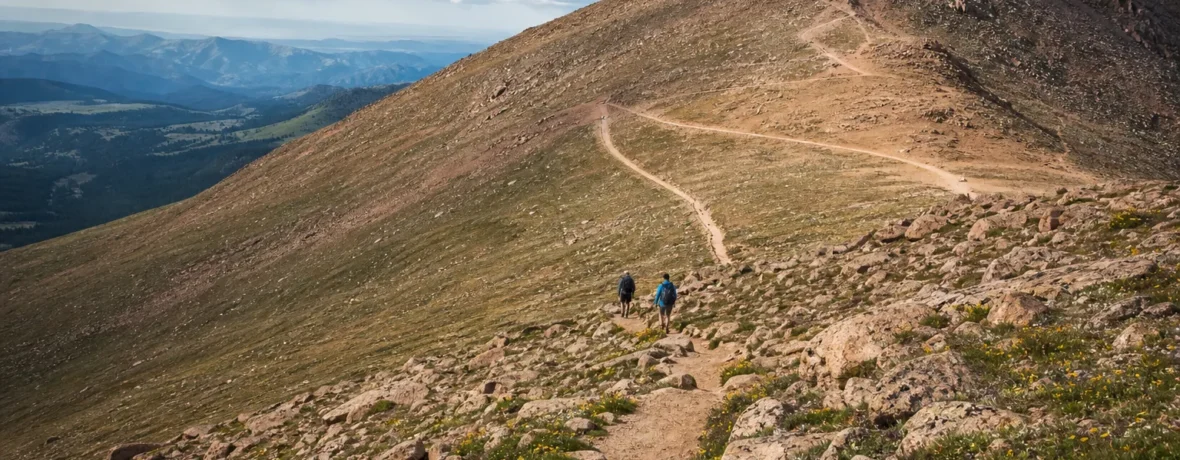
How long does it take to hike Pikes Peak? Most hikers need 8–12 hours to hike one way to the summit via Barr Trail, and 12–16 hours for the full round trip. Strong, acclimated hikers can go faster, but distance, 7,510 feet [2,289 m] of gain, altitude, and weather make this a serious day.
How long does it take to hike Pikes Peak via Barr Trail?
Plan on 8–12 hours to reach the summit, or 12–16 hours if you hike back down.
Barr Trail is the classic east-side route from Manitou Springs to the top of Pikes Peak. The official Pikes Peak trail information lists Barr Trail at 12.6 miles [20.3 km] one way with 7,510 feet [2,289 m] of elevation gain/loss, starting above the Cog Railway Depot and ending near the Summit House. The summit sits at 14,115 feet [4,302 m], according to the City of Colorado Springs’ Pikes Peak safety page.
That means the hike is not hard because of one terrifying section. It is hard because it keeps going. And going. And going.
| Plan | Typical hiking time | Best for |
|---|---|---|
| Hike up, ride down | 8–12 hours | Fit hikers who book summit transportation in advance |
| Round trip in one day | 12–16 hours | Very fit, acclimated hikers with an early start |
| Overnight at Barr Camp | 2 hiking days | Hikers who want a safer, less rushed summit push |
If you are coming from low elevation, do not build your plan around the fastest number. Build it around the slow number. A 10-hour climb on paper can become a 13-hour day when you add altitude headaches, food stops, cold wind above treeline, photos, foot care, and a careful descent.
How many miles is the Pikes Peak hike?
Barr Trail is 12.6 miles [20.3 km] one way and 25.2 miles [40.6 km] out and back.
The first landmark that matters is Barr Camp, 6.8 miles [10.9 km] from the lower trailhead on the official Pikes Peak trail description. That sounds like the halfway point, but the day does not split cleanly. The second half climbs higher, gets colder, has less oxygen, and leaves the trees behind. Your pace usually drops above Barr Camp.
Think of the route in three chunks:
- Trailhead to Barr Camp: steady climbing through forest. You are fresh, but the grade starts right away.
- Barr Camp to treeline: quieter, thinner air, and the point where fatigue starts to show.
- Treeline to summit: exposed alpine terrain where wind, lightning risk, snow patches, and altitude can slow everything down.
The descent is not free. Dropping more than 7,000 feet [2,134 m] pounds your knees, toes, hips, and patience. Many hikers underestimate the downclimb more than the climb.
Can a beginner hike Pikes Peak?
A true beginner should not make Pikes Peak their first big mountain hike.
This is a long, high-altitude, full-day effort. The trail is not technical in normal summer conditions, but “non-technical” does not mean easy. You need fitness, pacing, weather judgment, and the discipline to turn around while the summit is still above you.
You are more likely to have a good day if you can already do these without wrecking yourself:
- Hike 10–12 miles [16.1–19.3 km] on hilly terrain.
- Climb 3,000 feet [914 m] in a day.
- Start before dawn and move by headlamp.
- Eat and drink while hiking, not only at stops.
- Turn around when weather, time, or your body says no.
If that list feels aggressive, split the hike into two days with an overnight reservation at Barr Camp, or choose a shorter Pikes Peak area hike first.
What is a realistic Pikes Peak hiking schedule?
Start very early, aim to summit before late morning, and leave enough daylight for problems.
For a one-day Barr Trail attempt, many hikers start between 2:00 a.m. and 4:00 a.m. in summer. That is not for drama. It gives you cooler lower-trail temperatures, more daylight for the descent, and a better chance of being below exposed terrain before afternoon storms.
Here is a practical one-day schedule for a fit hiker:
- 2:30 a.m.: Start from Barr Trailhead with a headlamp and warm layers packed.
- 6:00–7:00 a.m.: Reach Barr Camp, eat real food, refill only if you have confirmed water availability and treatment plans.
- 9:00–10:00 a.m.: Reach treeline and make the hard decision: continue only if weather, energy, and timing are solid.
- 10:30 a.m.–12:00 p.m.: Summit window for a strong day.
- 12:00 p.m.: Start down, unless you have a confirmed ride, Cog Railway ticket, or other legal transportation from the summit.
- 5:00–7:00 p.m.: Return to Manitou Springs if hiking the full round trip.
Do not plan to walk down Pikes Peak Highway. As of November 2026, the City of Colorado Springs states that hiking and overnight camping/parking are not allowed on Pikes Peak Highway.
Is it better to hike Pikes Peak in one day or two?
Two days is the better plan for many hikers, while one day is better only if you are fit, acclimated, and prepared.
A one-day hike gives you a clean, simple objective: up and down. It also demands a very long effort at altitude. A two-day hike breaks the climb at Barr Camp, which the City of Manitou Springs describes as approximately 6.5 miles [10.5 km] from the trailhead and requiring a reservation for overnight trips, as of November 2026.
| Option | Pros | Tradeoffs |
|---|---|---|
| One-day round trip | No overnight gear, simple logistics | Very long day, higher fatigue, stricter weather timing |
| Two-day hike | Shorter daily mileage, better pacing, less rushed | Reservation needed, more planning, overnight gear |
| Hike up, ride down | Saves your knees and cuts total time | Requires firm transportation plans before you start |
If you hike up and ride down, book your descent before the hike. Do not count on finding a casual ride from a stranger at 14,115 feet [4,302 m]. That is not a plan. That is hope wearing trail shoes.
What makes Pikes Peak take longer than expected?
Altitude, elevation gain, weather, and the descent are the big time thieves.
Pikes Peak starts low for a Colorado fourteener route and finishes high. That huge vertical spread means you move through different conditions in one day. You can leave Manitou Springs warm, sweat through the forest, then hit freezing wind near the summit.
These are the usual pace killers:
- Altitude: Less oxygen means slower climbing, even for strong hikers.
- Afternoon storms: The National Weather Service says mountain thunderstorms typically develop in the early afternoon, and hikers should plan to be down the mountain by noon when storms are possible.
- Sun exposure: Above treeline, shade disappears.
- Snow and ice: Outside dry summer conditions, traction and route-finding can change your day completely.
- Foot pain: The descent is long enough to expose bad socks, loose shoes, and neglected hot spots.
- Summit delay: Food, bathrooms, photos, crowds, and transportation confusion can burn daylight fast.
Your turnaround time should be set before you start. If you are not at Barr Camp, treeline, or another chosen checkpoint by your cutoff, turn around. A summit reached too late is not a win.
What should you pack for hiking Pikes Peak?
Pack for a full alpine day, not a casual trail walk.
Even if the lower trail feels friendly, the upper mountain can punish sloppy packing. Bring enough to handle cold, wind, darkness, injury, and a slow finish.
- Headlamp plus spare power
- Insulating layer
- Rain shell or wind shell
- Warm hat and gloves
- Sun hat, sunglasses, and sunscreen
- Map, downloaded offline route, and backup navigation
- Water and a way to treat more water
- Salty snacks plus real food
- First-aid kit with blister care
- Emergency blanket or bivy
- Toilet kit and pack-out bag
- Trekking poles for the descent
Check current trail status before you go. Colorado Trail Explorer’s Pikes Peak route page is a useful official planning map, but it should not replace your own navigation tools or weather check.
Do you need a permit, reservation, or parking plan?
You need a parking plan, and overnight hikers need a Barr Camp reservation.
As of November 2026, the City of Manitou Springs Barr Trail and Barr Camp parking page says the Barr Lot is reserved for Barr Trail and Barr Camp users, paid parking is in effect 24/7, the maximum stay is 10 days, parking is first-come, first-served, and the lot has 40 spaces. The same city page says Incline users must not park there, and Cog Railway parking is not allowed in the Barr Lot.
That lot is small for a famous trail. Arrive early, read the signs, and have a backup plan that does not involve sneaking into residential parking. If you are staying at Barr Camp, reserve your spot before you build the rest of the trip around it.
When to see a doctor
See a doctor before the hike if you have heart, lung, sleep-breathing, or blood conditions, or if you have had serious altitude illness before.
Pikes Peak is high enough for altitude illness. The CDC Yellow Book guidance on high-altitude travel describes acute mountain sickness symptoms as headache with symptoms such as loss of appetite, dizziness, fatigue, nausea, or vomiting after ascent. It also advises descent if symptoms worsen despite rest or treatment at the same elevation.
Get medical help urgently if someone has confusion, trouble walking straight, severe shortness of breath at rest, blue lips, chest pain, fainting, or a cough with frothy sputum. Do not try to “push through” those signs on a mountain. The Wilderness Medical Society altitude illness guidelines emphasize descent for severe altitude illness and suspected high-altitude cerebral or pulmonary edema.
This guide cannot diagnose you. If your body is sending clear warning signals, descend and seek medical care.
How do you hike Pikes Peak faster without being reckless?
Move steadily, start early, and reduce wasted time instead of sprinting.
Speed on Pikes Peak is usually boring. That is good. Boring keeps you moving.
- Acclimate first. Spend time in Colorado Springs, Manitou Springs, or another high-elevation area before summit day if your schedule allows.
- Start slower than you want. Burning matches in the first 3 miles [4.8 km] can ruin the final 3 miles.
- Use short breaks. Stop for 5 minutes, not 25, unless you are managing a real problem.
- Eat by the clock. Waiting until you feel empty is too late.
- Filter distractions. Photos are fine. A long summit lounge is risky if you still have 12.6 miles [20.3 km] to descend.
- Turn around early when needed. A fast retreat beats a slow rescue.
Also, watch the sky. The National Weather Service lightning safety guidance says the only completely safe action during lightning is to get inside a safe building or vehicle. Above treeline on Pikes Peak, you may be miles from either.
So, how much time should you personally budget?
Budget more time than your ego wants.
If you are fit, acclimated, and hiking one way up Barr Trail with confirmed transportation down, block 8–12 hours. If you are hiking round trip, block 12–16 hours and start before dawn. If you are new to high altitude or not sure how your knees handle long descents, make it a two-day trip or choose a shorter route in the area.
The mountain is not going anywhere. Your job is not to force a summit. Your job is to make smart decisions long enough to come back with tired legs, a clear head, and a story you actually want to tell.
Related reading
- Is Pikes Peak a National Park?
- How Long Does It Take to Hike the Appalachian Trail?
- How Long Does It Take to Climb Mount Everest?
- Camping Food Without a Fridge: No-Cook Ideas
FAQ
Can you hike Pikes Peak in one day?
Yes, you can hike Pikes Peak in one day if you are fit, acclimated, and start very early. The Barr Trail round trip is 25.2 miles [40.6 km] with 7,510 feet [2,289 m] of gain/loss, so a one-day hike is a major endurance effort.
What is the fastest realistic time for hiking Pikes Peak?
Strong, acclimated hikers may reach the summit in 6–8 hours via Barr Trail. Most hikers should plan for 8–12 hours up, because altitude and weather matter more than flatland fitness.
Is Barr Trail hard to follow?
In normal dry conditions, Barr Trail is generally straightforward to follow. Snow, darkness, storms, fatigue, and poor visibility can make navigation harder, so carry an offline map and do not rely only on other hikers.
Can you ride down after hiking up Pikes Peak?
Yes, but only if you arrange legal transportation in advance. Do not assume you can walk down the highway or find an easy ride from the summit.
What is the best month to hike Pikes Peak?
For most hikers, the most practical window is summer into early fall, when snow is less likely on the standard route. Conditions still change fast at 14,115 feet [4,302 m], so check weather and trail status right before your hike.
Should I hike Pikes Peak if I feel altitude sickness symptoms?
No, you should not keep ascending if symptoms are getting worse. Stop, assess, descend if symptoms worsen, and seek medical care for severe symptoms such as confusion, trouble walking, chest pain, or shortness of breath at rest.