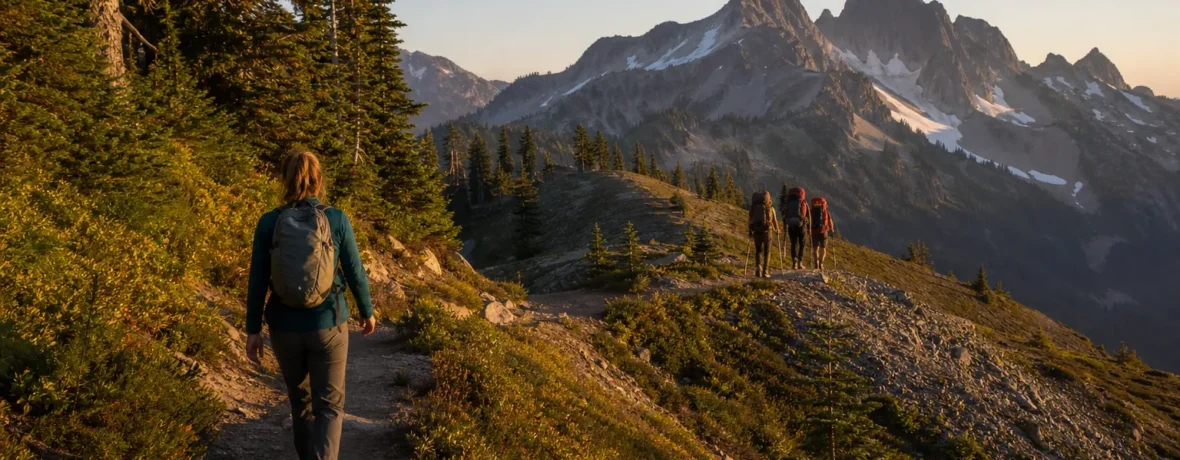
What is the difference between hiking and trekking? Hiking is usually a shorter walk on marked trails, often done in one day. Trekking is a longer, more demanding journey that often lasts multiple days, crosses rougher terrain, and requires heavier gear, route planning, food, shelter, and stronger backcountry skills.
What is the difference between hiking and trekking?
The short answer: hiking is usually simpler, shorter, and closer to trailheads; trekking is longer, tougher, and more self-supported.
Think of hiking as the broad category. A 2-mile [3.2 km] loop through a state park is a hike. So is a 12-mile [19.3 km] mountain day with 3,000 feet [914 m] of climbing. You start, walk, snack, sweat, maybe curse a steep section, then return to your car, cabin, campsite, or town the same day.
Trekking stretches the commitment. You may be out for 2 days, 5 days, or several weeks. You carry more. You think harder about water, weather, shelter, navigation, calories, and your exit plan. The route may include maintained trails, dirt roads, high passes, river crossings, snowfields, villages, or open country with faint paths.
The line can blur. A rugged 18-mile [29 km] day hike in the White Mountains can feel harder than a gentle 2-day trek between lodges. The real difference is not a single mileage number. It is the whole package: time, terrain, remoteness, gear, and how much you must solve on your own.
| Category | Hiking | Trekking |
|---|---|---|
| Typical duration | A few hours to one full day | Multiple days to weeks |
| Terrain | Usually marked trails | Trails, passes, remote routes, rough ground |
| Gear load | Day pack with essentials | Overnight pack, food, shelter, sleep system |
| Planning | Route, weather, water, daylight | Route stages, resupply, permits, camps, evacuation options |
Is trekking harder than hiking?
Yes, trekking is usually harder because you stay out longer and carry more weight.
A hike can be physically brutal. No argument there. A steep desert climb in heat or a high-elevation summit day can humble strong people fast. But trekking adds layers. You do not just walk one hard day. You wake up and do it again. Then again. Your feet swell. Your shoulders feel the pack. Small mistakes stack up.
That extra difficulty comes from four places:
- Load: A day hiker might carry water, layers, snacks, a map, a headlamp, and a first-aid kit. A trekker may add a tent, sleeping bag, pad, stove, fuel, meals, repair kit, and more clothing.
- Recovery: On a day hike, you can go home, shower, and sleep in a bed. On a trek, your recovery happens in camp, often on uneven ground, with colder nights and less comfort.
- Decision fatigue: Trekking forces you to keep making calls: where to refill water, when to stop, whether to push over a pass, how to adjust if weather turns.
- Exposure: A short hike may keep you near roads and help. A trek can put you many miles from the nearest quick exit.
So, is every trek harder than every hike? No. But if the terrain and elevation are similar, trekking asks more from your body and your planning brain.
How many miles is a hike compared with a trek?
A hike can be 1 to 20 miles [1.6 to 32.2 km] in a day, while a trek usually covers multiple daily stages.
Distance alone does not decide the label. A 5-mile [8 km] alpine route with loose rock, thin air, and 2,500 feet [762 m] of gain may be more serious than a 14-mile [22.5 km] rail trail. Still, mileage helps you picture the difference.
For many beginners, a comfortable day hike lands between 2 and 6 miles [3.2 and 9.7 km]. Intermediate hikers often enjoy 6 to 12 miles [9.7 to 19.3 km] when the trail is clear and daylight is generous. Strong day hikers may cover 15 miles [24.1 km] or more, especially with lighter packs.
A trek is better measured in stages. One day might be 7 miles [11.3 km]. The next could be 11 miles [17.7 km]. Then a short 4-mile [6.4 km] day over a pass or into a resupply point. Trekking is not about crushing one big number. It is about moving across a landscape over time.
What gear do you need for hiking vs trekking?
Hiking needs a well-packed day kit; trekking needs overnight systems that keep you fed, warm, dry, and oriented.
For hiking, do not let the small pack fool you. A short walk can still go sideways if the weather changes, the trail is icy, or you misjudge daylight. The National Park Service Hike Smart guidance recommends planning ahead and carrying the 10 essentials, even when the outing looks simple.
For a day hike, your checklist should include:
- Navigation: map, compass, GPS app, or dedicated GPS device
- Water and a way to treat more if needed
- Food plus an extra snack
- Rain shell or insulating layer, depending on the forecast
- Headlamp with charged batteries
- Sun protection: sunglasses, hat, sunscreen
- First-aid supplies and blister care
- Knife or multitool
- Fire starter where fires are legal and safe
- Emergency shelter, such as a space blanket or bivy
For trekking, add the gear that makes you self-sufficient overnight:
- Backpack sized for your route and load
- Tent, tarp, or other shelter
- Sleeping bag rated for expected lows
- Sleeping pad
- Stove, fuel, lighter, and cook kit if you are cooking
- Several days of food or a clear resupply plan
- Water filter, purifier, or chemical treatment
- Repair kit for shelter, pad, pack, and footwear
- Extra socks and layers
- Power bank or spare batteries
- Bear canister or food-hanging system where required
The trick is not to pack everything you own. The trick is to pack what the route demands. Desert trekking pushes water capacity. Alpine trekking pushes insulation, wind protection, and weather judgment. Wet forest routes push rain gear, dry bags, and foot care.
Do hiking and trekking require different fitness levels?
Yes, trekking usually requires more endurance, but both hiking and trekking reward steady training.
You do not need to be an elite athlete to hike. You need to match the trail to your current body. If you walk regularly, can climb stairs without feeling wrecked, and start with moderate terrain, you can build quickly.
Trekking asks for more durable fitness. That means your legs can climb, your lungs can work for hours, your feet can tolerate repeated days, and your shoulders can handle pack weight. It also means you can move at a calm pace instead of burning all your energy in the first hour.
Train for the thing you plan to do. Simple. If your trek includes long climbs, train on hills or stairs. If your pack will weigh 30 pounds [13.6 kg], do practice hikes with weight before the trip. If your route has rocky descents, build leg strength and balance so your knees are not taking every hit.
A practical build-up looks like this:
- Start with weekly walks. Walk 3 to 5 days per week on flat ground before adding harder trails.
- Add one longer hike. Make one outing each week longer than the others, but keep the pace easy.
- Train on similar terrain. Hills for hills. Sand for sand. Rocks for rocks. Your ankles learn by doing.
- Add pack weight slowly. Begin with a light day pack, then increase weight as your trip gets closer.
- Practice back-to-back days. For trekking, hike two days in a row so your feet, legs, and shoulders learn what repeat effort feels like.
- Test your shoes and socks. Do not save new footwear for the trail. That is how blisters get a vote.
How do you plan your first hike or trek?
Plan your first hike around simplicity; plan your first trek around backup options.
For your first hike, choose a marked trail with clear mileage, moderate elevation gain, easy parking, and a reliable weather window. Tell someone where you are going and when you expect to return. Check sunset time. Bring more water than you think you need. Turn around before you are exhausted, not after.
For your first trek, keep the ambition in check. Pick a route with obvious campsites, available water, and bail-out points. If possible, choose 2 or 3 days instead of a week. You want enough time to learn your systems without turning every mistake into a crisis.
Use this planning flow:
- Choose the route. Match distance, elevation, and terrain to your current fitness.
- Check land manager information. Look for trail conditions, seasonal closures, fire restrictions, camping rules, and permit requirements on official park, forest, or recreation pages.
- Read the map, not just the app. Find water, passes, road crossings, camps, junctions, and exit routes.
- Check weather close to departure. Mountain forecasts can change fast. Desert heat can punish bad timing.
- Build a gear list for that route. Do not copy a generic list without thinking about temperature, bugs, water, and remoteness.
- Share your plan. Leave route details, vehicle location, expected return time, and emergency contacts with someone reliable.
- Set turnaround rules. Decide before the trip what will make you stop or retreat: storms, injury, missed timing, low water, or navigation problems.
For U.S. public lands, official sources beat random comments. Start with the managing agency’s site, then confirm reservations or permits through official channels when they apply. The National Park Service camping trip planning page gives solid advice on trip plans, emergency communication, and preparing for changing conditions.
Which is better for beginners: hiking or trekking?
Hiking is better for most beginners because the commitment is lower and the learning curve is kinder.
Start with hiking. Learn how your feet feel after 5 miles [8 km]. Learn how fast you drink water. Learn which snacks you actually want when you are tired. Learn how your rain jacket performs, how your shoes grip, and how your body handles climbs.
Once day hikes feel normal, stretch the challenge. Try longer trails. Add elevation. Hike in different weather. Carry a slightly heavier pack. Practice using a map. Take a short overnight trip near a trailhead or established campground. That is the bridge from hiking into trekking.
Do not rush the label. Nobody hands out medals because you suffered under a giant pack before you knew how to adjust the hip belt. Strong trekkers are usually good hikers first. They know their pace, their feet, their hunger, and their limits.
What are the biggest risks in hiking vs trekking?
The biggest risks are getting lost, getting injured, running out of water, being caught by weather, and underestimating distance or elevation.
On hikes, the classic mistake is casual thinking. The trail is popular. The parking lot is full. The summit looks close. Then the temperature drops, the phone battery dies, or the descent takes twice as long as expected. A day hike still deserves a plan.
On treks, the risk shifts toward compound problems. A blister on day one changes your gait. That leads to knee pain on day two. Then you move slower, miss your planned camp, and reach water later than expected. Trekking punishes small neglect.
Watch these pressure points:
- Navigation: Carry a backup to your phone and know how to use it.
- Water: Identify reliable sources before you start, especially in dry country.
- Weather: Pack for the coldest, wettest realistic conditions, not the nicest hour of the day.
- Feet: Treat hot spots early. Waiting turns friction into trip-ending blisters.
- Food: Bring enough calories to keep moving and thinking clearly.
- Communication: Do not assume cell service. In remote areas, consider a satellite messenger or personal locator beacon.
Ticks deserve attention too, especially on brushy, grassy, or wooded routes. The CDC tick prevention guidance recommends reducing exposure, checking your body and gear, and using proven prevention steps before and after time outdoors.
When to see a doctor
Seek medical care right away for severe symptoms, worsening symptoms, or anything that affects breathing, alertness, balance, or chest comfort.
Hiking and trekking stress the body. Most sore legs and tired shoulders are normal. Some symptoms are not. Do not try to “tough it out” if you or someone in your group has confusion, fainting, severe shortness of breath, chest pain, coughing blood, inability to walk straight, signs of severe dehydration, or symptoms that rapidly get worse.
Altitude adds another layer. Acute mountain sickness can affect hikers, trekkers, skiers, and climbers at higher elevations, and severe forms can become life-threatening. The NIH MedlinePlus guide to acute mountain sickness says descending as rapidly and safely as possible is the main treatment for serious mountain sickness, and emergency help is needed for severe breathing problems, altered alertness, or coughing blood.
For high routes, gradual ascent is your friend. The Wilderness Medical Society altitude illness summary describes risk beginning with travel above 8,202 feet [2,500 m], though symptoms can occur lower depending on the person and ascent pattern. If you have heart, lung, neurologic, or blood conditions, talk with a clinician before committing to high-altitude trekking.
Heat and dehydration matter on lower trails too. Mayo Clinic notes that severe dehydration needs prompt medical treatment, and hikers should take symptoms like extreme weakness, confusion, or poor responsiveness seriously. Read their dehydration symptoms and causes guide before hot-weather trips.
How do you choose between hiking and trekking?
Choose hiking when you want a lower-commitment day outside; choose trekking when you want a longer journey and can manage the added risk.
Pick hiking if you are short on time, new to trails, testing gear, building fitness, or traveling with people who need an easy exit. Hiking gives you the reward without the full logistics puzzle. You can still find solitude, big views, hard climbs, and wild places.
Pick trekking if you want immersion. Trekking lets you move through a landscape instead of sampling one slice of it. You see morning light from camp, weather changes across valleys, and quiet miles beyond the day-hike crowd. That payoff is real. So is the responsibility.
Use this quick gut check:
- If you want to be home for dinner, hike.
- If you are ready to sleep outside or move between huts, trek.
- If your gear is untested, hike first.
- If the route has no easy exit, train and plan like the trip depends on it.
- If you are unsure, choose the shorter option. Trails are patient.
Related reading
- How to Use Trekking Poles Properly Uphill and Downhill
- Are Trekking Poles Worth It? What the Research Says
- How Long Is the Appalachian Trail? Miles, States and Time
- How to Plan a Camping Trip
FAQ
Is hiking the same as trekking?
No, hiking and trekking are not the same, though they overlap. Hiking usually means a shorter trip on established trails, while trekking usually means a longer, multi-day route with more gear and planning.
Can a day hike be harder than a trek?
Yes, a day hike can be harder than a trek if it has steep elevation gain, rough terrain, heat, snow, or high altitude. Difficulty depends on conditions, not just the name.
Do you need trekking poles for hiking or trekking?
No, you do not need trekking poles, but they can help with balance and reduce strain on long descents. They are more useful on treks because repeated days with a heavier pack put more stress on knees, ankles, and feet.
What should beginners do first, hiking or trekking?
Beginners should usually start with hiking. Build comfort with distance, layers, water, snacks, navigation, and footwear before adding overnight gear and multi-day planning.
Is backpacking the same as trekking?
Backpacking and trekking are very close. In the U.S., “backpacking” often means overnight hiking while carrying camping gear; “trekking” is more commonly used for long-distance or international multi-day routes.
How do I know if I am ready for a trek?
You are probably ready for a beginner trek if you can hike several hours with a loaded pack, manage your food and water, use basic navigation, and handle one night outside. Start with a short route that has clear water, campsites, and an easy exit.