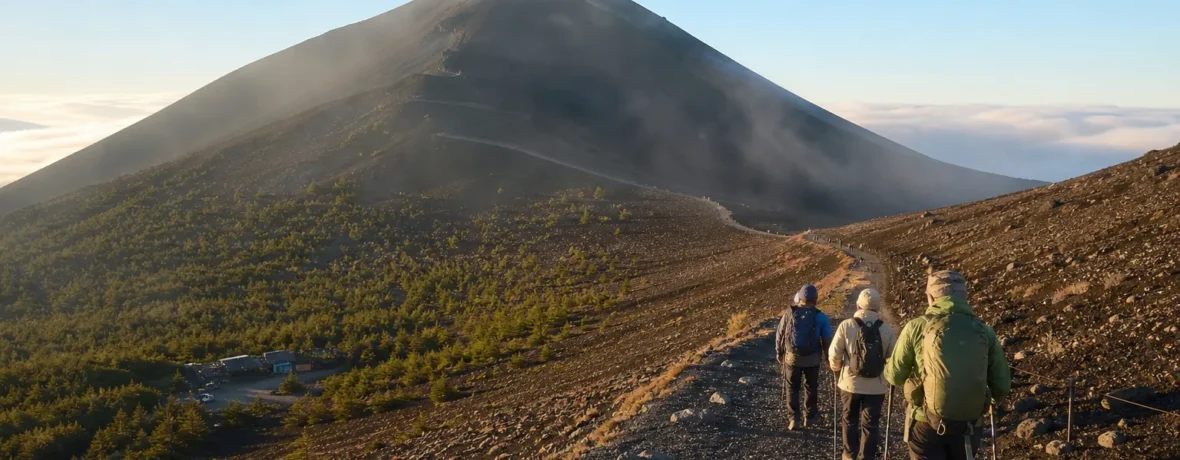
How long does it take to hike Mt Fuji? Most hikers need 8 to 12 hours of moving time for a round trip from a 5th Station trailhead to the 12,388-foot [3,776-meter] summit and back. Add hut time, sunrise waits, breaks, crowds, and altitude, and the trip often becomes a 2-day climb.
How long does it take to hike Mt Fuji by trail?
The shortest standard route takes under 8 hours of official hiking time, while the longest takes over 12 hours.
Mt Fuji has four main summer climbing routes: Yoshida, Fujinomiya, Subashiri, and Gotemba. The official Mt Fuji climbing site lists trail distances and estimated hiking times, not including breaks, hut stops, sunrise waits, or the slow shuffle that happens near the summit before dawn. Check the official Mt Fuji route comparison before you pick your trail.
| Trail | Official ascent time | Official descent time | Good choice if you want |
|---|---|---|---|
| Yoshida | 6 hr 10 min over 4.2 mi [6.8 km] | 3 hr 35 min over 4.3 mi [7.0 km] | Most huts, easiest logistics, biggest crowds |
| Fujinomiya | 5 hr 10 min over 2.7 mi [4.3 km] | 2 hr 40 min over 2.7 mi [4.3 km] | Shortest route, steep climbing |
| Subashiri | 6 hr 25 min over 4.3 mi [6.9 km] | 3 hr 20 min over 3.9 mi [6.2 km] | Forest lower down, quieter start |
| Gotemba | 8 hr 40 min over 6.5 mi [10.5 km] | 3 hr 30 min over 5.2 mi [8.4 km] | Harder, longer, less crowded hiking |
Those times are useful, but don’t treat them like a race clock. Fuji sits high enough for altitude to slow you down, especially if you came from Tokyo, Kyoto, or sea level the same day. Add 1 to 3 hours for food, bathrooms, layering up, photos, and crowd delays.
How long to hike Mt Fuji if you want to see sunrise?
Plan on 2 days if you want the sunrise without turning the hike into a miserable overnight grind.
The classic Fuji plan is simple: climb partway on day one, sleep or rest in a mountain hut, then start before dawn for the summit. That gives your body more time at altitude and keeps you from hiking all night without real rest.
- Arrive at your 5th Station trailhead in the late morning or early afternoon.
- Spend 60 to 90 minutes eating, hydrating, and letting your body adjust.
- Climb 3 to 5 hours to a reserved mountain hut, depending on trail and hut location.
- Rest for several hours. Sleep may be short. Take it anyway.
- Start again in the early morning darkness and climb 2 to 4 hours to the summit.
- Watch sunrise if the weather plays nice, then descend for 3 to 5 hours.
Here’s the catch: the summit approach can crawl near sunrise. You may be fit, your boots may feel great, and then the line barely moves. Build in slack. Fuji rewards patience more than speed.
Can you hike Mt Fuji in one day?
Yes, you can hike Mt Fuji in one day if you are fit, acclimatized, start early, and choose a realistic trail.
A one-day climb works best on Yoshida or Fujinomiya, where the trailhead starts high and services are stronger during the climbing season. Fujinomiya is shorter, but it is steeper and uses the same route up and down, so traffic can pinch in narrow spots. Yoshida is longer, but it has more huts and a dedicated descent route.
The hard part is not just the mileage. It is the altitude, the volcanic footing, the weather swing, and the descent. Many hikers underestimate the way loose gravel hammers their quads and knees on the way down. Going up feels like the achievement. Getting down safely is the job.
How much time should you add for altitude on Mt Fuji?
Add at least 1 extra hour if you are not used to hiking above 8,000 feet [2,438 meters].
The Yoshida 5th Station starts at 7,562 feet [2,305 meters], and the summit tops out at 12,388 feet [3,776 meters]. That is a fast jump. The CDC says travelers above 8,000 feet [2,438 meters] can be at risk for altitude illness, and people with symptoms should not keep ascending until symptoms improve; worsening symptoms call for descent. Read the CDC guidance on travel to high altitudes before you go.
Pacing matters. A steady, almost boring rhythm beats a hard push followed by long stops. If you are breathing hard while walking slowly, slow down more. Short steps. No ego.
What is the best Mt Fuji trail for your schedule?
Yoshida is the easiest trail to plan, Fujinomiya is the fastest on paper, Subashiri gives you variety, and Gotemba demands the most time.
Pick your route by time, fitness, transport, and tolerance for crowds. The right route is the one you can finish safely, not the one that looks shortest on a table.
- Choose Yoshida if this is your first Fuji climb and you want the most hut and transport options.
- Choose Fujinomiya if you want the shortest distance and can handle steep, rocky terrain.
- Choose Subashiri if you want a quieter lower trail with a forested start and sandy descent.
- Choose Gotemba only if you have strong fitness, extra time, and comfort with a long ascent.
When is Mt Fuji open for hiking?
Mt Fuji is normally a summer-only climb from early July to September 10, depending on the trail and conditions.
As of November 2026, the official 2026 season had ended, and the next season’s details had not yet been posted. In 2026, Yoshida and Subashiri opened July 1 to September 10, while Fujinomiya and Gotemba opened July 10 to September 10, according to the official Mt Fuji off-season notice.
Outside the official season, summit trails are closed. Huts, toilets, first-aid stations, and normal trail maintenance shut down, and the mountain can carry snow, ice, severe wind, and avalanche danger. This is not a casual shoulder-season hike.
Do permits, fees, and gate hours affect your hiking time?
Yes, rules can change your start time, route choice, and whether you are allowed through the gate.
As of November 2026, the last confirmed 2026 rules required a 4,000-yen hiking fee per person on the Yoshida Trail, with a gate closure from 2 PM to 3 AM except for mountain hut guests, and a daily cap of 4,000 climbers. The Yamanashi Yoshida Trail notice also said reservations could close once the daily limit was reached.
On the Shizuoka side, as of November 2026, the last confirmed 2026 rules for Fujinomiya, Gotemba, and Subashiri required e-learning, advance registration through the FUJI NAVI system, and a 4,000-yen hiking fee. The Shizuoka climbing notice said hikers entering between 2 PM and 3 AM needed a mountain hut stay.
Translation: don’t plan a late casual start. Reserve what needs reserving, read the current official page, and build your climb around the gate hours.
What should you pack to keep your Mt Fuji pace steady?
Pack for cold, wind, darkness, rain, dust, and slow moving at altitude.
Fuji can feel like summer at the trailhead and winter near the summit before sunrise. The official site says summit temperatures can drop near 32°F [0°C] even in summer, and wind chill can make it feel colder. Bring real layers, not wishful thinking.
- Broken-in hiking boots or sturdy trail shoes with grip
- Warm jacket, fleece or midlayer, hat, and gloves
- Waterproof rain jacket and rain pants
- Headlamp with fresh batteries
- Water and snacks you will actually eat
- Cash for toilets, food, and hut purchases
- Sunglasses, buff or mask, and gaiters for dusty descents
- Map, offline route, and charged phone
When to see a doctor
See a doctor before climbing Mt Fuji if you have heart disease, lung disease, diabetes, sleep apnea, pregnancy, or a history of altitude illness.
During the climb, stop ascending if you develop headache with nausea, dizziness, unusual fatigue, or vomiting. Descend and seek urgent medical help if symptoms worsen, if you become confused, lose coordination, feel short of breath at rest, feel very weak, or develop a persistent cough. For medical background, use the CDC Yellow Book section on high-altitude travel and altitude illness.
Related reading
- Can You Hike Mount Fuji? Season, Trails and Rules
- How Long Does It Take to Hike the Appalachian Trail?
- How Long Does It Take to Climb Mount Everest?
- Camping Food Without a Fridge: No-Cook Ideas
FAQ
How long does the Yoshida Trail take?
The official hiking estimate is 6 hours 10 minutes up and 3 hours 35 minutes down. Add breaks, crowds, hut time, and sunrise waiting, and many hikers spread Yoshida over 2 days.
What is the fastest Mt Fuji route?
Fujinomiya is the fastest standard route on official estimates: 5 hours 10 minutes up and 2 hours 40 minutes down. It is also steep and rocky, so “fastest” does not mean easiest.
Is Mt Fuji a hard hike?
Yes, Mt Fuji is hard because of altitude, loose volcanic rock, cold wind, and a long descent. It is not a technical climb in the summer season, but you still need fitness, pacing, and proper gear.
Can beginners hike Mt Fuji?
Yes, prepared beginners can hike Mt Fuji during the official season. Choose Yoshida, book a hut, avoid an all-night bullet climb, and train with uphill hikes before your trip.
How early should you start hiking Mt Fuji?
For a day hike, start in the morning so you have enough daylight and transport flexibility. For a sunrise climb, start the previous day, sleep or rest in a hut, and make your final summit push before dawn.