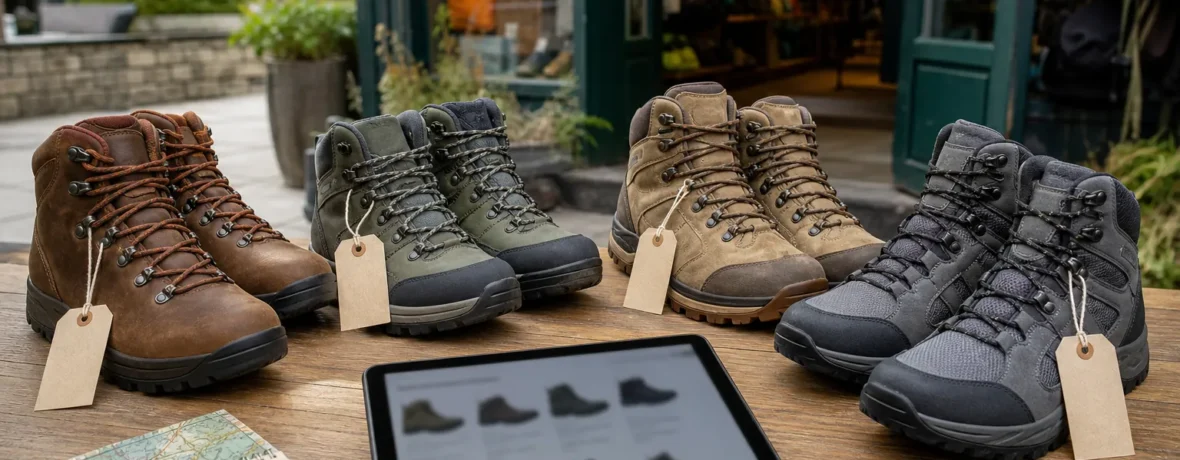
Where to buy hiking boots depends on your feet and your deadline: choose a local outdoor store if this is your first pair, your feet are hard to fit, or you need boots within 7 days. Buy online if you know your size in a specific brand and can order 2-3 pairs to compare at home.
Bad boots can turn a mellow 4-mile [6.4 km] loop into a hobble-fest. Good boots disappear under you. The trick is not finding the “best” boot on the internet. The trick is finding the boot that fits your foot, your trails, and your pack weight.
That changes where you should shop. Sometimes the right answer is a real boot wall, a sloped test ramp, and a patient staffer who knows lacing tricks. Sometimes it is your couch, a tape measure, and a return label.
Where to buy hiking boots: should you shop in store or online?
Shop in store for fit help; shop online for selection and repeat buys.
If you are new to hiking footwear, start at a specialty outdoor retailer or a local running/outdoor shop. You get the biggest advantage boots can offer before you pay: comparison. You can try different lasts, widths, ankle heights, and volumes back to back. That matters because a boot that is perfect for a narrow heel can feel like a brick on a wide forefoot.
Online shopping wins when you already know the brand, model family, and size range that works. It also helps if nearby stores carry only a thin selection. Some excellent hiking boots never make it to your local shelf, especially wide sizes, narrow sizes, approach-style shoes, and lighter fast-hiking models.
| Buying option | Best for | Main drawback | Smart move |
|---|---|---|---|
| Local outdoor store | First pair, fit problems, quick trips | Limited inventory | Try boots with your hiking socks and loaded pack if allowed |
| Brand website | Specific models, size charts, full color range | Harder to compare brands | Check width options and return rules before checkout |
| Large online retailer | Price checks, multiple sizes, fast shipping | Counterfeit and third-party seller risk | Buy from the brand or an authorized seller |
| Used gear shop | Budget buys, backup pairs | Unknown wear pattern | Inspect soles, midsoles, waterproof liners, and heel counters |
Is it better to buy hiking boots in a store?
Yes, if fit is uncertain.
A store gives you instant feedback. You can lace the boot, walk, climb a ramp, descend a ramp, and feel what your toes and heels do under pressure. That downhill test is gold. A boot can feel fine on flat carpet, then slam your toes the moment the trail points down.
Staff help can also save you from overbuying. Many hikers walk in asking for heavy leather boots when they really need a supportive hiking shoe. Others buy soft shoes for backpacking trips where a stiffer platform would feel better under a load. A good fitter asks where you hike, how much weight you carry, and what has gone wrong with past shoes.
Look for stores that have:
- A real hiking footwear section, not just one casual boot display.
- Half sizes and width options.
- A ramp, rock plate, or uneven test surface.
- Staff who ask questions before handing you boots.
- A clear return policy for unworn or lightly tested footwear.
Bring your own socks. If you use aftermarket insoles or orthotics, bring those too. A boot fitted with thin store socks can feel totally different on trail with thicker wool socks.
Is it safe to buy hiking boots online?
Yes, if the return policy is clear and the seller is legitimate.
Online buying is not reckless. Random buying is reckless. Before you click, read the shipping, return, and refund policy in plain English. The FTC’s online shopping guidance recommends checking the seller, product details, delivery terms, and refund rules before buying. That advice matters even more with footwear because one brand’s size 10 can feel nothing like another brand’s size 10.
The cleanest online strategy is to order the same boot in two sizes or two widths, test them indoors, and return the loser in new condition. Do not wear them outside unless the seller’s policy clearly allows trail testing. Dirt in the lugs can turn an easy return into an expensive closet mistake.
Use this online checklist before checkout:
- Confirm the seller is the brand itself or an authorized retailer.
- Read who pays return shipping.
- Check whether sale items are final sale.
- Make sure you can return footwear after indoor try-on.
- Save the box until you are fully committed.
- Take photos if the boots arrive damaged or clearly worn.
Where to buy hiking shoes if you do not want full boots?
Buy hiking shoes from the same places you would buy boots, but be pickier about underfoot feel.
Hiking shoes make sense for day hikes, warm weather, maintained trails, and hikers who prefer a lighter stride. They usually give up ankle coverage and some long-term support, but many people move better in them. If your trails are dry and your pack is light, shoes may be the smarter choice.
The phrase “hiking shoe” covers several animals: low-cut leather hikers, mesh trail shoes, approach shoes with sticky rubber, and trail runners that can handle dirt. Try them with the same seriousness you would give boots. Flex the forefoot. Check heel hold. Walk down a ramp. If your toes hit the front in the store, they will not magically behave after mile 6 [9.7 km].
For a helpful overview of footwear categories and fit factors, REI’s guide to choosing hiking boots and shoes breaks down boots, hiking shoes, and trail runners by use case.
How should hiking boots fit before you buy them?
They should feel snug, stable, and roomy in the toes from the first try-on.
Do not buy pain. Do not buy numbness. Do not buy the myth that a boot will stretch into a new shape after punishment. Leather can soften. Foam can settle. But a short, narrow, heel-slipping boot is still the wrong boot.
The American Academy of Orthopaedic Surgeons recommends leaving 1/2 inch [1.3 cm] between your longest toe and the front of the shoe. That is a useful starting point for hiking footwear, especially because feet swell during long walks and slide forward on descents.
Use this fit sequence:
- Shop late in the day. Feet often feel larger after hours of standing and walking.
- Wear your trail socks. Sock thickness changes boot volume fast.
- Remove the factory insole. Stand on it. Your toes should not spill over the sides or end.
- Lace from the toes up. Set the heel back in the pocket before tightening.
- Walk uphill. Your heel should lift only slightly, not swim.
- Walk downhill. Your toes should not bang the front.
- Check pressure points. Hot spots at the bunion, arch, ankle bone, or top of foot are warnings.
- Test both feet. Fit the larger foot, then tune the smaller foot with lacing or an insole if needed.
A little heel movement is normal in stiff boots before break-in. Repeated rubbing is not. Toe wiggle is good. Toe sliding is not. A secure midfoot is good. Crushed arches are not.
What stores should you check first for hiking boots?
Start with specialty outdoor stores, then brand stores, then general sporting goods stores.
A specialty outdoor shop gives you the highest chance of real fit help. Local independent shops can be excellent because they know the nearby trails: granite slabs, muddy roots, desert sand, snowmelt crossings, or steep Appalachian descents. That local knowledge beats a generic star rating.
Brand stores are useful when you already like a brand’s foot shape. If one model from that brand has worked for you, another model may feel familiar. Not always, but often enough to be useful.
General sporting goods stores can work if your feet are easy to fit and your hikes are moderate. The tradeoff is depth. You may see popular models, but fewer widths, fewer technical backpacking boots, and less staff specialization.
Used gear stores are a separate category. They can be great for camp shoes or lightly worn backup footwear. Be cautious with used hiking boots for serious trips. Midsoles compress, heel cups mold to the original owner, and waterproof membranes can fail before the outside looks destroyed.
How do you buy hiking boots online without wasting time?
Measure first, order narrowly, and test indoors like you mean it.
Online boot shopping gets messy when you order whatever looks rugged. Instead, build a short list. Choose 2-3 models that match your terrain and foot shape. Then order strategically.
- Measure both feet. Use a wall, paper, pencil, and ruler. Measure length and width while standing.
- Check the brand size chart. Do not rely only on your sneaker size.
- Read fit comments, not just ratings. Look for repeated notes like narrow heel, wide toe box, low volume, stiff cuff, or runs long.
- Order comparison sizes. If returns allow it, try your likely size plus the nearest half size or width.
- Test on clean floors. Stairs, carpet, and a homemade ramp can reveal toe bang and heel lift.
- Keep the winner on indoors for an extended session. Watch for numb toes, arch pressure, ankle bite, or heat spots.
- Return quickly. Do not let boxes sit past the return window.
Match the boot to the trip, too. A stiff backpacking boot can feel clumsy on a 3-mile [4.8 km] park loop. A soft mesh shoe can feel underbuilt under a heavy overnight pack. Terrain, distance, load, weather, and your ankles all get a vote.
What should you avoid when buying hiking boots?
Avoid buying for looks, brand loyalty, or one glowing review.
Boots are not trophies. They are tools. A burly boot that does not fit is worse than a plain boot that does. Ignore the color until the fit is right.
Watch for these mistakes:
- Buying too small. Downhill toe bang can wreck a hike fast.
- Buying too big to gain width. Choose a wider model instead when possible.
- Assuming waterproof is always better. Waterproof boots can run warmer and dry slower once wet inside.
- Skipping break-in. Stiffer boots need neighborhood walks before trail days.
- Testing only one boot. Your left and right feet may not match.
- Ignoring socks. Cotton socks, bulky seams, or the wrong thickness can change the fit.
- Trusting outsole looks only. Grip depends on rubber compound, lug shape, stiffness, and surface.
If you are between a boot and a shoe, think in tradeoffs. Boots offer more ankle coverage, better debris protection, and often more support under load. Shoes feel lighter, breathe better, and usually flex more naturally. Neither wins every trail.
When to see a doctor
See a healthcare professional if foot pain is severe, persistent, or tied to injury.
Gear can cause discomfort, but it cannot diagnose the cause. If you cannot put weight on your foot, have severe swelling, signs of infection, numbness, tingling, or pain that does not improve, follow medical guidance instead of trying to fix it with new boots. Mayo Clinic’s foot and ankle pain guidance lists red flags for getting care.
For blisters, stop blaming yourself and check the system: fit, socks, moisture, lacing, and mileage. If a blister shows spreading redness, warmth, pus, or increasing pain, Mayo Clinic’s blister first aid advice says to seek medical care.
So, should you buy hiking boots at a store or online?
Choose the store when fit risk is high. Choose online when model certainty is high.
Here is the clean decision:
- Go to a store if this is your first hiking boot, your feet are wide or narrow, you use orthotics, you have bunions, you blister easily, or you are preparing for a demanding trip.
- Buy online if you are replacing a known model, need a hard-to-find size, want to compare multiple pairs at home, or live far from a serious outdoor shop.
- Use both if you want the best odds: get measured and learn your fit in store, then use online inventory to find the exact width, color, or version you need.
The right boot should make you want to walk. Not pose in the mirror. Not “push through” pain. Walk. If a boot gives you secure heels, free toes, steady edging, and no hot spots during indoor testing, you are close. If it fights you before the trailhead, leave it on the shelf or send it back.
Related reading
- Where to Buy Bear Spray and How Much It Costs
- Where to Buy a National Park Pass
- How to Clean Hiking Boots Without Ruining Leather or Membranes
- Hiking Shoes vs Hiking Boots: Which Should You Buy?
FAQ
Where is the best place to buy hiking boots for beginners?
The best place is a specialty outdoor store with trained footwear staff. Beginners benefit from trying several brands, learning their width and volume, and testing boots on an incline before buying.
Should I buy hiking boots a size bigger?
Sometimes, but not automatically. You need enough room for toe movement and downhill swelling, yet the heel and midfoot still need to stay secure.
Can I buy hiking boots online and return them if they do not fit?
Yes, if the retailer’s policy allows it. Read the return rules before buying, test the boots indoors only, and keep the original box until you are sure.
Are hiking shoes better than hiking boots?
Hiking shoes are better for some hikers and trails. They are usually lighter and more flexible, while boots usually give more ankle coverage, support, and protection under heavier loads.
How long should I test hiking boots before keeping them?
Test them indoors for at least one extended wear session plus stairs or an incline. If you feel toe bang, numbness, sharp pressure, or heel rubbing indoors, the problem will usually get worse outside.
What is the biggest mistake when buying hiking boots?
The biggest mistake is buying a boot that almost fits. Small pressure points, tight toes, or sloppy heels rarely improve enough to save a long hike.