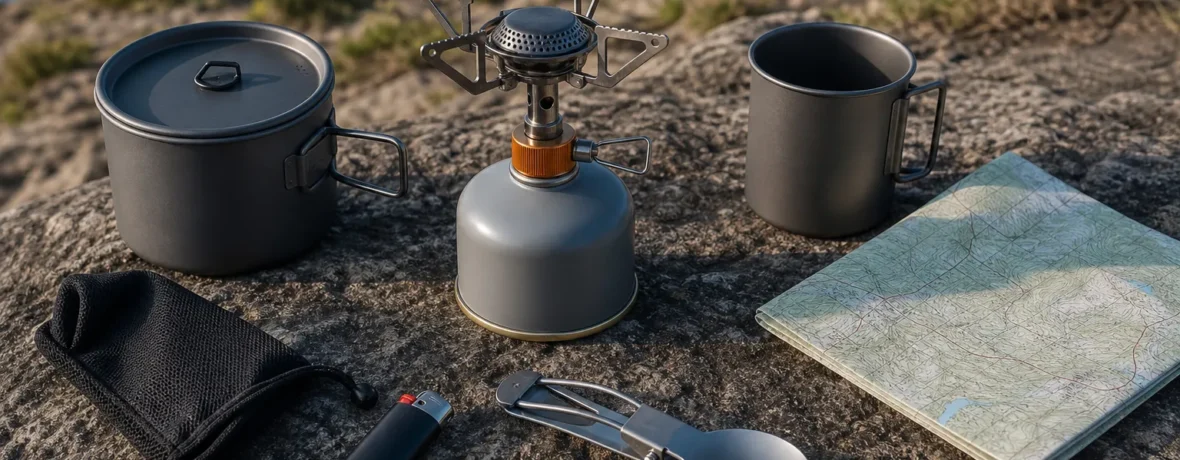
What is the best camping stove? For most hikers and weekend campers, the SOTO WindMaster with 4Flex is the best pick: 3.0 oz [87 g], 11,000 BTU, strong wind resistance, and real simmer control. Choose a two-burner propane stove instead if you cook for three or more at a car camp.
We may earn a commission when you buy through links on this page.
Quick Picks
| Category | Model | Weight | Key feature |
|---|---|---|---|
| Best overall | SOTO WindMaster with 4Flex | 3.0 oz [87 g] | Wind-resistant regulated canister burner |
| Best budget backpacking stove | MSR PocketRocket 2 | 2.6 oz [73 g] | Simple, compact, proven design |
| Best fast-boil system | Jetboil Flash 1.0L | 13.1 oz [371 g] | Integrated 1 L pot and heat exchanger |
| Best for wind | MSR WindBurner Personal | 15.3 oz [433 g] | Enclosed radiant burner system |
| Best ultralight stove | Snow Peak LiteMax Titanium | 1.9 oz [56 g] | Titanium build with 11,200 BTU output |
| Best for car camping | Camp Chef Everest 2X | 12 lb [5.4 kg] | Two 20,000 BTU burners |
| Best budget two-burner | Coleman Cascade Classic | 11 lb 14.4 oz [5.4 kg] | Two-burner propane setup |
| Best compact two-burner | Primus Kinjia | 8.2 lb [3.7 kg] | Slim dual-burner design |
How we chose
We chose these stoves from current specs, materials, verified owner feedback, and expert reviews. No hands-on testing is claimed here.
The goal was simple: recommend stoves you can still buy, that fit real camp cooking, and that do not require you to baby them every time the wind moves. Backpackers need low weight, good pot support, fuel availability, and dependable flame control. Car campers need burner space, stable grates, enough output for larger pans, and controls that can do more than “blast.”
We weighted the list toward hikers, because ihikefar readers tend to care about pack weight. Still, not every trip is a long walk. A 2 oz [57 g] burner is a poor tool for pancakes and bacon for four people. A 12 lb [5.4 kg] two-burner stove is dead weight on a trail. So this guide separates what each stove does best.
What is the best camping stove for most hikers?
The SOTO WindMaster with 4Flex is the best camping stove for most hikers because it balances weight, wind performance, pot support, and simmer control better than a basic ultralight burner.
It weighs 3.0 oz [87 g] with the 4Flex pot support, uses common threaded isobutane-propane canisters, and has an 11,000 BTU output. SOTO’s official spec says the WindMaster can boil 2 cups of water in under 2.5 minutes in strong winds and gusty weather, which is exactly the type of claim that matters when you are tired, cold, and trying to get dinner done before your hands stiffen up. See the SOTO WindMaster specs for the full manufacturer listing.
The short version: if you want one compact stove for solo hiking, two-person backpacking, and basic camp cooking, start there.
SOTO WindMaster with 4Flex – Best for most hikers
This suits backpackers who want low weight without giving up wind performance or a usable flame.
- Weight: 3.0 oz [87 g] with 4Flex pot support
- Fuel: Threaded isobutane-propane canister
- Output: 11,000 BTU
- Best use: Solo and two-person backpacking
- Price tier: Mid-range
Pros:
- Excellent balance of weight and stability
- Regulated burner helps keep output steadier as canister pressure drops
- 4Flex support handles wider pots better than tiny three-prong burners
- Built-in igniter is protected inside the burner post
Cons:
- Costs more than a basic screw-on stove
- Still needs careful shielding in hard wind
- Not ideal for big pots or large group cooking
- 100% propane is not compatible
Skip it if… you mostly camp beside your vehicle and want to cook with two full-size pans.
MSR PocketRocket 2 – Best for budget backpacking
This suits hikers who want a small, light, reliable stove with fewer parts and a lower price tier.
- Weight: 2.6 oz [73 g]
- Fuel: Threaded isobutane-propane canister
- Boil time: 1 L in 3.5 minutes under MSR test conditions
- Best use: Simple backpacking meals and hot drinks
- Price tier: Budget
The PocketRocket 2 is the classic answer when someone asks for a no-nonsense trail stove. It folds small, weighs next to nothing, and boils quickly for its size. MSR lists the stove at 2.6 oz [73 g] with a 3.5-minute 1 L boil time on MSR IsoPro fuel; the official details are on the MSR PocketRocket 2 product page.
Pros:
- Very light and compact
- Strong value for backpackers
- Good flame control for a tiny burner
- Hard-shell case included
Cons:
- No built-in igniter
- Less wind-resistant than integrated systems
- Tall canister setup needs level ground
- Small burner head creates hot spots on thin pots
Skip it if… you regularly cook exposed above treeline or want push-button ignition.
Jetboil Flash 1.0L – Best for fast water boiling
This suits hikers who mostly boil water for coffee, oatmeal, and freeze-dried meals.
- Weight: 13.1 oz [371 g], excluding fuel stabilizer
- Fuel: JetPower isobutane-propane canister
- Volume: 1 L
- Boil time: 120 seconds per 0.5 L under Jetboil test conditions
- Price tier: Premium
The Flash is built around one job: boil water fast. The burner and pot lock together, the FluxRing heat exchanger captures heat that would otherwise blow away, and the insulating cozy makes it easy to handle. Jetboil lists the current Flash 1.0L at 13.088 oz [371 g], with a 120-second 0.5 L boil time and a 1 L tall pot on the Jetboil Flash 1.0L spec page.
Pros:
- Fast and fuel-efficient for boiling water
- Integrated pot is easy to pack and set up
- Heat indicator helps prevent wasted fuel
- Good pick for freeze-dried meal users
Cons:
- Heavier than a simple burner and titanium pot
- Poor choice for actual pan cooking without accessories
- Tall shape can feel tippy on uneven ground
- Limited simmer control compared with open burners
Skip it if… you want to sauté, fry, or cook rice from scratch on trail.
MSR WindBurner Personal – Best for wind
This suits hikers who camp in exposed, breezy places and want a more protected all-in-one system.
- Weight: 15.3 oz [433 g] minimum
- Fuel: MSR IsoPro or compatible threaded canister
- Volume: 1 L
- Boil time: 1 L in 4.5 minutes under MSR test conditions
- Price tier: Premium
The WindBurner is heavier than the Jetboil Flash and much heavier than a tiny burner. That extra weight buys you a more enclosed, wind-resistant system. The radiant burner and heat-exchanger pot work together, so you should treat it as a stove system rather than a burner you mix with random cookware.
Pros:
- Strong wind performance
- Integrated 1 L pot keeps the kit tidy
- Pressure regulator helps with consistency
- Good for solo hot drinks and boil-only meals
Cons:
- Heavy for minimalist backpacking
- Uses dedicated WindBurner pots only
- Not built for broad skillet cooking
- Premium price tier
Skip it if… you want one burner that works with any pot in your gear bin.
Snow Peak LiteMax Titanium – Best for ultralight kits
This suits hikers trimming every ounce who still want a real canister stove, not an alcohol or tablet setup.
- Weight: 1.9 oz [56 g]
- Fuel: Iso-butane canister
- Output: 11,200 BTU
- Best use: Minimalist solo backpacking
- Price tier: Mid-range
The LiteMax is tiny. Almost absurdly tiny. It uses titanium, stainless steel, aluminum alloy, and brass to keep weight low while still giving you folding pot supports. Pair it with a 700 ml titanium mug and you have a sharp little coffee-and-noodle setup.
Pros:
- One of the lightest practical canister stoves
- High output for its weight
- Folds down very small
- Simple design with few things to snag
Cons:
- No built-in igniter
- Small pot support footprint
- Not the best choice for wide cookware
- Wind affects performance more than shielded systems
Skip it if… you value pot stability more than saving 1 oz [28 g].
Camp Chef Everest 2X – Best for car camping meals
This suits car campers who cook real meals with full-size pans and need big burner output.
- Weight: 12 lb [5.4 kg]
- Fuel: Propane
- Output: 40,000 BTU total
- Cooking area: 215 sq in [1,387 sq cm]
- Price tier: Premium
The Everest 2X is not for hiking. Good. It is not pretending. It belongs on a picnic table, tailgate, or camp kitchen where output and cooking space matter more than packed weight. Two 20,000 BTU burners give it enough muscle for big pots, cast iron, and breakfast for a small crew.
Pros:
- Very strong burner output
- Two burners for real meal prep
- Good windscreen coverage for a table stove
- Appliance-style controls are easy to use
Cons:
- Too heavy for any walk-in campsite with distance
- Bulky compared with slimmer two-burners
- High output can burn through small propane bottles quickly
- More stove than casual solo campers need
Skip it if… your camp cooking is mostly coffee, oatmeal, and one-pot dinners.
Coleman Cascade Classic – Best budget two-burner
This suits car campers who want a familiar two-burner propane stove without moving into premium territory.
- Weight: 11 lb 14.4 oz [5.4 kg]
- Fuel: Propane
- Output: 10,000 BTU per burner
- Dimensions: 21 x 13 x 3.6 in [53 x 33 x 9 cm]
- Price tier: Budget to mid-range
The Cascade Classic is the modern version of the basic propane camp stove many campers picture first. Two burners. Folding lid. Side windscreens. Room for a 12 in [30 cm] pan and a smaller pot if you choose cookware carefully.
Pros:
- Simple two-burner layout
- Good value for campground cooking
- Auto ignition
- Compact enough for most car trunks
Cons:
- Lower output than the Camp Chef Everest 2X
- Not built for backpacking or long carries
- Pan spacing can feel tight with two large skillets
- Wind protection is basic
Skip it if… you often cook for large groups or use oversized cookware.
Primus Kinjia – Best compact two-burner
This suits campers, van travelers, and paddlers who want two burners in a slimmer, better-looking package.
- Weight: 8.2 lb [3.7 kg]
- Fuel: Gas canister or compatible gas bottle setup
- Output: 2 x 3,000 W
- Boil time: 4:20 with a regular pot under Primus test conditions
- Price tier: Premium
The Kinjia trades raw output for slim storage, clean design, and a lighter two-burner body. It is a nice fit for people who camp out of a small vehicle, boat, or organized camp box. It has two burners and precise flame control, but it is not a high-output beast like the Everest 2X.
Pros:
- Slim and easy to store
- Lighter than many full-size two-burner stoves
- Good flame control
- Removable pot supports and drip tray help cleanup
Cons:
- No built-in igniter
- Premium price tier
- Lower output than heavy-duty propane stoves
- Fuel setup may require more planning than 1 lb propane bottles
Skip it if… you want maximum heat for cast iron, big pots, or windy group breakfasts.
What type of camping stove should you buy?
Buy the stove that matches how far you carry it and how you cook.
| Stove type | Best for | Main tradeoff |
|---|---|---|
| Canister burner | Backpacking, solo trips, simple meals | Less stable with large pots |
| Integrated canister system | Fast water boiling and freeze-dried meals | Limited cooking flexibility |
| Two-burner propane stove | Car camping, families, base camps | Heavy and bulky |
| Liquid-fuel stove | Cold weather and international fuel access | More maintenance and setup |
If you are backpacking, choose a canister burner or integrated system. If you are camping from a vehicle, choose a two-burner propane stove. If you are winter camping below freezing, a liquid-fuel stove or a regulated remote-canister system starts to make more sense, but that is a more specialized purchase.
How much stove weight is reasonable for backpacking?
A good backpacking stove setup usually weighs 2 oz to 16 oz [57 g to 454 g] before fuel, depending on whether you use a tiny burner or an integrated system.
For solo trips, a 2 oz to 3 oz [57 g to 85 g] burner plus a titanium pot is hard to beat. For comfort and fuel efficiency, a 13 oz to 16 oz [369 g to 454 g] integrated system can still make sense, especially if you only boil water. The real weight comparison must include the pot, lid, lighter, canister stand, windscreen if safe to use, and fuel.
- Fast and light: Snow Peak LiteMax or MSR PocketRocket 2
- Balanced: SOTO WindMaster with 4Flex
- Boil-only comfort: Jetboil Flash 1.0L or MSR WindBurner
- Car camping: Ignore ounces and focus on burner space, stability, and output
Is BTU the most useful camping stove spec?
No. BTU matters, but burner design, wind resistance, pot shape, fuel pressure, and flame control matter just as much.
A big BTU number looks great on a hang tag. It does not guarantee better meals. A narrow, screaming flame can scorch the middle of a thin pot while leaving the edges cold. A lower-output integrated system can boil water efficiently because the pot and burner are designed together. A two-burner propane stove with wide burners gives you better pan coverage for eggs, pancakes, and real cooking.
Use BTU this way: compare similar stoves. A 40,000 BTU two-burner car-camping stove has more raw power than a 20,000 BTU two-burner. But do not compare that number directly with a 3 oz [87 g] backpacking stove and assume it tells the whole story.
What fuel is best for a camping stove?
Isobutane-propane canisters are best for most hikers; propane is best for most car campers.
Threaded isobutane-propane canisters are compact, clean, and widely used in backpacking stoves. They are easy to attach and require no priming. Their weakness is cold-weather performance, especially as the canister empties.
Propane bottles are heavier and bulkier, but they make sense for campground stoves. They run two-burner setups well and are easy to find near camping areas. White gas and other liquid fuels still have a place in deep winter and remote travel, but they need more maintenance and skill.
If you fly to a trailhead, plan to buy fuel after landing. The FAA PackSafe guidance says camp stove fuels, including compressed fuel canisters, liquid fuels, and solid fuel tabs, are forbidden in carry-on and checked baggage as of November 2026; check the current FAA PackSafe fuels page before you pack.
How do you choose a camping stove step by step?
Start with your cooking style, then match the stove to the trip.
- Decide how far you will carry it. If the answer is miles, ignore two-burner propane stoves.
- Count people. Solo hikers can use tiny burners. Groups need larger pots or multiple burners.
- Pick your meal style. Freeze-dried meals favor fast-boil systems. Real cooking favors wider burners and better simmer control.
- Check fuel access. Choose fuel you can reliably buy near home and near your destination.
- Think about wind. Exposed camps punish tiny burners with no protection.
- Match pot size to pot supports. A wide 2 L pot on a tiny burner is wobbly.
- Pack ignition backup. Built-in igniters are nice. A lighter or stormproof matches still belong in the kit.
What safety checks should you make before cooking at camp?
Use the stove outside, on stable ground, away from tents, dry grass, and loose gear.
Camp stoves are simple until they are not. Leaking fuel, unstable pots, and bad cooking locations cause the trouble. Before lighting, set the stove on mineral soil, rock, a picnic table, or another stable nonflammable surface. Keep sleeves, towels, stuff sacks, and food wrappers away from the flame. Never cook inside a tent.
- Check the fuel connection for leaks before lighting.
- Keep kids and dogs away from the cooking zone.
- Use a canister stand with tall canister setups when stability is poor.
- Do not fully wrap a canister stove with a windscreen unless the stove maker says it is safe.
- Let the stove cool before packing it.
- Store food, trash, fuel, and scented cooking items properly in bear country.
The National Park Service advises campers not to leave food unattended and to check local food-storage rules in bear country; see the NPS guide to cooking in camp before trips where wildlife is part of the equation.
Camping stove comparison table
Use this table to narrow the list fast.
| Model | Best use | Weight | Fuel |
|---|---|---|---|
| SOTO WindMaster with 4Flex | Best overall for hikers | 3.0 oz [87 g] | Threaded isobutane-propane |
| MSR PocketRocket 2 | Budget backpacking | 2.6 oz [73 g] | Threaded isobutane-propane |
| Jetboil Flash 1.0L | Fast water boiling | 13.1 oz [371 g] | JetPower canister |
| MSR WindBurner Personal | Windy backpacking camps | 15.3 oz [433 g] | Threaded isobutane-propane |
| Snow Peak LiteMax Titanium | Ultralight solo kits | 1.9 oz [56 g] | Iso-butane canister |
| Camp Chef Everest 2X | Car camping meals | 12 lb [5.4 kg] | Propane |
| Coleman Cascade Classic | Budget two-burner camping | 11 lb 14.4 oz [5.4 kg] | Propane |
| Primus Kinjia | Compact two-burner setups | 8.2 lb [3.7 kg] | Gas canister or bottle setup |
Related reading
- How to Plan a Camping Trip
- How to Start Camping: A Beginner's Guide
- Dispersed Camping in Colorado: Best Areas and Rules
- Camping Checklist: What to Bring
FAQ
What is the best camping stove for backpacking?
The SOTO WindMaster with 4Flex is the best pick for most backpackers. It is light at 3.0 oz [87 g], handles wind better than many tiny burners, and has better pot support than many ultralight stoves.
Is Jetboil better than a regular canister stove?
Yes, if you mostly boil water. A Jetboil Flash is faster and more fuel-efficient for hot drinks and freeze-dried meals, but a regular canister stove is better for simmering, frying, and using different pots.
What camping stove should I use for car camping?
Use a two-burner propane stove for car camping. The Camp Chef Everest 2X is the strongest pick here for cooking performance, while the Coleman Cascade Classic is the better value choice.
How many BTUs do I need for a camping stove?
For backpacking, do not shop by BTU alone. For car camping, 10,000 BTU per burner is workable, while 20,000 BTU per burner gives you faster boiling and better performance with larger cookware.
Can you use a camping stove inside a tent?
No. Use a camping stove outside in a ventilated area on a stable surface, away from tent fabric and flammable gear. Cooking inside a tent can create fire and carbon monoxide hazards.
Can you fly with camping stove fuel?
No. Camp stove fuel canisters, liquid fuels, and solid fuel tabs are not allowed in carry-on or checked baggage under FAA PackSafe guidance as of November 2026. Buy fuel after you arrive.
What is the safest camping stove for beginners?
A simple canister stove is safest for most beginner backpackers, and a standard two-burner propane stove is easiest for campground cooking. Pick a stable setup, practice at home, and always carry a backup lighter.