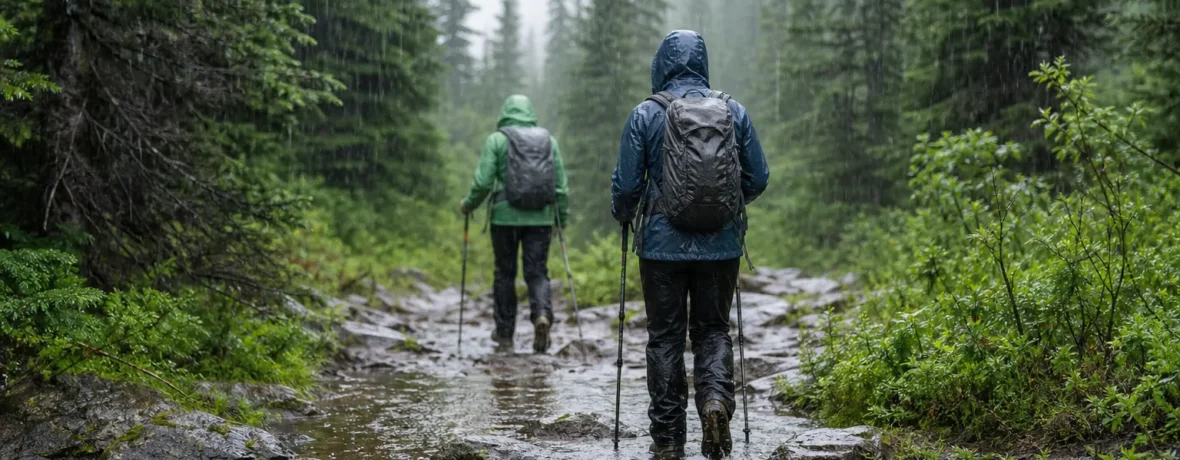
Hiking in the rain is worth doing when the forecast is steady rain, not thunderstorms, flash-flood risk, or cold you cannot manage. Start with routes under 6 miles [10 km], carry one dry insulating layer, turn around at rising water, and get to shelter the first time you hear thunder.
Is it OK to hike in the rain?
Yes, if the risk is rain and not severe weather.
That line matters. Rain is not the enemy. Lightning is. Rising water is. A soaked cotton hoodie at 43°F [6°C] with wind on an exposed ridge is. But rain by itself? Rain is just weather. It changes the texture of the day. It makes the trail smell alive. It clears the parking lot. It turns ordinary woods into a sharper, quieter place.
The case against hiking in the rain usually comes from discomfort, not danger. Wet cuffs. Fogged glasses. Mud on the calves. Sandwiches with damp corners. Fine. Those are inconveniences. They are not a reason to surrender a whole season to the couch.
The better argument is this: you should learn to hike in rain because perfect weather is a lousy teacher. Bluebird days let you coast. Wet days make you pay attention. You check your layers before you are cold. You notice drainage on the trail. You learn which shoes grip wet rock and which ones turn every root into a prank. You get honest about your pace, your gear, and your judgment.
That is not romantic nonsense. It is practical trail literacy.
What is rainy day hiking actually good for?
Rainy day hiking is good for solitude, sensory payoff, and better decision-making.
On popular trails, rain does what reservation systems and early alarms cannot: it thins the crowd. The overlook may not give you a 50-mile [80-km] view, but you may get something better—no Bluetooth speaker, no conga line, no pressure to move at someone else’s speed.
Wet weather also makes familiar trails new. Moss brightens. Creeks speak up. Dust settles. Wildlife signs stand out in soft ground. Water beads on leaves and runs down bark in clean, silver lines. A forest in rain is not a worse version of a forest in sun. It is a different room in the same house.
And yes, rain can make you a better hiker. You stop treating the forecast as a decoration and start treating it as a plan. You learn to ask sharper questions: Where does this trail cross a creek? Is the route clay, granite, sand, or boardwalk? Is there a bailout road? Is the high point exposed? How long before my hands get cold if I stop?
What should you wear for hiking in the rain?
Wear layers that stay useful when wet.
The old advice still holds because physics still works: skip cotton, manage sweat, and protect your core. A waterproof shell is not a magic force field. If you climb hard in warm rain, you can soak yourself from the inside. That is why the best rain setup is not the heaviest jacket. It is the system that lets you keep moving without steaming yourself like a dumpling.
| Layer | Best choice | Why it works |
|---|---|---|
| Base layer | Wool or synthetic | Moves moisture and dries faster than cotton |
| Insulation | Fleece or synthetic puffy in a dry bag | Keeps warmth available for stops |
| Shell | Waterproof rain jacket with hood | Blocks rain and wind on exposed sections |
| Feet | Trail shoes or boots with grippy tread | Traction matters more than looking clean |
Pack gloves even when the start feels mild. Bring a beanie. Put one warm layer in a real dry bag or a sealed plastic bag. If everything gets wet except that one layer, you still have a reset button.
Rain pants are a judgment call. In cold rain, they can be the difference between steady and miserable. In warm rain, they may be a sweat trap. A brimmed cap under your hood often does more for morale than another expensive membrane because it keeps water off your face.
How do you hike safely in the rain?
You hike safely in the rain by making conservative choices sooner.
Wet trails shrink your margin. Rock gets slick. Roots get greasy. Creek crossings rise. Hands get clumsy when cold. Your phone screen may stop cooperating. None of that means stay home. It means stop pretending your dry-day pace and dry-day route still apply.
- Check the hourly forecast, not just the daily icon.
- Choose a shorter route with a simple exit.
- Avoid exposed ridges if thunderstorms are possible.
- Turn around before a creek crossing becomes a debate.
- Keep one insulating layer completely dry.
- Eat and drink before you feel chilled or foggy.
- Tell someone your route and your latest expected return time.
The first clap of thunder changes the trip. NOAA’s lightning safety guidance says to get into a substantial building or fully enclosed vehicle and stay there at least 30 minutes after the last thunder. A grove of trees is not a shelter. A cliff overhang is not a shelter. A positive attitude is really not a shelter.
Flash flooding is the other hard stop. The National Weather Service’s Turn Around Don’t Drown campaign is aimed at roads, but the trail lesson is plain: do not cross moving floodwater. In canyons, drainages, desert washes, and steep creek valleys, rain falling upstream can become your problem fast.
Is hiking in the rain bad for trails?
It can be, if you walk around the mud.
This is where rainy-day hikers need to be honest. Loving wet trails does not give you permission to widen them. The clean-shoe shuffle around puddles kills vegetation, breaks trail edges, and turns singletrack into braided mess. If you choose to hike in rain, choose to get your shoes dirty.
Leave No Trace’s durable surfaces guidance says to walk single file in the middle of the trail even when it is wet or muddy. That may feel wrong the first time. Do it anyway. The trail is already the impact zone. The ferns, meadow edges, cryptobiotic soil, and soft shoulders beside it are not your personal bypass lane.
- Step through mud, not around it.
- Stay off closed trails.
- Skip steep clay routes after heavy rain if your footprints are cutting deep.
- Use trekking poles for balance, not for stabbing fragile trail edges.
- Clean mud from your shoes after the hike to reduce the spread of seeds and pathogens.
If the local land manager asks people to stay off saturated trails, listen. The defense of hiking in the rain is not a defense of trashing the place.
When should you cancel a rainy hike?
Cancel when the weather adds consequences you cannot control.
Rain is acceptable. Thunderstorms, flood warnings, high wind in burned or beetle-killed forest, and cold rain without proper clothing are different problems. So are routes with mandatory creek crossings, slick scrambles, or long exposed traverses.
Use this blunt test: if one small mistake would become a rescue, pick another trail or another day. There is no virtue in forcing a bad plan through bad weather. The point is not to prove you are tough. The point is to come home wanting the next hike.
Hypothermia deserves special respect because it can sneak into “not that cold” weather. The CDC says hypothermia can occur above 40°F [4°C] when a person is wet from rain, sweat, or cold water and becomes chilled; see the CDC’s hypothermia prevention guidance. That is the classic rainy hiking trap: you climb hard, sweat into your layers, stop for lunch in wind, and suddenly the day feels mean.
What should you pack for a rainy day hike?
Pack for wet movement and a dry stop.
Your pack does not need to look like an expedition duffel. It needs to keep you functional if the temperature drops, the trail takes longer, or someone twists an ankle and the group has to stand still.
- Waterproof jacket with a working hood
- Dry insulating layer in a sealed bag
- Warm hat and gloves
- Map downloaded offline plus a paper backup when the route is complex
- Headlamp, even for a morning hike
- First-aid kit
- Extra food you can eat with wet hands
- Water or a filter, depending on the route
- Trash bag or pack liner
- Trekking poles for slick descents and creek judgment
Do not overthink the pack cover. A liner inside the pack is usually more reliable because rain runs down your back and soaks the side against you. Keep the dry layer dry at all costs. That is the layer you put on when movement stops.
When to see a doctor
Get medical help right away if hypothermia is possible.
This article cannot diagnose you, and trail partners should not play doctor in a storm. Treat confusion, slurred speech, loss of coordination, drowsiness, slow breathing, or uncontrollable shivering as urgent warning signs after cold rain exposure. Mayo Clinic’s hypothermia first-aid guidance says to call 911 or your local emergency number if you suspect hypothermia.
While waiting for help, get the person out of wind and rain if you can do so safely, remove wet clothing when possible, and use dry layers or blankets to reduce further heat loss. Do not ignore symptoms because the trailhead is “only” 1 mile [1.6 km] away. A cold, wet mile can be a long mile.
Why the rain deserves a better reputation
The rain is not the problem; bad planning is.
Too many hikers treat rain as a cancellation notice. That is a loss. Some of the best trail days are gray, drippy, and quiet. They ask less from your camera and more from your attention. They reward patience. They punish vanity. They make warm socks in the car feel like a luxury hotel.
So yes, defend the rainy hike. Defend the low clouds and the empty trailhead. Defend the humble 4-mile [6.4-km] loop done well instead of the epic route done stupidly. Defend mud on your shins and a sandwich eaten standing under spruce branches.
Just do not confuse romance with recklessness. Check the forecast. Respect thunder. Respect water. Respect cold. Walk through the mud. Bring the dry layer. Turn around early enough that it feels almost embarrassing.
That is the sweet spot: not conquering the rain, not hiding from it, just moving through it with enough sense to enjoy what most people missed.
Related reading
- How Far Can You Hike in a Day? Realistic Mileage by Terrain
- How Many Miles Should You Walk a Day?
- What Is National Trails Day?
- National Public Lands Day: Free Entry and Volunteering
FAQ
Is rainy day hiking safe for beginners?
Yes, if beginners choose a short, familiar trail without exposed ridges, hard creek crossings, or severe weather in the forecast. A 2- to 4-mile [3.2- to 6.4-km] loop is a smarter first rainy hike than a remote all-day route.
Are waterproof boots required for hiking in the rain?
No, waterproof boots are not required. Grippy footwear, warm socks, and dry layers matter more; in warm weather, some hikers prefer quick-drying trail shoes because they drain faster after puddles.
Should you hike if thunderstorms are possible?
No, not on exposed or remote terrain. If thunder starts, seek a substantial building or fully enclosed vehicle and wait at least 30 minutes after the last thunder before resuming outdoor activity.
How do you keep your backpack dry in heavy rain?
Use a pack liner or heavy-duty trash bag inside your pack. Pack covers help, but water can still run between your back and the pack, so critical items should be sealed inside.
Is it better to hike through mud or around it?
Hike through the mud when you are on an established trail. Walking around puddles widens trails and damages vegetation, which is worse than getting your shoes dirty.