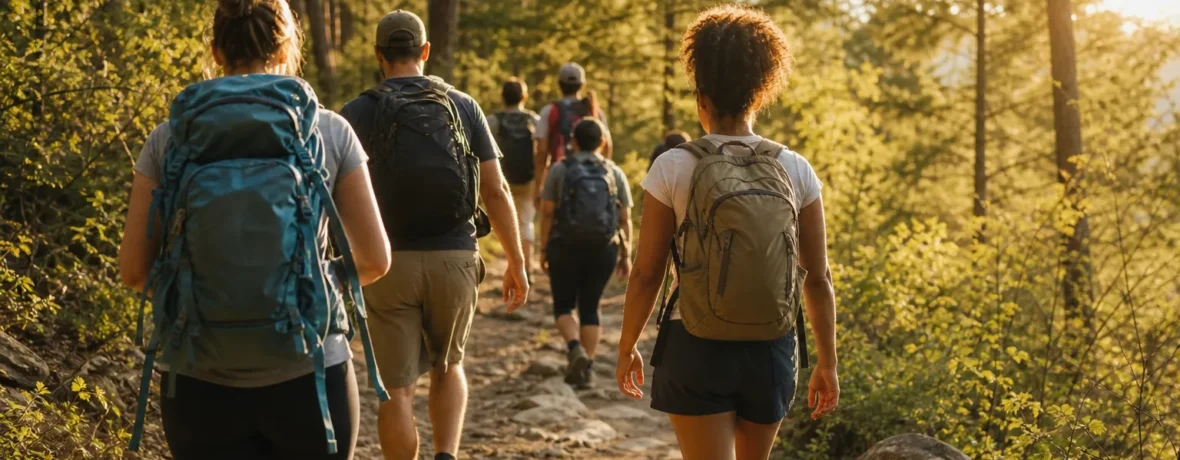
What is hiking? Hiking is a purposeful walk outdoors on a route that feels separated from ordinary transportation—usually a trail, path, beach, desert wash, forest road, ridge, or off-trail line. Yes, a 1-mile [1.6 km] loop can count if the point is the walk, not commuting, errands, or getting from one building to another.
What is hiking, exactly?
Hiking is recreational walking with a chosen outdoor route and a little commitment.
That last word does the work. Commitment does not mean danger, suffering, heroic mileage, or a pack big enough to hide a Labrador. It means you have stepped out of ordinary walking and into a route that asks something from you: time, attention, footing, weather sense, water, a turnaround point, maybe a map.
A sidewalk stroll around the block is walking. A paved greenway through a city park can become a hike if you choose it as an outing, follow a route, and treat the setting as part of the point. A steep 0.8-mile [1.3 km] trail to an overlook is absolutely a hike. So is a flat 6-mile [9.7 km] loop through pine woods.
The cleanest definition is not based on distance. It is based on purpose and setting. Hiking begins when walking stops being merely transportation and becomes the activity itself.
What is a hike?
A hike is one complete outing on foot, usually outdoors, with a start, a route, and an end.
That may sound plain, but it matters. A hike can be short. It can be easy. It can be on dirt, rock, sand, snow, grass, gravel, boardwalk, or a paved path through a natural area. It can take 25 minutes or all day. It can climb 200 feet [61 m] or 4,000 feet [1,219 m].
Here is the position: gatekeeping hiking by mileage is lazy. The better test is this: did you choose an outdoor walking route for its own sake, and did the route require some awareness of terrain, weather, effort, or direction? If yes, call it a hike and get on with your life.
Is walking the same as hiking?
No, but hiking is a kind of walking.
Walking is the big category. Hiking is walking with intent, terrain, and a route. The difference is not moral. Hiking is not “better” walking. It is simply walking moved into a setting where the ground, the weather, the grade, and the distance become part of the experience.
That is why a 3-mile [4.8 km] road walk to the grocery store is usually not a hike, while a 1.5-mile [2.4 km] trail loop behind a county park office often is. Same legs. Different purpose.
| Activity | What it means | Best plain-English test |
|---|---|---|
| Walking | Moving on foot for transport, exercise, or leisure | Are you mainly getting somewhere or moving your body? |
| Hiking | Following an outdoor route for recreation | Is the route itself the reason you are out? |
| Trekking | A longer, more demanding journey on foot | Does it take multiple days or serious planning? |
| Backpacking | Hiking while carrying overnight gear | Are you sleeping out and carrying camp? |
How long does a walk have to be to count as a hike?
There is no minimum distance.
Not 1 mile. Not 3 miles. Not 10 miles. The distance test sounds tidy, but it breaks fast. A half-mile [0.8 km] trail through slickrock, stairs, heat, or snow can demand more care than 4 flat miles [6.4 km] on a crushed-gravel rail trail.
If you need a practical line, use this: a hike has enough distance, terrain, or exposure that you would be annoyed—or unsafe—if you brought nothing, checked nothing, and wore the wrong shoes.
That is not a macho standard. It is a responsibility standard. The National Park Service Hike Smart guidance frames hiking around planning, essentials, weather, water, and knowing your limits. That is the right lens. Hiking does not have to be hard, but it does ask you to pay attention.
Does hiking have to be in the mountains?
No, hiking does not require mountains.
Mountains get the posters. Fair enough. They are dramatic, photogenic, and very good at making your calves file complaints. But hiking also happens in prairie preserves, coastal dunes, hardwood forests, desert washes, canyon rims, swamp boardwalks, river corridors, and urban wildlands.
A trail does not need a summit to count. It needs a route, an outdoor setting, and a reason to walk it. The Midwest has hikes. Florida has hikes. City parks have hikes. A beach walk can be a hike when the tide, footing, distance, and route matter.
This is where the argument matters. If hiking only counts when it looks like an alpine postcard, we shrink the outdoors for no good reason. That keeps beginners out, flatlanders apologizing, and local trails treated like second-class places. Bad trade.
What makes hiking different from trekking or backpacking?
Hiking is the base activity; trekking and backpacking are more specific versions of traveling on foot.
Trekking usually implies a longer, harder, often multi-day journey. Backpacking means you are carrying overnight gear and sleeping away from a fixed lodging base. Day hiking means you go out and return the same day.
The labels are useful only when they help someone prepare. If “trek” makes a route sound bigger and more remote, fine. If “backpacking” tells you to bring shelter, sleep gear, food storage, and a permit where required, good. If the label becomes a status badge, toss it in the trailhead trash can.
How do you know if you are ready for a hike?
You are ready when the route matches your body, your gear, and your judgment.
Use a simple check before you go:
- Read the route. Look at distance, elevation gain, surface, shade, water crossings, and whether the path is marked.
- Check the weather. Heat, wind, lightning, snow, and cold change a route faster than your optimism can keep up.
- Pick a turnaround time. This saves more trips than pride ever will.
- Tell someone your plan. Share the trailhead, route, and expected return time when the outing is remote or solo.
- Carry enough basics. Water, layers, light, food, navigation, and a small first-aid kit belong on more hikes than people admit.
The National Park Service hiking safety page points hikers toward the Ten Essentials. You do not need to haul a survival bunker on a short local loop, but the habit is sound: bring what you would need if the hike took longer than planned.
What should you bring on a hike?
Bring enough to handle the route if it gets slower, colder, hotter, darker, or wetter than expected.
For a short, familiar trail, that may fit in a small daypack. For longer or more remote routes, scale up. A sensible hiking checklist starts here:
- Water, plus a way to treat more on longer routes
- Snacks with salt and calories
- Map, downloaded route, compass, or GPS device
- Sun protection: hat, sunglasses, sunscreen, protective clothing
- Extra layer or rain shell
- Headlamp or small flashlight
- First-aid supplies
- Knife or small repair tool
- Fire starter where fires are legal and conditions allow
- Emergency shelter, such as a space blanket, on longer or colder hikes
Also bring manners. Stay on durable surfaces where possible, yield with common sense, keep noise down, pack out trash, and do not carve your name into living things. The Leave No Trace Seven Principles give a strong baseline for keeping trails and wild places from getting loved to death.
Is hiking exercise?
Yes, hiking counts as physical activity when it raises your effort above resting level.
A gentle nature trail can be light activity. A brisk climb can be moderate or vigorous activity. Grade, pack weight, heat, altitude, and footing all change the workload. The CDC adult physical activity guidance lists 150 minutes of moderate-intensity aerobic activity per week as a target for adults, and hiking can contribute to that total.
Still, do not turn every hike into homework. Some hikes are training. Some are recovery. Some are wandering with snacks. All three are allowed.
When to see a doctor
Seek medical care promptly for severe symptoms, symptoms that worsen, or symptoms that do not improve after rest, cooling, hydration, and getting out of the weather.
Call emergency services for confusion, fainting, signs of heat stroke, chest pain, trouble breathing, a serious fall, or an injury that prevents walking out safely. Mayo Clinic’s heat exhaustion first-aid guidance says to get emergency help if heat symptoms get worse or fail to improve after cooling measures. After a tick bite, the CDC advises seeing a doctor if rash or fever develops within several weeks.
This is not a diagnosis checklist. It is a reminder that hiking is still real life, with real bodies, real weather, and real consequences when bravado drives.
Related reading
- Type 2 Fun: Why Hard Hikes Feel Good Later
- The Seven Summits Explained
- What Is Geocaching?
- What Is a Pilgrimage? Walking With Meaning
FAQ
Can a short walk be a hike?
Yes, a short walk can be a hike if it is an outdoor route chosen for recreation. Distance matters less than purpose, setting, and the need to pay attention to terrain or conditions.
Does a hike need to be on a dirt trail?
No, a hike does not need dirt underfoot. Boardwalks, sand, rock, gravel, snow, grass, and paved paths through natural areas can all support a real hike.
Is hiking the same as backpacking?
No, backpacking is hiking with overnight gear. All backpacking includes hiking, but most hikes are day outings without a sleep system, shelter, stove, and overnight food load.
Is hiking hard for beginners?
It does not have to be. Beginners should start with short, well-marked routes, modest elevation gain, stable weather, and enough daylight to finish without rushing.
What is the best definition of hiking?
The best definition is this: hiking is purposeful outdoor walking on a chosen route where the route itself is the point. That definition includes beginners, local trails, short loops, flat landscapes, and serious mountain days without pretending they are all the same.