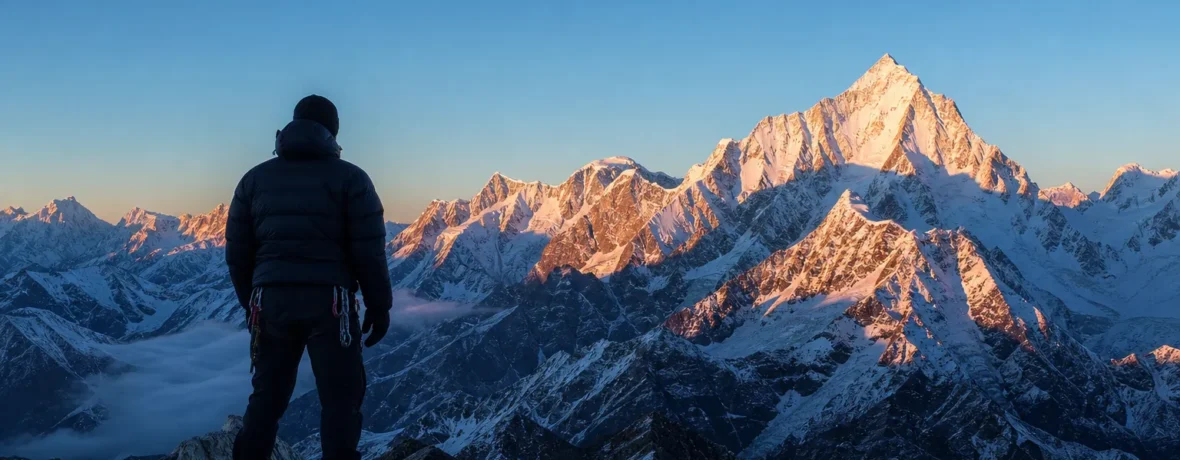
The seven summits are the highest mountains on the seven continents: Everest, Aconcagua, Denali, Kilimanjaro, Elbrus, Vinson, and either Carstensz Pyramid or Kosciuszko, depending on the list. Yes, they are a real mountaineering goal, but no, they are not a neat ladder from hiker to expert.
What are the seven summits?
They are the highest named peaks on each continent. That sounds tidy until you reach the Australia/Oceania problem, where two lists fight for the seventh slot like bad weather on summit day.
The classic idea is simple: climb the high point of every continent. The execution is not simple. You move from a nontechnical walk-up on Kilimanjaro to glacier travel on Denali, severe cold on Vinson, extreme altitude on Everest, and technical limestone climbing on Carstensz Pyramid if you choose the harder list.
| Continent | Peak | Elevation | What it really asks of you |
|---|---|---|---|
| Asia | Everest | 29,032 ft [8,848.86 m] | Extreme altitude, long expedition time, fixed-line traffic, big consequences |
| South America | Aconcagua | 22,837 ft [6,960.8 m] | High altitude, wind, expedition logistics, heavy carries |
| North America | Denali | 20,310 ft [6,190 m] | Cold, glacier travel, sled hauling, crevasse rescue skills |
| Africa | Kilimanjaro | 19,341 ft [5,895 m] | Acclimatization discipline, steady hiking, summit-night grit |
| Europe | Elbrus | 18,510 ft [5,642 m] | Glacier terrain, weather, crampon and ice-axe competence |
| Antarctica | Vinson | 16,046 ft [4,892 m] | Polar cold, remoteness, aircraft-dependent logistics |
| Oceania/Australia | Carstensz Pyramid or Kosciuszko | 16,024 ft [4,884 m] or 7,310 ft [2,228 m] | Technical rock climbing or a day hike, depending on the list |
Which Seven Summits list is official: Bass or Messner?
Neither list owns the mountain world, but the Messner list is the better test. The Bass list uses Mount Kosciuszko as the high point of mainland Australia. The Messner list uses Carstensz Pyramid, also called Puncak Jaya, as the high point of the broader Australia/Oceania region.
Here is the straight take: if you want a continental high-point project with clean hiking appeal, Kosciuszko counts. If you want the stronger mountaineering claim, Carstensz is the one. It is taller, more technical, and far more in line with the spirit of the challenge.
That does not make Kosciuszko worthless. It makes it different. Kosciuszko is a beautiful high point and a worthy mountain day. It just does not belong in the same difficulty conversation as Everest, Denali, Vinson, or Carstensz. Calling both versions “the Seven Summits” is polite. Treating them as equal is not honest.
How hard are the Seven Summits?
They range from strenuous trekking to serious expedition climbing. The trap is thinking the list climbs in a clean progression, because it does not.
Kilimanjaro has no technical climbing on the standard routes, yet it tops out higher than every peak in the Lower 48. Aconcagua has a normal route that is often described as nontechnical, but its altitude is punishing. Denali is lower than Aconcagua but colder, more complex, and more self-sufficient. Everest is Everest: thinner air, more time exposed, more people, more money, and less room for fantasy.
For hikers, the Seven Summits sell a dangerous little myth: that enough fitness can replace mountain judgment. It cannot. Fitness gets you to the start line. Judgment keeps you from making one bad decision after another when weather, altitude, ego, and sunk costs start talking.
- Easiest on paper: Kosciuszko, if using the Bass list.
- Most approachable major summit: Kilimanjaro, if you choose a longer acclimatization route and respect the altitude.
- Best bridge from trekking to expeditions: Aconcagua.
- Best test of expedition craft: Denali.
- Most remote logistics: Vinson.
- Most technical seventh summit: Carstensz Pyramid.
- Largest overall undertaking: Everest.
Can a regular hiker climb the Seven Summits?
Yes, but only if “regular hiker” becomes “trained mountaineer” along the way. A strong weekend hiker can start the journey. That same hiker should not pretend the finish line is a bigger version of a local peak.
This is where the goal has value. The list can push you to learn real skills: crampon footwork, rope travel, crevasse rescue, cold-weather camping, expedition nutrition, self-arrest, pacing, and decision-making under stress. That is the good version. The bad version is outsourcing judgment to guides, buying bigger objectives too fast, and collecting summits without building competence.
If you are drawn to the Seven Summits, fine. Let them be a curriculum, not a trophy shelf. The mountains will not care which package you bought.
How should you train for the Seven Summits?
Train in phases, not in panic. A smart path builds aerobic capacity first, then mountain-specific strength, then technical skills, then expedition experience.
- Build a hiking engine. Spend months hiking uphill with a loaded pack, then add longer back-to-back days. Your legs need repeatable effort, not one heroic workout.
- Learn snow skills early. Take instruction in crampon travel, ice-axe use, self-arrest, rope team movement, and avalanche awareness before you need those skills at 18,000 ft [5,486 m].
- Climb smaller glaciated peaks. Use training climbs to practice systems when the stakes are lower. Denali should not be your first time managing a rope team.
- Test your cold-weather systems. Gloves, boots, sleep systems, goggles, layers, and stoves need field time. A gear list is not experience.
- Practice altitude discipline. Choose itineraries that give your body time to adapt. Summit fever loves rushed schedules.
- Pick objectives for learning, not bragging. A failed attempt that teaches you weather judgment is more useful than an easy summit you barely remember.
When to see a doctor
See a doctor before high-altitude travel if you have heart, lung, sleep-breathing, blood, or other chronic medical conditions. The CDC’s high-altitude travel guidance says travelers with underlying medical conditions should consult a physician familiar with high-altitude medicine before going high.
On the mountain, do not self-diagnose your way through worsening symptoms. Headache, nausea, dizziness, fatigue, confusion, poor coordination, severe breathlessness, or a wet cough at altitude deserve immediate attention from qualified medical support when available. Descent is often the key safety move, and waiting for symptoms to “toughen out” is how small problems become rescues.
What is the right order to climb the Seven Summits?
The best order is skill-based, not status-based. Start with the peak that teaches the next skill you need, not the peak that photographs best.
A sensible pathway for many hikers is Kosciuszko or Kilimanjaro, then Elbrus, then Aconcagua, then Denali, then Vinson, then Carstensz if using the Messner list, and Everest last. That order is not law. Weather windows, politics, access, partners, and money will shove the calendar around. Still, the principle holds: do not let logistics make your skill progression stupid.
The blunt position: the Seven Summits are overrated as a measure of greatness and underrated as a training framework. They do not prove you are the best climber in the room. They can prove you are patient enough to learn across different ranges, climates, and styles. That is worth something.
Related reading
- Type 2 Fun: Why Hard Hikes Feel Good Later
- What Is Geocaching?
- What Is Hiking, Really? A Definition Worth Arguing About
- What Is a Pilgrimage? Walking With Meaning
FAQ
What are the Seven Summits in order of height?
The order by elevation is Everest, Aconcagua, Denali, Kilimanjaro, Elbrus, Vinson, then Carstensz Pyramid or Kosciuszko. Carstensz is the higher and harder seventh summit; Kosciuszko is the lower mainland Australia option.
Is Kilimanjaro one of the Seven Summits?
Yes. Kilimanjaro is Africa’s highest mountain and appears on both major Seven Summits lists. It is not technical on standard routes, but its 19,341 ft [5,895 m] summit makes altitude the main challenge.
Is Mont Blanc part of the Seven Summits?
No, not on the standard lists. Elbrus is generally used as Europe’s highest summit because it is taller than Mont Blanc. Some climbers argue geography, but the common Seven Summits objective uses Elbrus.
Which Seven Summits list should I follow?
Follow the Messner list if you want the stronger mountaineering version. Follow the Bass list if your goal is the classic mainland Australia interpretation. If you want to silence the debate, climb both Kosciuszko and Carstensz.
Do you need climbing experience for the Seven Summits?
Yes, for the full project. You can hike some peaks with strong fitness and good acclimatization, but Denali, Vinson, Elbrus, Carstensz, and Everest require technical systems, cold-weather judgment, and expedition discipline.