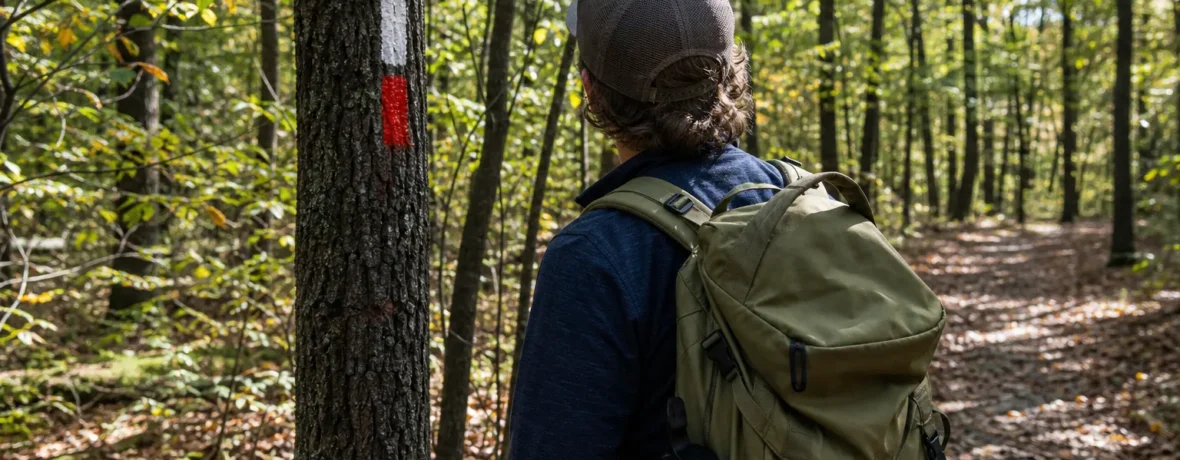
What does a blaze mean on a trail? A blaze is an official mark that tells you the route continues, turns, or needs extra attention. It may be painted on a tree or rock, posted as a tag, or built as a cairn. Color meanings change by park, trail system, and land manager.
What does a blaze mean on a trail?
A blaze means “you are on the intended route.” In the simplest setup, one blaze reassures you that the trail continues ahead; two blazes often warn you to slow down and look for a turn, junction, or route change. On the Appalachian Trail, the Appalachian Trail Conservancy describes the standard white blaze as a 2-by-6-inch [5-by-15-cm] rectangle used for daylight travel in both directions, while side trails and shelter trails use blue blazes. The A.T. Basics page explains that system. (appalachiantrail.org)
Don’t treat one color as a national rule. A white blaze can mean “Appalachian Trail” in Shenandoah National Park, while a yellow blaze there means a hiking trail that is also open to horses. At Buffalo National River, NPS says trails are marked with white blazes for hiking only and yellow blazes for hiking/horse riding, as of November 2026. Same colors. Similar idea. Still local rules. Shenandoah’s official hiking page and Buffalo National River’s backcountry page spell out their own systems. (nps.gov)
What are trail markers and trail blazes?
Trail markers are the signs, posts, tags, paint, cairns, and other marks that help you follow the route.
A blaze is one kind of marker. Think of it as the breadcrumb you can see from the trail itself. The U.S. Forest Service calls these “reassurance markers” when they confirm the route where tread is faint, snow covers the ground, fog or rain reduces visibility, or multiple paths make the line confusing. Forest Service guidance says reassurance markers may be metal, plastic, wood, or rock cairns; blazes can include arrows and may be mounted on posts or trees at least 3 ft [1 m] above the ground, high-water line, or average snow depth. The Forest Service Trail Maintenance and Construction Notebook gives those standards. (fs.usda.gov)
| Mark you see | What it usually tells you | What you should do |
|---|---|---|
| Single paint blaze | The route continues | Keep going, then look for the next mark |
| Double blaze | A turn, junction, or route change is close | Slow down and scan left, right, and ahead |
| Arrow or directional tag | The route bends or leaves an obvious path | Follow the arrow, then confirm with the next blaze |
| Rock cairn | The route crosses rock, alpine terrain, desert, or faint tread | Move cairn to cairn without disturbing the rocks |
What do trail blaze colors mean?
Trail blaze colors mean whatever that park, forest, or trail system says they mean.
That’s the rule you can trust. Colors are not universal across the United States. In Shenandoah National Park, as of November 2026, NPS lists blue as a hiking trail, white as the Appalachian Trail, and yellow as a hiking trail also open to horses. The same park also uses cement posts at trailheads and intersections, with metal bands showing the trail name, connecting trails, and mileage. (nps.gov)
On the A.T., as of 2026, the official route is 2,197.9 miles [3,537.2 km], and the familiar white blazes mark the main footpath; blue blazes mark side and shelter trails. The A.T. also warns that blaze spacing varies, and in federally designated wilderness areas the blazes are intentionally less frequent, sometimes up to 0.25 mile [0.4 km] apart. (appalachiantrail.org)
So read the map legend. Read the trailhead sign. Snap a photo of both before you leave the parking lot. Tiny move. Big payoff.
What does a double blaze mean?
A double blaze means “pay attention now.”
Two stacked blazes usually signal a turn, a junction, a route shift, or a place where hikers commonly wander the wrong way. On the A.T., two white blazes, one above the other, mark an obscure turn, route change, incoming side trail, or another situation that needs extra attention; sometimes the upper blaze is offset toward the turn. (appalachiantrail.org)
Here’s the practical move: stop walking for three seconds. Look for tread, cut logs, worn soil, another blaze, a signpost, or a cairn. Then move. Most wrong turns start with momentum, not mystery.
Are cairns official trail markers?
Cairns are official only when the land manager uses and maintains them.
A cairn is a stack of rocks. In some parks, cairns are essential route markers. In others, random rock stacks are decoration, damage, or a hazard to navigation. NPS says, as of November 2026, every park handles cairns differently, and you should check the park’s website and trail map before relying on them. NPS also gives one shared rule: don’t disturb cairns, don’t build your own, and don’t add to existing ones. The NPS rock cairns explainer is blunt about that. (home.nps.gov)
El Malpais National Monument is a clean example. On the Lava Falls Trail, NPS says cairns may be the only markers on lava terrain, where a normal footpath is hard to build. Hikers are told to keep the next cairn in sight, look back often, and not build new cairns because false markers can send other people off route. El Malpais explains cairned-route travel here. (home.nps.gov)
What should you do when you lose the blazes?
Stop, backtrack, and rebuild certainty.
- Stop moving. Don’t keep wandering “just a little farther.” That turns a small miss into a bigger one.
- Turn around. Look behind you. Blazes are often placed for travel in both directions, but the view can change completely when you reverse.
- Return to the last confirmed blaze. On the A.T., the Conservancy advises retracing your steps if you have gone a few hundred yards without seeing a blaze. (appalachiantrail.org)
- Check your map, app, and compass. A phone track is useful. A paper map still matters when batteries, rain, or cold get involved.
- Scan for the next official marker. Look for paint, posts, tags, signs, cairns, cut logs, or a maintained tread.
- Do not create your own mark. At Buffalo National River, NPS specifically says not to leave flagging, hang markings in trees, or make rock cairns to mark your route, as of November 2026. (home.nps.gov)
What should you check before trusting a blaze?
Check the local system before you hike.
- Trailhead map: Look for the color key and route name.
- Land manager page: National park, national forest, state park, city park, or trail association rules can differ.
- Junction signs: Confirm the trail name, not just the color.
- Allowed uses: Some blaze colors show hiking-only trails; others may indicate horse, bike, ski, ATV, or snowmobile routes.
- Closures and reroutes: Fresh signs beat old paint.
- Terrain: Above treeline, on slickrock, in desert, or across lava, cairns may matter more than paint.
The Forest Service’s own marker table shows why checking matters: approved reassurance marker colors and sizes vary by trail type, from hiker/pedestrian routes to ski, bicycle, water, ATV, motorcycle, and snowmobile routes. That is a management system, not a hiker guessing game. (fs.usda.gov)
Related reading
- Is the Bright Angel Trail Open? Closures and Water
- When to Start an Appalachian Trail Thru-Hike
- Trail Access in 2026: Permits, Parking and What Is Changing for Hikers
- Best Hiking Apps 2026: Navigation, Weather and Trail Conditions Compared
FAQ
What is a trail blaze?
A trail blaze is an official mark that shows the route. It can be paint, a tag, a sign, an arrow, or another approved marker placed by the land manager or trail crew.
Does one blaze mean go straight?
Usually, yes: one blaze means the trail continues. Still, don’t sleepwalk past it; the next marker, tread, or sign should confirm where the route goes.
What does a double blaze mean on a hiking trail?
A double blaze usually means a turn, junction, or route change is coming. Slow down, look for the next mark, and confirm before charging ahead.
Are white blazes always the Appalachian Trail?
No. White blazes mark the Appalachian Trail in many A.T. locations, but colors are local. A different park or forest can use white for a different purpose, so read that trail’s map and signs.
Can I build a cairn if the trail is confusing?
No. Don’t build your own cairn unless you are part of an authorized trail crew working under that land manager’s direction. NPS warns that unofficial cairns can confuse hikers and damage soil, plants, and small habitats.
Should I follow paint or my hiking app?
Follow the official route on the ground when it is clearly marked, then use your map and app to confirm. If blazes and your app disagree, stop and investigate; reroutes, closures, and old map data can all fool you.