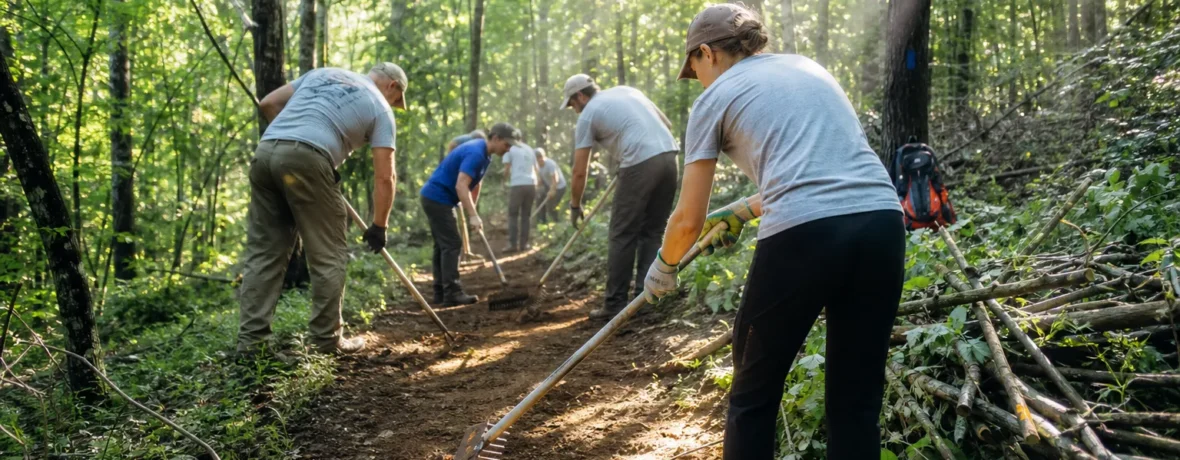
National Trails Day is an annual U.S. celebration of trails held on the first Saturday in June. It was started by American Hiking Society in 1993, and people mark it with hikes, cleanups, trail work, education, and advocacy. It is not automatically a free-entry day; fees and permits depend on the specific park, forest, or trail.
When is National Trails Day?
National Trails Day is held on the first Saturday in June each year. American Hiking Society, which organizes the nationwide observance, describes it as a day of public events focused on trail service, advocacy, and getting people outside on trails. See the official American Hiking Society National Trails Day page for the current year’s event information.
The early-June timing is no accident. In many parts of the U.S., snow has melted from lower trails, summer hiking season is opening up, and land managers are getting a hard look at winter damage: blowdowns, washed-out tread, missing signs, clogged drains, and overgrown corridors.
That makes the day more than a feel-good hashtag. It is a useful nudge. You get outside, meet local trail crews, learn who maintains the places you love, and maybe put your hands on the work that keeps those paths open.
Who started National Trails Day?
American Hiking Society started National Trails Day in 1993. The idea grew from a simple need: trails need public attention, public funding, and public labor.
The bigger story reaches back to the National Trails System Act of 1968. As of November 2026, the National Park Service says that law established four classes of trails: national scenic trails, national historic trails, national recreation trails, and side and connecting trails. The same official NPS page states that the act calls for trails in urban and rural settings for people of all ages, interests, skills, and physical abilities; you can read the current language on the NPS National Trails System Act page.
That legal backbone matters. A sidewalk path beside a creek, a rail-trail across town, a national forest route to a lookout, and a long-distance national scenic trail all need planning, maintenance, and public support. National Trails Day puts that work in front of everyday hikers.
What do people do on National Trails Day?
People hike, volunteer, learn trail skills, and speak up for trail protection. The best event for you depends on your energy level, your schedule, and how dirty you want your gloves to get.
| Event type | What you might do | Good fit if you want |
|---|---|---|
| Guided hike | Walk with a ranger, club leader, naturalist, or local volunteer | A low-pressure way to explore a new trail |
| Trail work | Clear brush, clean drains, move limbs, repair tread, or improve signs | Hands-on stewardship |
| Cleanup | Pick up trash at trailheads, parking areas, shorelines, and paths | A short event with visible results |
| Skills or education event | Learn map reading, Leave No Trace habits, local ecology, or safety basics | More confidence before bigger hikes |
Bring the right mindset. A volunteer event is not a race, and a group hike is not the place to prove your speed. Show up on time. Listen to the crew leader. Wear closed-toe shoes. Pack water, snacks, sun protection, rain gear, and work gloves if the event description asks for them.
Is National Trails Day free?
National Trails Day itself is free to recognize, but parks, forests, trailheads, campgrounds, shuttles, timed-entry systems, and special events may still charge fees. Do not assume the gate will be free just because the calendar says National Trails Day.
As of November 2026, the National Park Service entrance-pass page says NPS sites that charge an entrance fee offer free admission only on posted free-entrance days, and that other fees, including timed-entry or reservation fees, may still apply. Check the official NPS entrance passes and free entrance days page before you build your plan around a free visit.
As of November 2026, Recreation.gov states that fees vary by location and activity for tickets, timed entry, permits, camping, cabins, and day-use facilities. That means two trail-related plans can look completely different: one local greenway walk may need no payment at all, while a popular national park hike may require an entrance pass, timed entry, shuttle booking, or backcountry permit. The current policies are listed on the official Recreation.gov reservation policies page.
Do you need a permit or reservation on National Trails Day?
Yes, you still need a permit or reservation if that trail, park, campground, shuttle, or entrance corridor requires one. National Trails Day does not cancel local rules.
This is where many hikers get burned. They see a public event post, invite friends, drive hours, and discover that the trailhead parking lot fills early or the hike they wanted sits behind a quota system. A celebration day can make popular places busier, not easier.
Use this quick check before you go:
- Open the official park, forest, refuge, city, county, or state park page for the exact trailhead.
- Look for alerts, closures, fire restrictions, flood damage, storm damage, road work, and shuttle notices.
- Check whether the activity requires timed entry, a day-use reservation, a parking reservation, a wilderness permit, or a group permit.
- Read the event listing closely; some volunteer projects require advance registration, age limits, waivers, or specific clothing.
- Save offline maps and reservation confirmations before you lose service.
What trail rules should you check before you go?
Check the rules for the exact land manager and trail, not just the trail name. A route can cross city land, state land, national forest, private easements, tribal land, or national park land, and the rules can change at a boundary you barely notice on foot.
Start with the basics: hours, parking, pets, bikes, e-bikes, horses, drones, fires, camping, food storage, group size, and seasonal closures. If the official page says a trail is closed, pick another trail. A closure can protect nesting wildlife, unstable slopes, burned areas, flood damage, cultural sites, or crews working with tools and machines.
For low-impact hiking habits, the National Park Service lists the Seven Principles of Leave No Trace as: plan ahead and prepare; travel and camp on durable surfaces; dispose of waste properly; leave what you find; minimize campfire impacts; respect wildlife; and be considerate of other visitors. As of November 2026, the current NPS guidance is available on the NPS Leave No Trace Seven Principles page.
Here is the plain-English version for a busy June trail:
- Stay on the trail, even if mud makes the middle ugly.
- Pack out trash, food scraps, fruit peels, dog waste bags, and broken gear.
- Give wildlife distance and never feed animals.
- Keep music low or use headphones so the trail still sounds like a trail.
- Step aside in durable spots, not into fragile plants.
- Let uphill hikers set the pace when passing on narrow trail.
How do you find a National Trails Day event near you?
Start with the official event listings, then check local land managers and trail groups. The closer the organizer is to the trail, the better the practical details usually are.
- Search the American Hiking Society event resources for your state or region.
- Check nearby national parks, national forests, Bureau of Land Management offices, state parks, county parks, and city parks.
- Look at local hiking clubs, trail associations, watershed groups, land trusts, and outdoor retailers.
- Read the event description for mileage, elevation gain, tools, age limits, pets, parking, restrooms, and registration rules.
- Register early if the event has a cap. Volunteer crews often need head counts for tools, safety talks, and project assignments.
- If the event is full, do your own small cleanup on an open trail and report major problems to the land manager.
How should you prepare for a National Trails Day hike or volunteer project?
Prepare like the trail will be busier than normal. That means arriving early, carrying your own essentials, and having a backup plan.
For a hike, bring water, food, a map, sun protection, rain layers, a headlamp, a first aid kit, and shoes that match the terrain. For a volunteer project, wear long pants, sturdy closed-toe footwear, eye protection if requested, and gloves if the organizer asks you to bring your own. Skip sandals for trail work. Tools, roots, rocks, and wet wood do not care how casual the event sounds.
If you are bringing kids, choose a short event with clear logistics. If you are bringing a dog, confirm pets are allowed on that specific trail and at that specific event. If you are joining a crew, do not bring your own saw, power tool, or digging tool unless the organizer clearly asks for it. Trail work has safety standards for a reason.
Related reading
- National Public Lands Day: Free Entry and Volunteering
- Best Hiking Trails in National Parks: 12 Routes Worth Planning Around
- How Many National Parks Are There in the US?
- National Park Pass Changes for 2026
FAQ
What is the purpose of National Trails Day?
The purpose is to celebrate trails and support the work that keeps them open, safe, and cared for. That includes hiking, volunteering, cleanups, education, and advocacy for public access.
Is National Trails Day the same as National Public Lands Day?
No. National Trails Day is held on the first Saturday in June and focuses on trails. National Public Lands Day is a separate fall event focused more broadly on public lands and volunteer stewardship.
Can beginners join National Trails Day events?
Yes, many events are beginner-friendly. Choose a short guided hike, cleanup, or education event, and read the listing for distance, difficulty, registration rules, and required gear.
Are dogs allowed at National Trails Day events?
Only if the event organizer and land manager allow dogs. Check the exact event page and the official trail rules before you bring a pet, because dog rules vary by park, trail, and habitat.
What should I bring to a National Trails Day volunteer project?
Bring water, snacks, sun protection, sturdy closed-toe shoes, weather layers, and any items listed by the organizer. If tools are needed, the event page should say whether they are provided or whether you should bring specific gear.
Do I have to volunteer, or can I just hike?
You can just hike. Still, the spirit of the day is stewardship, so pick up trash, stay on the trail, follow posted rules, thank a trail crew, or donate to a local trail organization if you can.