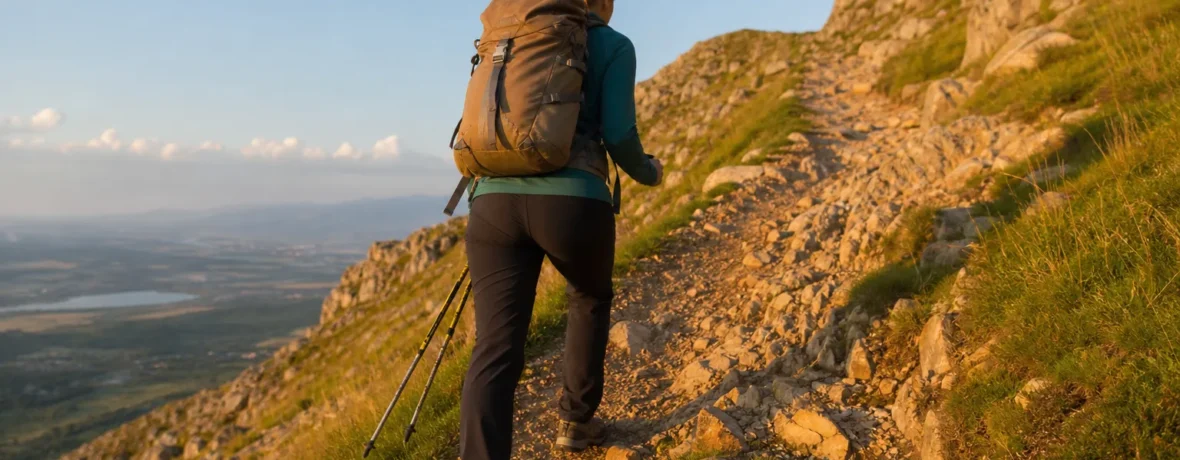
What is incline walking? It is walking uphill on a treadmill, road, ramp, or trail, usually at a 3% to 15% grade. A 10% grade climbs 10 feet for every 100 feet forward [3 m per 30 m], making your legs, lungs, and hiking muscles work harder without running.
What is incline walking?
Incline walking is regular walking with the ground tilted upward.
On a treadmill, incline is shown as a percent grade. A 5% incline means the belt rises 5 feet for every 100 feet of horizontal travel [1.5 m per 30 m]. Outside, the same idea shows up as a steep neighborhood hill, a parking-garage ramp, a fire road, or the first grinder after the trailhead.
For hikers, incline walking matters because hiking is rarely flat. Your calves, glutes, hamstrings, quads, hip flexors, and core all work differently when you climb. Your stride shortens. Your breathing changes. Your heart rate rises even if your pace stays slow.
That is the magic. You can walk, not run, and still build trail-specific fitness. The CDC counts moderate-intensity aerobic activity toward weekly movement goals, and the “talk test” is a simple gauge: if you can talk but not sing, you are usually working at moderate intensity. See the CDC guide to what counts as physical activity and its page on measuring exercise intensity. (cdc.gov)
Why do hikers use incline walking for training?
Hikers use incline walking because it trains the exact engine they need uphill.
Flat walking is useful. Incline walking is more specific. Climbing asks you to push through the ball of your foot, extend your hip, brace your trunk, and keep moving while your breathing gets loud. That is the feeling of a loaded climb, a switchbacking approach, or the final mile to a pass.
Incline walking also gives you control. On a treadmill, you can set the grade and pace instead of hoping the local terrain fits your training plan. You can start at 3%, move to 6%, then touch 10% when your legs are ready. No guesswork. No sprinting down pavement afterward unless you choose to.
It is especially useful when:
- You live somewhere flat but have mountain hikes planned.
- You are rebuilding fitness after time off.
- You want uphill stamina without the pounding of running.
- You need weekday training that fits into 30 to 45 minutes.
- You are preparing to hike with a daypack or overnight pack.
What are the benefits of incline walking for hikers?
The main benefits are stronger climbing legs, better aerobic fitness, and less impact than running.
Incline walking loads the posterior chain: glutes, hamstrings, calves, and the smaller stabilizers around your hips and ankles. That matters on trail because weak hips and tired calves make every step feel taller than it is.
It also trains pacing. Many hikers start climbs too fast, spike their heart rate, stop, repeat, then wonder why a 2-mile [3.2 km] ascent feels brutal. Incline walking teaches a steadier rhythm. You learn how slow “sustainable” feels. That skill carries straight to switchbacks.
There is a joint-friendly angle too. Running adds impact with every landing. Incline walking can raise cardiovascular demand while keeping one foot on the ground. That does not make it risk-free, but it gives many hikers a lower-impact way to work hard.
| Training type | Best for | Watch out for |
|---|---|---|
| Flat walking | Base fitness, recovery days, long easy volume | Limited uphill specificity |
| Incline walking | Climbing stamina, glutes, calves, aerobic work | Calf or Achilles tightness if you jump grades too fast |
| Stair climbing | Steep step-ups, quads, short hard sessions | Can irritate knees if volume rises too quickly |
| Running | Cardio capacity, speed, time-efficient workouts | Higher impact and less hiking-specific than uphill walking |
Is incline walking better than flat walking?
Incline walking is better for uphill hiking fitness, while flat walking is better for easy mileage and recovery.
You do not need to pick one forever. Use both. Flat walking builds your base and lets you spend more time on your feet. Incline walking adds the climbing stress that flat routes cannot provide.
A simple split works well: keep most walks easy and flat or gently rolling, then add 1 to 3 incline sessions each week. If every walk becomes a hill workout, your calves may complain. If every walk stays flat, your first real climb may feel rude.
The CDC’s adult guideline is 150 minutes of moderate-intensity aerobic activity per week, plus 2 days of muscle-strengthening activity. Incline walking can contribute to the aerobic side when the effort reaches moderate intensity. (cdc.gov)
How steep should incline walking be for hiking training?
Start with 3% to 6%, then build toward 8% to 12% if your calves, feet, and breathing handle it well.
You do not need to crank the treadmill to 15% on day one. That move often creates sore calves, cranky Achilles tendons, and sloppy posture. Better plan: start modest, stay consistent, then make one variable harder at a time.
- Week 1: Walk 20 to 30 minutes at 3% to 4% incline, easy enough to speak in short sentences.
- Week 2: Keep the same pace and time, raise the incline to 5% to 6%.
- Week 3: Add 5 minutes or add a light daypack, not both.
- Week 4: Try short blocks at 8% to 10%, such as 3 minutes uphill, 2 minutes easier.
- Week 5 and beyond: Build toward 35 to 60 minutes, using grades that match the hikes you are training for.
Use the talk test. Moderate effort lets you talk but not sing. Hard effort limits you to a few words. Mayo Clinic also describes intensity through breathing, heart rate, sweating, and muscle fatigue in its guide to measuring exercise intensity. (mayoclinic.org)
How do you do incline walking with good form?
Walk tall, shorten your stride, and keep your hands off the rails unless you need balance.
Good uphill form is simple, but not always easy. The steeper the grade, the more tempting it is to hunch forward and hang from the treadmill. That cheats the workout. On trail, there are no side rails.
- Stand tall with a slight lean from the ankles, not the waist.
- Take shorter steps than you use on flat ground.
- Land under your body instead of reaching far ahead.
- Drive your elbows back gently to help rhythm.
- Keep your gaze forward, not down at your shoes.
- Use trekking poles outside if they match your hiking style.
- Back off the grade if your calves feel sharp, hot, or strained.
If you are training for backpacking, add pack weight slowly. Start with an empty pack or 5 to 10 pounds [2.3 to 4.5 kg]. Build load after your time and incline feel controlled. Heavy pack plus steep grade plus tired legs is a spicy mix.
Can incline walking help prepare for altitude?
Incline walking can improve climbing fitness, but it does not acclimatize you to high altitude.
This distinction matters. Strong legs help you move efficiently uphill. Better aerobic fitness helps you handle sustained effort. But a treadmill at sea level does not create the lower oxygen pressure of a high mountain pass.
If your hike goes high, plan for gradual ascent, conservative pacing, and symptoms awareness. The Wilderness Medical Society’s altitude illness guidance covers prevention and treatment of acute altitude illness; for a practical overview, read the AAFP summary of Wilderness Medical Society altitude illness guidelines. Symptoms associated with acute mountain sickness can include headache, nausea, vomiting, fatigue, dizziness, and insomnia. (aafp.org)
When to see a doctor
Talk with a clinician before hard incline training if you have heart, lung, balance, joint, foot, ankle, or uncontrolled blood pressure concerns.
Do the same if you have chest pain, fainting, unusual shortness of breath, new swelling, dizziness that does not settle, or pain that changes your walking pattern. Do not self-diagnose through a training article.
If you are returning after surgery, pregnancy complications, a major illness, or a long break from activity, ask what intensity and progression make sense for you. Mayo Clinic advises checking with a health care professional before starting a vigorous exercise program when health concerns are present. (mayoclinic.org)
What is a simple incline walking workout for hikers?
A good beginner hiker workout is 30 minutes with a warm-up, steady climbing block, and cool-down.
- Warm up: 5 minutes flat or 1% incline at an easy pace.
- Settle in: 10 minutes at 4% to 6%, breathing controlled.
- Climb block: 10 minutes at 6% to 8%, using short steps.
- Finish steady: 3 minutes at 3% to 4%.
- Cool down: 2 minutes flat and easy.
Do that 1 or 2 times per week for two weeks. If it feels smooth, add 5 minutes. If your calves stay sore for more than 48 hours, reduce the grade before adding time.
For a stronger hiker, use intervals: 5 minutes easy, then 6 rounds of 3 minutes at 8% to 12% with 2 minutes at 2% to 4%, then cool down. Keep the hard sections controlled. This is hiking training, not a treadmill punishment contest.
Related reading
- Does Incline Walking Burn Fat?
- Does Incline Walking Build Glutes?
- Incline Walking vs Running
- How Many Calories Does Walking Burn vs Hiking?
FAQ
Is incline walking good for hiking?
Yes. Incline walking is one of the most direct gym-based ways to train for uphill hiking because it builds climbing-specific leg strength and aerobic stamina.
It works best when paired with real trail time, strength training, and longer easy walks.
What incline should I walk at for hiking?
Start at 3% to 6% if you are new to incline walking. Build toward 8% to 12% once your calves, feet, and breathing adapt.
Use 15% sparingly unless you are already conditioned for steep climbs.
How long should hikers do incline walking?
Most hikers can start with 20 to 30 minutes per session. Build toward 45 to 60 minutes when training for longer climbs.
Add time before adding heavy pack weight or very steep grades.
Does incline walking replace hiking?
No. Incline walking supports hiking, but it does not fully replace uneven ground, rocks, descents, weather, and pack handling.
Use it as a weekday training tool, then get outside when you can.
Should I hold the treadmill rails while incline walking?
No, not for normal training. Holding the rails reduces the work your legs and core have to do.
Use the rails briefly for balance or safety, then lower the speed or grade if you cannot walk without hanging on.
Can incline walking hurt your knees?
It can bother your knees if you progress too fast, overstride, use poor form, or train through pain. Many hikers tolerate incline walking well because it is lower impact than running.
If knee pain changes your gait or lingers after training, stop the workout and get medical guidance.