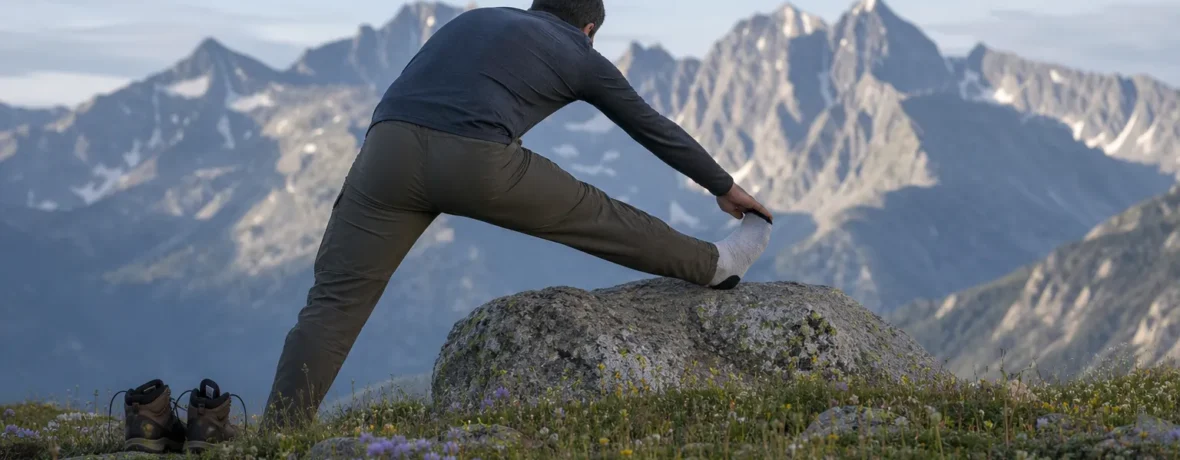
Yes, hamstring stretches are a good choice after a hike if your legs feel tight but not injured. Wait until you’ve cooled down for 5 to 10 minutes, then hold each stretch for 30 seconds, 2 to 4 times per side. Stop if you feel sharp pain, numbness, or pulling behind the knee.
Should you stretch your hamstrings after a hike?
Yes, stretch them after hiking, not before a hard climb.
Your hamstrings run along the back of your thighs and help bend your knees, extend your hips, brake your stride on descents, and stabilize you when the trail gets ugly. After a hike, they’re warm, loaded, and ready for gentle lengthening. That’s the sweet spot.
The safest rhythm is simple: finish the hike, walk easy for a few minutes, drink water, change out of wet layers if needed, then stretch. Mayo Clinic’s stretching guidance recommends warming up first, stretching gently, avoiding bouncing, and holding stretches for about 30 seconds.
Do not yank on cold hamstrings in the parking lot before your hike starts. If you want to move better at the trailhead, use dynamic movement: easy walking, leg swings, short step-ups, ankle circles, and a few shallow lunges. Save long holds for later.
What are the best hamstring stretches after hiking?
The best post-hike hamstring stretches are stable, slow, and easy to control.
You do not need fancy gear. A log, picnic table, trekking pole, towel, sleeping pad strap, or the side of your vehicle can help. The goal is not to fold yourself in half. The goal is to feel a steady pull in the belly of the muscle, breathe normally, and come out of the stretch feeling looser instead of crankier.
| Stretch | Best for | Hold | Gear |
|---|---|---|---|
| Standing heel-on-rock stretch | Quick trailhead reset | 30 seconds per side | Rock, step, or bumper |
| Seated towel hamstring stretch | More control after a long descent | 30 seconds per side | Towel or strap |
| Doorway hamstring stretch | At home after the drive | 30 to 45 seconds per side | Doorway or wall |
| Single-leg hinge stretch | Hikers who dislike floor stretches | 8 to 10 slow reps per side | None |
How do you do hamstring stretches after a hike?
Start easy, keep your spine long, and stop before the stretch turns into pain.
Use these steps after your hike, after a short cool-down walk. If your hamstring feels strained, bruised, swollen, or suddenly painful, skip stretching and treat it like an injury instead of normal tightness.
-
Cool down for 5 to 10 minutes.
Walk slowly around the trailhead, campsite, or block. Let your breathing settle. Stretching a warm muscle feels better and gives you more control.
-
Try the standing heel-on-rock stretch.
Place one heel on a stable rock, step, bench, or bumper about 12 to 18 inches [30 to 46 cm] high. Keep that knee soft, not locked. Hinge forward from your hips until you feel a mild pull along the back of your thigh. Hold for 30 seconds, then switch sides.
-
Use a towel or strap for a seated stretch.
Sit on the ground, a pad, or a folded jacket. Extend one leg and bend the other knee. Loop a towel, belt, or strap around the ball of the extended foot. Sit tall and gently pull until the back of your thigh stretches. Keep your shoulders relaxed.
-
Do the doorway stretch when you get home.
Lie on your back near a doorway. Put one leg up the wall or door frame and keep the other leg straight on the floor if that feels good. Slide closer only until you feel a comfortable stretch. This is excellent after a long drive because it removes balance from the equation.
-
Add a single-leg hinge.
Stand with one foot slightly in front of the other. Put most of your weight on the front heel. With a flat back, push your hips behind you as if closing a car door with your butt. Return to standing. Do 8 to 10 slow reps per side.
-
Finish before you overdo it.
Two to four rounds per side is plenty. More is not automatically better. If the muscle starts guarding, shaking, or feeling sharper, you’re done.
How long should you hold a hamstring stretch after hiking?
Hold each hamstring stretch for 30 seconds, then repeat it 2 to 4 times per side.
That gives the muscle enough time to relax without turning your cool-down into a second workout. Keep the stretch at a mild to moderate pull. You should be able to breathe through your nose or speak a sentence. If you’re clenching your jaw, holding your breath, or trying to “win” the stretch, back off.
For a short hike, one or two rounds may be enough. For a steep downhill day, a backpacking trip, or a hike with lots of stone steps, use the full 2 to 4 rounds. Stretch both sides even if only one side feels tight. Your stronger leg may have been doing more braking on the descent.
What stretches for hiking help your whole backside?
Hamstrings matter, but your calves, glutes, and hips need attention too.
Tightness after a hike rarely lives in one clean little box. Downhill travel asks your calves to control ankle movement, your glutes to stabilize your hips, your quads to brake your knees, and your hamstrings to help keep your stride from getting sloppy. Give the whole chain a few minutes.
- Calf wall stretch: Place both hands on a wall, tree, or vehicle. Step one foot back, heel down, toes forward. Hold for 30 seconds per side.
- Figure-four glute stretch: Sit on a bench or tailgate. Cross one ankle over the opposite knee and hinge forward with a long spine. Hold for 30 seconds per side.
- Low lunge hip flexor stretch: Step one foot forward and drop the back knee onto a pad or soft ground. Tuck your pelvis slightly and shift forward. Hold for 20 to 30 seconds per side.
- Quad stretch: Stand tall, hold a stable object, and bring one heel toward your butt. Keep your knees close. Hold for 20 to 30 seconds per side.
- Easy forward fold with bent knees: Let your torso hang, bend your knees generously, and relax your neck. Stay for 20 to 30 seconds.
Why do your hamstrings get tight after hiking downhill?
Downhill hiking makes your hamstrings work like brakes.
On flat ground, your stride rolls forward in a fairly predictable rhythm. On descents, every step asks your legs to slow your body down. Your hamstrings help control hip movement and knee position while your quads and calves absorb impact. Add a pack, loose gravel, wet roots, or big stone steps, and that braking job gets harder fast.
Long steps can make it worse. If you overstride downhill, your heel lands far out in front of you, and the back of your leg gets tugged repeatedly. Shorter steps usually feel smoother. Trekking poles can also reduce some of the load by helping you share work through your upper body.
Other common reasons your hamstrings feel tight after a hike:
- You climbed more elevation than usual.
- You descended fast to beat weather or darkness.
- Your glutes got tired, so your hamstrings picked up extra work.
- You sat in the car for a long drive home right after hiking.
- You wore shoes with a different heel-to-toe drop than usual.
- You skipped strength training for your hips, glutes, and posterior chain.
Can stretching fix hamstring pain after hiking?
Stretching can ease normal tightness, but it will not fix every kind of hamstring pain.
There’s a big difference between a tired muscle and an injured one. Normal tightness feels dull, broad, and symmetrical enough that gentle movement helps. A possible strain may feel sudden, sharp, localized, or weak. You may notice swelling, bruising, tenderness, or pain when walking uphill, bending forward, or pushing off.
MedlinePlus hamstring strain aftercare describes a strain as an overstretched or torn muscle and says light stretching and light physical activity come later, when pain has decreased enough. That means you should not force a stretch into a fresh, sharp hamstring pain.
If the hike ended and your hamstring simply feels short and tired, gentle stretching is fair game. If you felt a pop, had to limp out, or can point to one hot spot that hurts, stop stretching and switch to basic care: rest from aggravating movement, protect the area, and seek medical advice if symptoms are not improving.
What should you avoid when stretching after a hike?
Avoid bouncing, forcing range, locking your knees, and stretching through pain.
Post-hike stretching should feel calm. Not dramatic. Not heroic. Your nervous system has already handled uneven terrain, heat, cold, river rocks, talus, or whatever the trail threw at you. Don’t turn the parking lot into a circus act.
- Do not bounce. Move into the stretch slowly and stay there.
- Do not lock the knee. Keep a small bend so the stretch stays in the hamstring, not behind the knee.
- Do not round hard through your lower back. Hinge from your hips and keep your spine long.
- Do not chase the deepest position. A steady pull beats a dramatic pose.
- Do not compare sides. One hamstring is often tighter. Treat it patiently.
- Do not stretch a suspected injury. Sharp pain is a stop sign.
When should you stretch: at the trailhead, at camp, or at home?
Stretch as soon as you can do it safely and calmly.
If the weather is warm and you have flat ground, the trailhead works well. If it’s cold, windy, buggy, or dark, do a shorter version, change clothes, then stretch more at home or camp. Your muscles do not turn to stone if you wait 30 or 60 minutes. The bigger problem is sitting in the car for two hours and never moving again.
For backpackers, the best time is usually after camp chores but before you crawl into your tent. Filter water, put on dry layers, eat something, then stretch on a pad or flat patch of ground. Keep it mellow. You’re not trying to become flexible in one night; you’re trying to wake up less stiff.
What is a simple 7-minute post-hike hamstring routine?
Use three hamstring moves, one calf stretch, and one glute stretch.
This routine fits at a trailhead, campsite, or living room. Set a timer if you tend to rush.
- Easy walk: 1 minute around the parking area, campsite, or sidewalk.
- Standing heel-on-rock hamstring stretch: 30 seconds per side.
- Calf wall or tree stretch: 30 seconds per side.
- Seated towel hamstring stretch: 30 seconds per side.
- Figure-four glute stretch: 30 seconds per side.
- Single-leg hinge: 8 slow reps per side.
- Second round on the tighter hamstring: 30 seconds, gentle and steady.
If you want a longer version, repeat the whole routine once. If you’re tired, cold, or hungry, do the first five steps and call it good.
How can you keep hamstrings from tightening on your next hike?
Train your hamstrings, glutes, and calves between hikes.
Stretching helps flexibility, but strength keeps your stride from falling apart when the trail gets steep. The CDC adult physical activity guidelines recommend muscle-strengthening activities at least 2 days per week. For hikers, that can mean simple lower-body work at home, not a gym membership.
Build a small routine around these moves:
- Step-ups: Use a stable box or stair. Drive through the whole foot.
- Glute bridges: Lie on your back, knees bent, and lift your hips.
- Romanian deadlifts: Use body weight, dumbbells, or a loaded pack. Hinge from your hips.
- Calf raises: Rise slowly, pause, and lower with control.
- Side steps with a band: Train hip stability for uneven terrain.
On the trail, shorten your stride on descents, take breaks before your form gets sloppy, and use poles if they help you move with control. After the hike, stretch while the legs are still warm enough to cooperate.
When to see a doctor
See a doctor or qualified healthcare professional if pain is sharp, severe, worsening, or not improving with basic self-care.
Do not try to diagnose a hamstring injury from a stretch routine. Get medical help if you felt a pop, cannot walk normally, have significant swelling or bruising, notice numbness or weakness, or have pain that keeps returning every time you hike. MedlinePlus exercise injury guidance advises contacting a provider for muscle or joint pain that does not go away after self-care.
If you have a history of back problems, nerve pain, recent surgery, osteoporosis, or a previous hamstring tear, ask a clinician or physical therapist which stretches fit your body. The right move is the one you can do without making symptoms worse.
Related reading
- Calf Stretches for Hikers
- How Many Steps in a Mile (Walking vs Hiking)?
- What Is the Best Cardio for Hikers?
- What Is VO2 Max and Why It Matters for Hikers
FAQ
Are hamstring stretches good after hiking?
Yes, they’re good after hiking if you’re dealing with normal tightness, not sharp pain. Stretch after a short cool-down, hold each stretch for 30 seconds, and keep the pull mild to moderate.
Should I stretch hamstrings before or after a hike?
Use dynamic movement before the hike and static stretching after. Before hiking, walk, step up, and move your legs through comfortable range; after hiking, use longer holds while the muscles are warm.
Why do my hamstrings hurt after hiking?
Your hamstrings may hurt because they worked hard controlling your stride, especially on descents. Sharp, sudden, swollen, or one-sided pain may point to an injury, so stop stretching and get medical advice if it does not improve.
How often should hikers stretch hamstrings?
Stretch after hikes and on 2 to 3 non-hiking days each week if tightness keeps coming back. Keep sessions short: 5 to 10 minutes is enough for most hikers when done consistently.
What is the safest hamstring stretch for tight hikers?
The doorway hamstring stretch is one of the safest because you’re lying down and not fighting for balance. Move closer to the wall only until you feel a comfortable pull, then hold without bouncing.
Can tight hamstrings cause knee or back discomfort on hikes?
Tight hamstrings can contribute to uncomfortable movement patterns, especially when paired with weak glutes or tired hips. They are not the only possible cause, so recurring knee or back pain deserves a professional assessment.