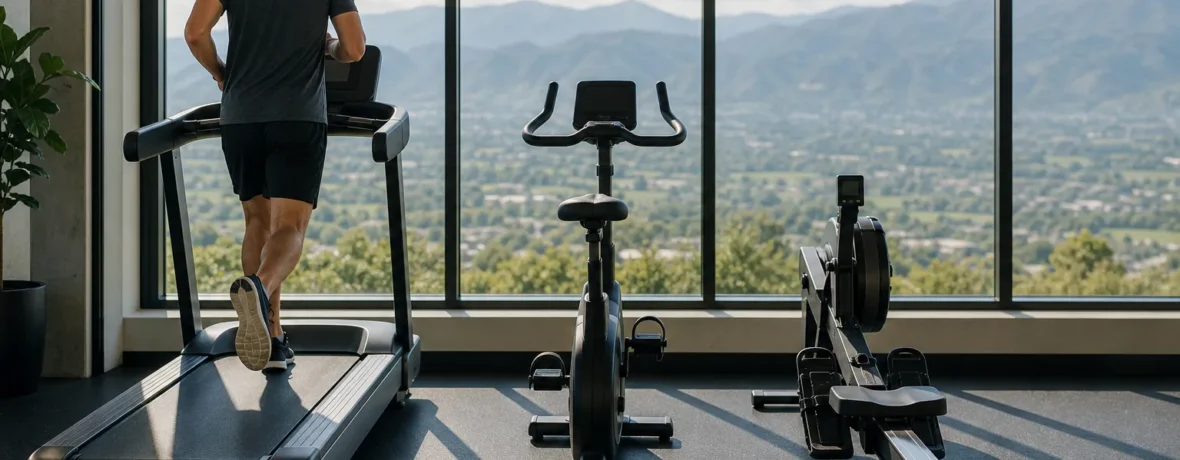
The treadmill usually wins when you run hard or hike steeply. For a 200 lb [91 kg] person, 30 minutes at 10.3 METs burns 490 calories. A stair climber at 9.3 METs burns 443, while vigorous elliptical or spin work at 9.0 METs burns 429.
Which cardio machine burns the most calories for most hikers?
The treadmill burns the most calories when you use speed, incline, or both.
That answer comes with a big hiking-sized asterisk: the machine only wins if you can sustain the effort. A treadmill jog at 5.0 to 5.2 mph [8.0 to 8.4 km/h] is listed at 8.5 METs in the 2024 Adult Compendium of Physical Activities. Running uphill at 4.5 mph [7.2 km/h] on a 5% grade is listed at 10.3 METs. That is a serious burn.
MET means metabolic equivalent of task. One MET is resting effort. The CDC describes METs as a way to compare activity intensity: 3.0 to 5.9 METs is moderate, and 6.0 METs or higher is vigorous. So when a treadmill climb hits 10.3 METs, your body is working hard. Your calves know. Your lungs know.
Here’s the catch. If you can only hold that treadmill effort for 6 minutes, but you can row smoothly for 30 minutes, the rower may burn more total calories in your real workout. Calories are not just about the machine. They come from intensity times time, with your body weight in the mix.
For hiking training, the best calorie-burning machine is often the one that also builds the engine you need on trail: legs, lungs, posture, and the ability to keep grinding when the grade turns rude.
How many calories do cardio machines burn in 30 minutes?
Calories vary by body weight, effort, and time.
The clean way to compare machines is to use METs. The calorie formula commonly used by fitness professionals is: METs x 3.5 x body weight in kilograms / 200 = calories per minute. The American Council on Exercise explains this MET calorie formula and why oxygen use tracks energy cost.
For this table, the numbers use 30 minutes and two trail-relevant body weights: 150 lb [68 kg] and 200 lb [91 kg]. These are estimates, not lab measurements. Still, they give you a sharp comparison.
| Machine and effort | METs | 150 lb [68 kg], 30 min | 200 lb [91 kg], 30 min |
|---|---|---|---|
| Treadmill, uphill run at 4.5 mph [7.2 km/h], 5% grade | 10.3 | 368 calories | 490 calories |
| Stair climber / stair treadmill, general | 9.3 | 332 calories | 443 calories |
| Elliptical, vigorous effort | 9.0 | 321 calories | 429 calories |
| Spin bike class | 9.0 | 321 calories | 429 calories |
| Treadmill run, 5.0 to 5.2 mph [8.0 to 8.4 km/h] | 8.5 | 304 calories | 405 calories |
| Rowing machine, 100 to 149 watts | 7.5 | 268 calories | 357 calories |
| Stationary bike, 90 to 100 watts | 6.0 | 214 calories | 286 calories |
| Elliptical, moderate effort | 5.0 | 179 calories | 238 calories |
The ranking changes when intensity changes. A relaxed treadmill walk loses to a hard row. A gentle bike spin loses to a steep treadmill hike. A savage bike interval can outrun almost anything for a short burst, but you may not hold it long enough to matter.
Is the treadmill better than the stair climber for calorie burn?
Yes, the treadmill can burn more calories, but the stair climber is often easier to aim at hiking fitness.
A treadmill gives you the widest range. You can walk, jog, run, climb, add incline, or stack speed and incline together. That makes it the top machine for pure calorie potential. It also lets you train the exact movement pattern hikers need: forward travel under your own body weight.
The stair climber is brutally useful. It puts your quads, glutes, calves, and lungs under steady pressure. It mimics the uphill part of hiking better than a flat jog does. If your goal is to feel less wrecked on long climbs, the stair climber deserves a spot near the top.
But it has two traps.
- Leaning on the rails: If your arms are holding half your weight, the calorie number on the screen turns into fiction.
- Tiny steps: Short, rushed steps can spike fatigue without building strong hiking mechanics.
- No downhill training: The stair climber trains the climb, not the eccentric quad pounding of descent.
For a trail-ready blend, use the treadmill for incline hiking and the stair climber for uphill strength endurance. One builds your stride. The other builds your grit.
Does the rowing machine burn more calories than the treadmill?
The rowing machine can beat an easy treadmill workout, but a hard treadmill run or incline climb usually burns more.
Rowing is sneaky. You sit down, strap in, and think you’re getting a break. Then 8 minutes later your legs, back, arms, and lungs are all filing complaints. A rowing machine uses more upper body than a treadmill, which makes it valuable if you want whole-body conditioning without foot strike.
The Compendium lists rowing at 100 to 149 watts as 7.5 METs and rowing at 150 to 199 watts as 11.0 METs. That higher range is no joke. For a 200 lb [91 kg] person, 30 minutes at 11.0 METs lands at 524 calories. That beats the 10.3-MET uphill treadmill example.
So why doesn’t the rower automatically win? Because wattage matters. Many casual rowing sessions hover below that hard 150-watt line, especially if technique is messy. Good rowing asks for leg drive first, then hip swing, then arms. If you yank with your arms and fold your back like a lawn chair, you’ll burn energy, but not in the way you want.
Use the rower when you want:
- High calorie burn with less impact than running
- Cardio that includes legs, hips, back, and arms
- A break from treadmill pounding
- Conditioning on days when your feet or shins need mercy
For hikers, rowing is best as a supporting machine. It builds the engine. The treadmill and stair climber build the mountain legs.
Is the elliptical good for burning calories?
Yes, the elliptical can burn plenty of calories when you push resistance and pace.
The elliptical gets mocked because people use it like a moving handrail. That’s not the machine’s fault. At vigorous effort, the Compendium lists the elliptical at 9.0 METs, the same listed value as a spin class. For a 150 lb [68 kg] person, that is 321 calories in 30 minutes. For a 200 lb [91 kg] person, it is 429.
The elliptical’s real strength is low-impact volume. If running irritates your knees, feet, hips, or lower back, the elliptical lets you train your heart and legs without the repeated landing forces of a treadmill. That can be gold during a heavy hiking season, when you still want cardio but your joints are already negotiating with you.
To make the elliptical count, stop floating through it. Use resistance. Stand tall. Keep your hands light. Drive the pedals like you mean it. If the machine has moving handles, use them, but do not let your upper body turn the workout into a slow dance.
The elliptical is not the most hiking-specific machine, but it is one of the easiest ways to add calorie-burning cardio without beating up your body.
Is the bike or treadmill better for weight loss?
The better machine for weight loss is the one you’ll use consistently at a hard enough effort.
The treadmill usually has higher calorie potential because you carry your full body weight. Walking uphill, jogging, and running all ask your legs to move you through space. That costs energy.
The stationary bike supports your body weight, so easy riding burns fewer calories than treadmill running. But the bike has a hidden advantage: it is easier to recover from. You can ride hard, ride often, and spare your feet from extra pounding. For hikers piling gym work on top of weekend miles, that matters.
Bike numbers swing hard by wattage. Stationary cycling at 90 to 100 watts is 6.0 METs. At 151 to 199 watts, it jumps to 10.3 METs. At 230 to 250 watts, it reaches 12.5 METs. Most people cannot hold the high end for long, but intervals can be fierce.
For weight loss, don’t crown a machine and ignore food, sleep, stress, and recovery. A 30-minute machine workout helps. A month of repeatable workouts helps more. A plan you hate usually dies by week three.
What cardio machine is best for hiking training?
The incline treadmill is the best all-around cardio machine for hiking training.
It trains the pattern you use outside: standing, stepping, breathing, climbing, and managing your pace while your legs carry your body weight. Add incline, and the treadmill becomes a clean tool for uphill hiking fitness.
Here is a simple hiking-focused ranking:
- Incline treadmill: Best match for uphill hiking, especially if you use a steady grade and avoid holding the rails.
- Stair climber: Best for uphill leg endurance and glute burn, but it does not train downhill control.
- Rowing machine: Best low-impact full-body cardio and a strong option for high-output intervals.
- Stationary bike: Best for low-impact aerobic volume and recovery-friendly conditioning.
- Elliptical: Best for joint-friendly cardio when you want leg work without pounding.
If you’re training for a hilly hike, don’t just chase the biggest calorie number. Chase the transfer. A steep treadmill walk with a controlled stride may serve you better than a frantic bike sprint that leaves you cooked but not more trail-ready.
How can you burn more calories on a cardio machine without wrecking yourself?
Raise intensity slowly and make the work repeatable.
The biggest mistake is turning every session into a death march. You finish drenched, proud, and secretly unwilling to do it again. Bad trade. Smart training lets you stack weeks, not just heroic Tuesdays.
Use this progression:
- Start with 5 minutes easy. Let your joints warm up and your breathing settle.
- Pick one lever. Increase speed, incline, resistance, or watts. Not all four.
- Work for 2 to 5 minutes. You should breathe hard but stay in control.
- Recover for 1 to 3 minutes. Drop the setting enough that your form comes back.
- Repeat 4 to 8 rounds. Stop before your technique gets sloppy.
- Cool down for 5 minutes. Easy pace. No drama.
The CDC’s talk test is a handy guardrail: during moderate effort, you can talk but not sing; during vigorous effort, you can only say a few words before breathing again. That is simple and useful. No lab coat required.
For hiking, mix two types of sessions each week:
- Steady climbs: 30 to 60 minutes on an incline treadmill, stair climber, elliptical, or bike at a pace you can hold.
- Short intervals: 20 to 35 minutes total with hard bursts and real recoveries.
- Easy cardio: 20 to 45 minutes at conversational effort when you need movement without punishment.
Are cardio machine calorie counters accurate?
No, cardio machine calorie counters are estimates.
They can be useful for comparing one workout to another on the same machine, but don’t treat the number like a receipt. Machines may not know your true weight, fitness level, body composition, rail-holding, stride mechanics, or efficiency. Two hikers can do the same treadmill session and burn different amounts.
Use machine calories as a trend, not truth. If your stair climber session reads 410 calories this week and 455 next week at the same time and similar effort, you probably worked harder. Good enough.
For better tracking:
- Enter your current body weight when the machine allows it.
- Use heart rate and perceived effort together.
- Compare similar workouts on the same machine.
- Ignore inflated numbers from sessions where you leaned on rails.
- Track minutes, incline, watts, resistance, and pace alongside calories.
The trail doesn’t care what the console said. It cares whether you can keep moving when the switchbacks stack up.
When to see a doctor
See a doctor if exercise brings chest pain, dizziness, fainting, unusual shortness of breath, or symptoms that feel wrong for you.
This article cannot diagnose you. It also should not talk you into ignoring warning signs. The NIH’s National Heart, Lung, and Blood Institute says to talk with a doctor if you have chest pain or dizziness during physical activity, and that people with heart disease, diabetes, high blood pressure, or other chronic conditions should ask what activity is safe. MedlinePlus also advises starting slowly if you have not exercised in a while and seeking help if you have pain, extreme shortness of breath, or dizziness.
Get medical guidance before hard intervals or steep treadmill work if you have known heart, lung, metabolic, balance, or orthopedic problems. Same if you’re returning after surgery, illness, a long layoff, or a scary on-trail episode. The goal is not to be timid. The goal is to train hard with the green light to do it.
So, which machine should you choose?
Choose the treadmill for the highest hiking-specific calorie burn.
If your body tolerates it, an incline treadmill gives you the best mix of calorie burn and trail transfer. You can walk steeply, run lightly, build long climbs, and train your pacing without weather, traffic, mud, or darkness getting a vote.
Choose the stair climber when you want climbing legs. Choose the rower when you want hard cardio without impact. Choose the bike when you want repeatable sweat that won’t hammer your feet. Choose the elliptical when your joints want a truce.
The best setup for many hikers is not one machine. It is a rotation:
- 1 incline treadmill session for trail-specific climbing
- 1 stair climber or rower session for hard conditioning
- 1 bike or elliptical session for lower-impact aerobic work
That mix burns calories, builds durability, and keeps your training from turning stale. More importantly, it points your gym time toward the place you actually care about: the trailhead.
Related reading
- What Is the Best Cardio for Hikers?
- How Many Calories Does Walking Burn vs Hiking?
- Is Walking Cardio? How Much Counts
- Does Cardio Kill Gains?
FAQ
What cardio machine burns the most belly fat?
No cardio machine targets belly fat directly. The treadmill often burns the most calories, but fat loss comes from a sustained calorie deficit, consistent training, and recovery.
Is 30 minutes on a cardio machine enough?
Yes, 30 minutes is enough for a productive workout if the effort matches your goal. A steady moderate session builds aerobic fitness, while intervals can pack harder work into the same window.
Does incline walking burn more calories than running?
Incline walking can burn more calories than easy running if the grade is steep enough. A hard uphill treadmill walk also transfers well to hiking because it trains climbing under body weight.
Which cardio machine is easiest on the knees?
The bike and elliptical are usually easiest on the knees because they reduce impact. The rower is also low-impact, but poor technique can bother the back or hips.
Should hikers use the stair climber?
Yes, hikers should use the stair climber if they can do it with good posture and light hands. It builds uphill leg endurance, but it should be paired with walking, strength work, and downhill preparation.