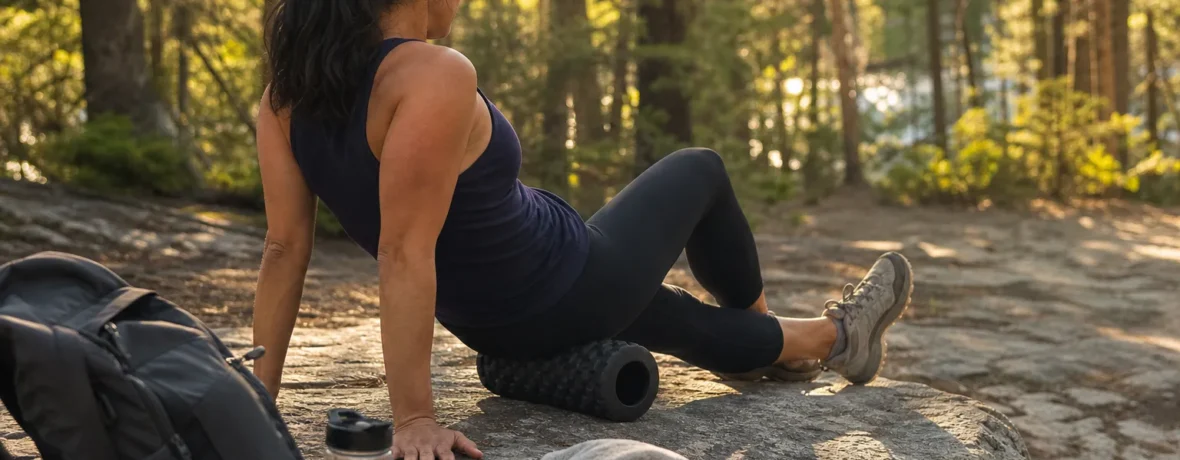
Foam rolling helps hikers when it is used as recovery, not as treatment for an injury. Spend 5 to 10 minutes total, using 30 to 60 seconds per tight muscle group, 3 to 5 days per week. Keep pressure at a 4 to 6 out of 10 and skip sharp pain.
What are the foam rolling benefits for hikers?
Foam rolling may help you feel less stiff and move more freely after steep climbs, long descents, and heavy-pack days.
For hikers, the big win is simple: your legs take repeated hits from step-ups, braking on downhill grades, uneven footing, and pack weight. A roller gives you a controlled way to apply pressure to sore muscle tissue without needing a massage table or a recovery gadget the size of a bear canister.
Research is not magic-wand strong, but it is useful. A review on myofascial rolling found the most consistent short-term benefit was reduced muscle soreness, with at least 90 seconds per muscle appearing helpful in the studies reviewed; you can read the abstract through NIH’s PubMed database. Another review found foam rolling can acutely increase joint range of motion; see the open-access paper in PubMed Central.
What does that mean on trail life terms? You may squat to filter water more easily. Your calves may not bark as much the morning after a climb. Your hips may feel less cranky before you shoulder the pack again.
What foam rolling will not do: fix a sprain, erase poor training, make too-small shoes fit, or replace strength work. The CDC adult activity guidelines still point adults toward aerobic activity plus muscle-strengthening work. Rolling is a sidekick. Not the whole training plan.
Does foam rolling help sore legs after hiking?
Yes, it can reduce the feeling of soreness for some hikers, especially when done after the hike or later the same day.
Post-hike soreness usually shows up in the calves, quads, glutes, hamstrings, and the small stabilizers around the hips. Descents hit the quads hard because they are working to slow you down. Climbing pounds the calves and glutes. Sidehill trail and rocky tread ask your hips to keep correcting your balance.
Use foam rolling for normal muscle soreness: dull, broad, symmetrical, and tied to effort. Do not use it to grind into a hot spot, swollen area, bruise, sharp pain, numbness, tingling, or pain that changes your gait. That is not “recovery.” That is your body waving a red flag.
Should you foam roll before or after a hike?
After is usually the better time for longer rolling; before a hike, keep it short and pair it with movement.
Before a hike, you want to feel loose without making your legs lazy. Roll briefly, then move. Think 20 to 30 seconds on calves or quads, followed by ankle circles, leg swings, bodyweight squats, or a few minutes of easy walking from the trailhead.
After a hike, you can slow down. Use 30 to 60 seconds per area. Breathe. Let the pressure sink in without forcing it. If you are backpacking and carrying a short roller or massage ball, roll in camp before your legs stiffen up completely.
| Timing | Best use | How long | What to avoid |
|---|---|---|---|
| Before hiking | Loosen tight calves, quads, and hips | 20 to 30 seconds per area | Long, painful rolling |
| After hiking | Reduce stiffness and calm sore muscles | 30 to 60 seconds per area | Rolling bruises, joints, or sharp pain |
| Rest day | Recovery plus mobility work | 5 to 15 minutes total | Replacing strength training |
How do you foam roll after hiking?
Use slow passes, moderate pressure, and stop before pain turns sharp.
The best routine is the one you will actually do. You do not need 30 moves. You need a short, repeatable sequence that targets the muscles hikers use most.
- Calves: Sit with one calf on the roller. Cross the other leg on top if you need more pressure. Roll from just above the Achilles tendon to below the knee for 30 to 60 seconds per side.
- Hamstrings: Place the roller under the back of the thigh. Roll from above the knee to below the glute. Keep the pressure lighter here; 30 to 45 seconds per side is plenty.
- Quads: Lie face down with the roller under the front of one thigh. Roll from above the kneecap to below the hip crease for 45 to 60 seconds per side.
- Glutes: Sit on the roller and cross one ankle over the opposite knee. Lean slightly toward the crossed-leg side. Roll the meaty part of the glute for 45 to 60 seconds per side.
- Outer hip, not the IT band: Roll the side of the hip and upper outer thigh lightly. Do not mash straight down the knee side of the IT band. Keep this gentle for 30 seconds per side.
- Upper back: Lie with the roller across your upper back, knees bent, hips low. Roll from the shoulder blades to mid-back for 30 to 45 seconds. Skip the lower back.
Use a pain scale. A 4 to 6 out of 10 is enough. If you are holding your breath, clenching your jaw, or trying to win a toughness contest with a cylinder of foam, back off.
What muscles should hikers foam roll?
Start with calves, quads, glutes, hamstrings, and the outer hips.
Those areas do the heavy lifting on most hikes. Your calves push you uphill. Your quads brake you downhill. Your glutes drive step-ups and stabilize your pelvis. Your hamstrings help control the hip and knee. Your outer hips keep your knees from wobbling inward when the trail tilts, twists, or gets rocky.
Use this quick checklist after long hikes, hill repeats, stair workouts, or backpacking days:
- Calves feel tight after climbing or wearing stiff boots
- Quads feel tender after long descents
- Glutes feel dull and heavy after big step-ups
- Hips feel stiff after sidehill trail or scrambling
- Upper back feels tight from pack straps
Avoid rolling directly over knees, ankles, hip bones, the spine, bruises, varicose veins, open skin, or any area with numbness. More pressure is not better. Better pressure is better.
What kind of foam roller is best for hiking recovery?
A medium-density smooth roller is the best first pick for most hikers.
Hard, knobby rollers look serious, but they can be too aggressive if you are sore from a big trail day. Start simple. A 12 to 18 in [30 to 46 cm] roller is easy to store at home or toss in the car. A 36 in [91 cm] roller is nicer for upper-back work and balance drills, but it is bulky.
| Tool | Best for | Trail practicality |
|---|---|---|
| Smooth foam roller | Calves, quads, hamstrings, glutes | Best home or car-camping option |
| Textured roller | Experienced users who like firmer pressure | Useful, but easy to overdo |
| Massage ball | Feet, glutes, small hip spots | Best backpacking option |
| Water bottle | Light calf or foot rolling in camp | Works in a pinch |
When should you not foam roll?
Do not foam roll an injury, swelling, sharp pain, numbness, or a spot that feels worse as you continue.
Normal muscle soreness should ease as you warm up or roll gently. Injury pain often feels sharp, localized, unstable, or protective. If your stride changes, your knee buckles, your ankle swells, or you cannot bear weight normally, put the roller away.
Also be cautious if you have a medical condition that affects blood clotting, sensation, circulation, skin integrity, or bone health. If you are unsure, ask a qualified clinician before adding deep pressure work.
When to see a doctor
See a medical professional if pain is severe, worsening, or interfering with normal walking.
Foam rolling is not a diagnostic tool. It should not be used to “test” an injury or push through a problem. Mayo Clinic advises getting medical care right away for muscle pain with trouble breathing, dizziness, extreme weakness, high fever with stiff neck, or a severe injury that keeps you from moving; it also recommends making an appointment for signs such as infection, rash after a possible tick bite, calf pain that occurs with exercise and goes away with rest, or muscle pain after starting or increasing a medicine. Read the full guidance from Mayo Clinic on muscle pain.
In the backcountry, take lower-body pain seriously because small problems can become evacuation problems. Wilderness medicine guidance treats unusable or unstable musculoskeletal injuries as reasons to seek evacuation support; see the Wilderness Medical Society-published minimum guidelines for wilderness first aid.
Related reading
- Weighted Vest Benefits for Hikers
- What Are the Benefits of Hiking? The Evidence for Body and Mind
- How Many Steps in a Mile (Walking vs Hiking)?
- What Is the Best Cardio for Hikers?
FAQ
How often should hikers foam roll?
Roll 3 to 5 days per week if it helps you feel better. Keep most sessions between 5 and 10 minutes, and use lighter pressure on days when your legs are very sore.
Can foam rolling replace stretching?
No, foam rolling should not fully replace stretching or mobility work. Use rolling to reduce stiffness, then add active movement such as ankle mobility, hip openers, leg swings, or easy walking.
Is it better to foam roll fast or slow?
Slow is better. Move roughly 1 in [2.5 cm] per second, pause on tender areas for a few breaths, and stop if the sensation turns sharp or electric.
Should you foam roll your IT band?
Do not grind directly down the IT band. Roll the outer hip, glutes, quads, and hip flexor area instead, since those muscles influence tension around the outside of the thigh.
Can foam rolling help knee pain from hiking?
It may help nearby muscle tightness, but it will not fix the cause of knee pain. If knee pain is sharp, swollen, unstable, recurring, or changes your gait, stop rolling and get assessed by a medical professional.