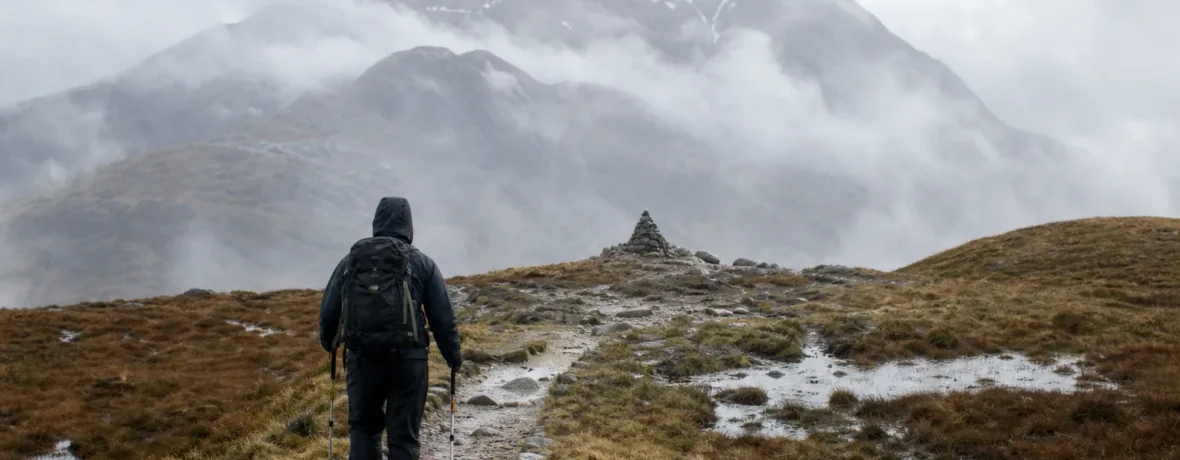
Most hikers take 7 to 9 hours to hike Ben Nevis by the Mountain Track, with 4 to 5 hours up and 3 to 4 hours down. The route is 10 miles [16 km] round trip, climbs 4,396 feet [1,340 m], and reaches the UK’s highest summit at 4,413 feet [1,345 m].
How long does it take to hike Ben Nevis?
Plan on 7 to 9 hours for the standard Ben Nevis hike.
That answer fits most walkers using the Mountain Track from Glen Nevis Visitor Center. The official Visitor Center FAQ gives 7 to 8 hours as the average time to the summit and back, while Mountaineering Scotland describes the same route as a demanding 6 to 9 hour hill day. If you want a safe planning window, use 8 hours as your working number and carry enough layers, food, and daylight for 9. See the Ben Nevis Visitor Center FAQ and Mountaineering Scotland’s Ben Nevis guidance.
Fast, hill-fit hikers can finish in less time. First-timers, big groups, photographers, charity teams, and anyone walking in cloud, rain, wind, snow patches, or poor visibility should expect the upper end of the range.
The climb is not technical in normal summer conditions, but it is still a proper mountain day. You gain nearly 4,400 feet [1,340 m], spend hours on rock and stone steps, and descend on tired legs. The downhill is where many people slow down.
How far is the Ben Nevis hike?
The Mountain Track is 10 miles [16 km] round trip.
That distance runs from Glen Nevis Visitor Center to the summit and back the same way. The numbers sound manageable on paper. They feel different on the hill because almost all of the first half is uphill, and the surface becomes rougher as you climb.
| Route | Distance | Typical time | Best for |
|---|---|---|---|
| Mountain Track | 10 miles [16 km] | 7 to 9 hours | Most hikers with good fitness |
| Carn Mor Dearg Arête | Longer and more committing | 10 to 11 hours | Experienced hikers and scramblers |
The Mountain Track is the usual choice and starts at the Visitor Center in Glen Nevis. VisitScotland describes two main walking routes: the Mountain Track for most walkers, and the Carn Mor Dearg Arête for experienced hillwalkers who can handle a longer day, boulders, exposure, and careful navigation. Read the route overview from VisitScotland’s Ben Nevis guide.
Is Ben Nevis hard to climb?
Yes, Ben Nevis is hard because it is long, steep, high, and exposed.
Do not let the old nickname “Tourist Track” fool you. The Mountain Track is the most straightforward way up Ben Nevis, not an easy walk. You need steady legs, lungs that can handle a long climb, and the patience to keep moving after the summit buzz has worn off.
The lower path is clear and built, with stone steps and a steady gradient. Higher up, the track crosses rougher ground, loose stones, and a broad summit plateau where cloud can erase the line of the path. Near the top, cliffs and gullies sit close enough that navigation matters when visibility drops.
What makes it tough:
- Elevation gain: 4,396 feet [1,340 m] is a serious climb.
- Time on feet: 7 to 9 hours is a long hiking day.
- Weather: Fort William can feel mild while the summit is cold, wet, windy, or still holding snow.
- Descent fatigue: Quads, knees, ankles, and feet take a pounding on the way down.
- Navigation: Cloud can reduce visibility fast on the upper mountain.
Which route up Ben Nevis should you take?
Most hikers should take the Mountain Track from Glen Nevis Visitor Center.
This is the standard walking route. It is direct, well-used, and starts from the main visitor hub in Glen Nevis. You still need mountain clothing, food, water, a map, a compass, and the skill to use them if the cloud drops.
The Carn Mor Dearg Arête is a different beast. It is longer, more strenuous, and includes exposed scrambling across a narrow ridge. Save it for a clear, settled day if you already have scrambling experience, a good head for heights, and strong route-finding skills.
If this is your first Scottish mountain, pick the Mountain Track. If this is your first mountain anywhere, build up on smaller hills first.
How long does each part of the Ben Nevis hike take?
Most walkers spend 4 to 5 hours going up and 3 to 4 hours coming down.
Your exact split depends on fitness, weather, crowding, breaks, and how confident you are on rocky ground. Use the schedule below as a planning tool, not a promise.
| Section | Typical time | What to expect |
|---|---|---|
| Visitor Center to the halfway lochan | 1.5 to 2 hours | Steady climb, stone steps, Glen Nevis views |
| Halfway lochan to Red Burn | 30 to 45 minutes | Shorter-feeling section before the upper climb |
| Red Burn to summit | 2 to 2.5 hours | Zigzags, loose rock, colder air, possible cloud |
| Summit back to Visitor Center | 3 to 4 hours | Long descent on tired legs |
The psychological halfway point is the Red Burn area, not the summit-to-distance halfway. From there, the upper slopes take work. The zigzags help, but they can feel endless when the wind picks up.
Do not burn all your energy getting to the top. The summit is only halfway through your day.
What slows people down on Ben Nevis?
Weather, weak pacing, poor footwear, and long summit stops slow people down fastest.
Ben Nevis rewards boring discipline. Start steady. Eat before you feel empty. Add layers before you get chilled. Keep breaks short in wind. Turn around if the mountain is telling you to.
The biggest time-killers are:
- Starting too fast: The first climb punishes anyone who treats it like a race.
- Carrying too little water: The Visitor Center FAQ advises taking at least 2 liters per person on a sunny day, as of November 2026.
- Stopping too long at the summit: Ten minutes in a cold wind can drain heat fast.
- Wearing soft shoes: Trainers with poor grip make the rocky descent slower and riskier.
- Relying only on a phone: Battery drain, cold, rain, drops, and patchy signal all happen.
- Waiting too late to turn back: A smart turnaround beats a benighted stumble every time.
What time should you start climbing Ben Nevis?
Start early enough to finish in daylight with a 1 to 2 hour buffer.
For a typical summer hike, many walkers aim to leave Glen Nevis Visitor Center in the morning. If your group may take 9 hours, starting at 9:00 a.m. puts you back near 6:00 p.m. in good conditions. That leaves little room for delays on shorter autumn days, so move earlier outside midsummer.
In spring, autumn, and winter, daylight changes the whole plan. Winter is not just “Ben Nevis with a jacket.” Snow, ice, cornices, and whiteout can turn the Mountain Track into a mountaineering objective. If you do not have winter mountain skills, winter navigation skills, and the right gear, choose a lower route instead.
Check the mountain forecast before you go, then check again. Mountaineering Scotland recommends dedicated mountain weather sources because the summit can be far colder and windier than Fort William.
Can beginners hike Ben Nevis?
Fit beginners can hike Ben Nevis in good summer conditions, but it should not be treated as a casual walk.
If you can walk uphill for several hours, handle uneven stone underfoot, and keep going when tired, the Mountain Track may be realistic. If your recent walking history is short city strolls and flat paths, build up first.
A sensible build-up looks like this:
- Walk 6 miles [10 km] on rolling terrain without feeling wrecked the next day.
- Add hills until you can climb for 2 continuous hours.
- Do a 4 to 5 hour hike carrying the pack you plan to use on Ben Nevis.
- Practice using a map and compass before you need them in cloud.
- Test your boots, socks, waterproofs, and snacks on a real hill day.
If you are not ready, that is not failure. Ben Nevis is not going anywhere.
What should you pack for Ben Nevis?
Pack for cold wind, rain, low cloud, and a slower day than planned.
Scottish Mountain Rescue lists boots, layered clothing, waterproofs, hat, gloves, and other hillwalking essentials as core safety kit. Their advice is simple: the gear you carry should match the activity and the conditions you may face. Use their mountain safety advice as a baseline.
- Broken-in hiking boots with good grip
- Waterproof jacket with hood
- Waterproof pants
- Warm mid-layer
- Spare insulating layer
- Hat and gloves, even in summer
- Map and compass
- Fully charged phone in a waterproof bag
- Power bank
- Headlamp with spare battery
- Food for the full day plus extra snacks
- At least 2 liters of water on warm days
- Small first aid kit
- Emergency shelter or bivy bag for the group
- Sunscreen and sunglasses when the forecast calls for sun
- Trash bag for everything you carry in
As of November 2026, the Visitor Center FAQ says there are no litter bins on the route, so bring everything back down. Banana peels, tissues, wrappers, and “just one” orange peel all count as trash.
How do you pace the Ben Nevis hike?
Start slower than feels necessary and keep your breaks short.
The first hour sets up the rest of the day. If you are breathing hard from the car park, back off. You should be able to speak in short sentences while climbing. Not sing. Not gasp. Just talk.
A simple pacing plan:
- Walk the first 30 minutes gently. Let your legs warm up.
- Stop after 45 to 60 minutes. Drink, eat, adjust layers, and move again.
- Take micro-breaks on the upper zigzags. Thirty seconds standing can beat a cold 10-minute sit.
- Limit summit time in bad weather. Get the photo, eat if safe, then start down.
- Use poles if your knees dislike descents. They can help spread the load on stone steps and rough ground.
The descent deserves respect. Keep your concentration until you are back at the Visitor Center. Ankles usually get lazy near the end.
When to see a doctor
Get medical help fast for confusion, slurred speech, severe shivering, worsening heat illness, chest pain, fainting, or an injury that stops normal walking.
Ben Nevis is not high enough for classic altitude illness, but cold stress, heat stress, dehydration, asthma flare-ups, trips, slips, and knee or ankle injuries can all end a day quickly. Mayo Clinic describes hypothermia as a medical emergency and advises calling local emergency services if you suspect it. Read Mayo Clinic’s hypothermia first aid guidance.
On the mountain, call 999 and ask for Police, then Mountain Rescue, if someone cannot continue safely or is in immediate danger. Do not wait for a minor problem to become a rescue in darkness.
Related reading
- How Long Does It Take to Hike the Appalachian Trail?
- How Long Does It Take to Climb Mount Everest?
- Camping Food Without a Fridge: No-Cook Ideas
- How Long Does It Take to Hike Mt Fuji?
FAQ
How long does it take to walk up Ben Nevis?
Most hikers take 4 to 5 hours to walk up Ben Nevis by the Mountain Track. Strong hillwalkers may be quicker, while first-timers and groups often need longer.
How long does it take to get down Ben Nevis?
Most hikers take 3 to 4 hours to get down Ben Nevis. The descent is steep, rocky, and tiring, so do not assume it will be quick just because it is downhill.
Can you hike Ben Nevis in 5 hours?
Yes, very fit hikers can complete Ben Nevis in 5 hours, but that is faster than the usual walking pace. Most people should plan for 7 to 9 hours instead.
Is Ben Nevis harder than Snowdon?
Yes, Ben Nevis is generally harder than Snowdon because it has more ascent, a higher summit, and a longer standard mountain day. Weather on the upper mountain can also be harsher.
Do you need a guide for Ben Nevis?
No, you do not need a guide for the Mountain Track in good conditions if you have fitness, kit, and navigation skills. A guide is a smart choice if you are nervous, inexperienced, leading a group, or walking outside summer.
What is the best month to hike Ben Nevis?
June through September usually gives the most practical mix of daylight and milder conditions. Snow, cold wind, rain, and cloud can still happen, so choose your day by the mountain forecast, not just the calendar.