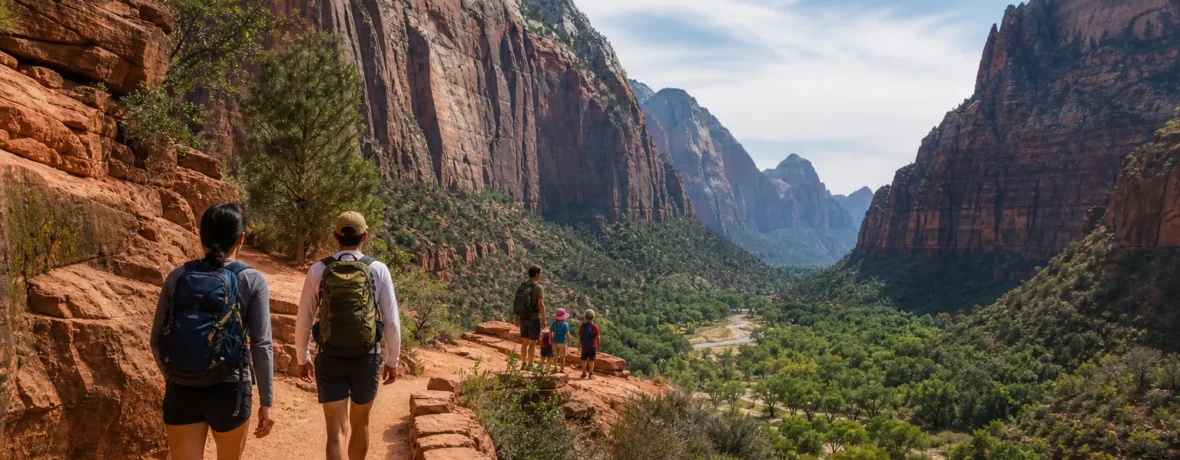
Start with 1 to 3 hikes matched to your legs: Riverside Walk or Pa’rus for easy miles, Canyon Overlook or Watchman for moderate views, and Angels Landing, Scout Lookout, or The Narrows for a tougher day with serious planning.
What are the best hikes in Zion National Park by difficulty?
The best Zion hikes range from flat riverside paths to exposed sandstone ridges. Use this table to pick your day fast, then build around shuttle timing, heat, water, and permits.
| Difficulty | Best picks | Why choose them |
|---|---|---|
| Easy | Pa’rus Trail, Riverside Walk, Lower Emerald Pool | Shorter mileage, mellow grades, strong canyon scenery |
| Moderate | Canyon Overlook, Watchman Trail, Kayenta to Emerald Pools | Better viewpoints, more climbing, manageable half-day hikes |
| Strenuous | Scout Lookout, Angels Landing, The Narrows | Big effort, exposure or water travel, stricter safety calls |
Zion rewards simple plans. Pick one main hike and one backup. Then stop trying to cram the whole park into one day. The canyon is slow, shuttles take time, parking fills, and desert heat makes “just one more trail” feel very different at 3 p.m.
What to do in Zion National Park if you have one day?
With one day, hike early, ride the shuttle efficiently, and choose one signature trail instead of three rushed ones. A clean one-day plan beats a frantic checklist every time.
- Start at the Zion Canyon Visitor Center. Get there early, use the restroom, fill bottles, and board the Zion Canyon shuttle if it is running.
- Choose your main hike. Pick Riverside Walk for easy scenery, Watchman or Canyon Overlook for a moderate viewpoint, or Scout Lookout for a harder climb without the Angels Landing chain section.
- Add one short bonus. Lower Emerald Pool or Pa’rus Trail fits well if you still have energy.
- Save time for the scenic stops. Court of the Patriarchs, Big Bend, and the Virgin River are not filler. They are part of the day.
- Leave before you are wrecked. Zion’s best day ends with dusty shoes and a clear head, not a headlamp walk you did not plan for.
If you are searching for things to do in Zion National Park beyond hiking, keep it simple: ride the shuttle through Zion Canyon, bike the Pa’rus Trail, watch sunset from a safe roadside viewpoint, visit Kolob Canyons, or spend time along the Virgin River without entering the water.
What are the best easy hikes in Zion National Park?
The best easy hikes in Zion are Pa’rus Trail, Riverside Walk, and Lower Emerald Pool. They deliver red cliffs, river views, and canyon shade without asking for a full suffer-fest.
Pa’rus Trail
Pa’rus Trail is one of Zion’s friendliest walks: 3.5 miles [5.6 km] round trip with 50 feet [15 m] of elevation change. It starts near the visitor center and follows the Virgin River toward Canyon Junction. This is a smart first hike after a long drive because you do not need to commit to the shuttle line right away.
The trail is paved, open to bikes, and gives you classic canyon walls without steep climbing. Go early for cooler air or late for softer light. If you are hiking with mixed abilities, this is the easy win.
Riverside Walk
Riverside Walk is 2.2 miles [3.5 km] round trip with 57 feet [17 m] of elevation change. It begins at Temple of Sinawava, the last Zion Canyon shuttle stop, and follows the Virgin River into a narrowing canyon.
This is the dry-land gateway to The Narrows. You can stop at the end of the paved path, watch hikers step into the river, and turn around with clean socks. The first 0.4 miles [0.6 km] is the most accessible section, though sand and uneven pavement can still make it harder than it looks.
Lower Emerald Pool
Lower Emerald Pool is a short hike with a big payoff: alcoves, dripping rock, and a lush pocket tucked under sandstone. The common round trip is 1.2 miles [1.9 km] with 69 feet [21 m] of elevation change, though access routes can shift when trail work or closures affect the Zion Lodge side.
Do not swim in the pools. Treat this as a look-and-leave place. It gets crowded because it is close to the shuttle and short enough for many hikers, so start early if you want breathing room.
What are the best moderate hikes in Zion National Park?
The best moderate hikes in Zion are Canyon Overlook, Watchman Trail, and Kayenta to Emerald Pools. They ask for more climbing, but they pay you back with real viewpoints.
Canyon Overlook Trail
Canyon Overlook is 1 mile [1.6 km] round trip with 163 feet [50 m] of elevation change. It sits on the east side of the Zion-Mount Carmel Tunnel and ends at a fenced viewpoint over lower Zion Canyon.
This trail is short, but not casual-flat. Expect stone steps, uneven rock, exposed sections, and narrow spots. Parking near the trailhead is limited, so have patience and never invent a parking space on the shoulder. That move creates problems for everyone.
Watchman Trail
Watchman Trail is 3.3 miles [5.3 km] round trip with 368 feet [112 m] of elevation gain. It starts near the visitor center, which makes it a strong choice when shuttle lines are long or you want a hike without riding deep into the canyon.
The trail climbs to views of the Towers of the Virgin, Springdale, and lower Zion Canyon. It is exposed and can feel hot fast. Bring more water than you think you need, especially from late spring through early fall.
Kayenta Trail to Emerald Pools
Kayenta Trail gives the Emerald Pools area more bite. Instead of a quick out-and-back from Zion Lodge, you climb from The Grotto and link into the pools system.
This is a better choice if you want a moderate walk with changing views rather than one short stop. Watch your footing. Sand on rock acts like ball bearings, and casual shoes turn small descents into little circus acts.
What are the hardest hikes in Zion National Park?
The hardest popular Zion hikes are Angels Landing, Scout Lookout, and The Narrows. They are not hard for the same reason, so pick based on exposure, water, weather, and your comfort with risk.
Scout Lookout
Scout Lookout is the smart hard hike for many visitors. You take the West Rim Trail from The Grotto up a steep route that includes Walter’s Wiggles, a tight stack of switchbacks, then stop before the permitted Angels Landing chain section.
The views are huge. The effort is real. You get most of the climb and much of the drama without stepping onto the narrowest ridge. If exposure makes you freeze, Scout Lookout is a better goal than forcing Angels Landing because it is famous.
Angels Landing
Angels Landing is 5.4 miles [8.7 km] round trip with 1,488 feet [454 m] of elevation gain when hiked from The Grotto. The final 0.5 miles [0.8 km] follows a narrow ridge with chains, uneven steps, two-way hiker traffic, and major drop-offs.
As of November 2026, you need a permit to hike Angels Landing beyond Scout Lookout. The National Park Service says permits are handled through seasonal and day-before lotteries on Recreation.gov, with a $6 application fee and a $3 per-person fee if awarded. Check the official Angels Landing permit page before you build your itinerary.
The Narrows from the bottom up
The Narrows is less of a trail and more of a river hike. From Temple of Sinawava, you walk Riverside Walk for 1 mile [1.6 km], then enter the Virgin River and travel upstream between towering canyon walls.
The bottom-up day hike does not require a permit as far as Big Spring, but that does not make it casual. You walk on slippery river rocks, in moving water, often in shade, with cold-water and flash-flood risk. As of November 2026, the park closes The Narrows when the Virgin River flow is over 150 cubic feet per second or when the National Weather Service issues a Flash Flood Warning; check Zion’s current conditions page before you go.
Do you need permits, reservations, or shuttle tickets for Zion?
Most Zion day hikes do not need permits, but Angels Landing does. As of November 2026, you do not need a reservation or ticket to enter Zion National Park or ride the park shuttle, but you do need to pay the entrance fee or use a valid pass.
The official Zion Canyon shuttle page says the shuttle is free to ride and does not require a permit, ticket, or reservation. During shuttle season, private vehicles are generally not allowed on Zion Canyon Scenic Drive beyond Canyon Junction, so plan your trailhead access around shuttle stops.
As of November 2026, Zion’s standard entrance pass ranges from $20 to $35 depending on entry type, and a private vehicle pass is $35 for 7 days. Non-U.S. residents age 16 and older have an additional $100 per-person fee unless admitted with an Annual or America the Beautiful Pass. Confirm current costs on the official Zion fees and passes page before paying or budgeting.
How do you get around Zion National Park without wasting time?
Use the shuttle for Zion Canyon, drive for the east side and Kolob Canyons, and avoid switching plans every hour. Zion punishes indecision.
The Zion Canyon shuttle connects the visitor center with major stops for Emerald Pools, The Grotto, Angels Landing access, Big Bend, and Temple of Sinawava. The full ride from the visitor center to Temple of Sinawava takes 45 minutes, so a round trip on the bus can eat 90 minutes before you count hiking.
- For Angels Landing or Scout Lookout: ride to The Grotto.
- For Emerald Pools: use Zion Lodge or The Grotto, depending on your route and current trail access.
- For Riverside Walk and The Narrows: ride to Temple of Sinawava.
- For Watchman Trail: start near the visitor center.
- For Canyon Overlook: drive to the east side of the tunnel and be patient with limited parking.
Kolob Canyons is a separate park district off Interstate 15, 40 miles north of Zion Canyon. Go there when you want quieter scenery, a shorter scenic drive, or a break from the main-canyon crowds.
What should you pack for hiking in Zion?
Pack for heat, slick rock, shuttle delays, and sudden weather changes. Zion hikes are short on paper until sun, sand, exposure, and crowds slow you down.
- 2 to 3 liters of water per person for most warm-weather day hikes
- Salty snacks and real food, not just candy
- Sun hat, sunglasses, and sunscreen
- Trail shoes or hiking shoes with sticky tread
- Light layers for shade, wind, and winter mornings
- Headlamp, even for a day hike
- Downloaded map or paper map
- Small first-aid kit
- Trekking poles for The Narrows or sandy descents
- Dry bag and river footwear if hiking The Narrows
For The Narrows, do not treat rental gear as a fashion choice. Cold water, unstable footing, and long shade can drain you quickly. In cooler months, proper river footwear, neoprene socks, dry pants, or a dry suit can turn a miserable mistake into a manageable hike.
When to see a doctor
Get medical help right away for severe heat symptoms, possible hypothermia, or illness after contact with cyanobacteria-affected water. This section is safety guidance, not a diagnosis.
Zion can be brutally hot. The CDC lists confusion, altered mental status, slurred speech, loss of consciousness, and seizures among emergency warning signs for serious heat illness; seek immediate care if these appear during or after a hike. Review CDC guidance on heat-related illnesses before hiking in hot weather.
Cold water matters too. The CDC says signs of hypothermia can include shivering, exhaustion, confusion, fumbling hands, memory loss, slurred speech, and drowsiness, and you should seek immediate medical attention for signs of hypothermia. That risk is real in The Narrows, especially when air temperatures are mild but you are wet for hours; read the CDC’s hypothermia warning signs.
As of November 2026, Zion warns visitors not to submerge their head in or drink instream water because of toxic cyanobacteria concerns. If you feel sick after exposure to suspicious water, contact a healthcare provider or Poison Control; if a pet becomes sick after water contact, call a veterinarian immediately.
Related reading
- Las Vegas to Zion: Distance, Drive and Day-Trip Plan
- Where to Stay in Zion National Park
- Can You Drive Through Zion National Park?
- How Many Days Do You Need in Zion National Park?
FAQ
What is the best hike in Zion National Park for first-timers?
Riverside Walk is the best first Zion hike for many visitors. It is scenic, not too steep, and gives you a dramatic canyon experience without committing to river hiking or exposed cliffs.
Can you hike Angels Landing without a permit?
No, not beyond Scout Lookout. As of November 2026, a permit is required for the Angels Landing chain section, but you can hike to Scout Lookout without an Angels Landing permit.
Is The Narrows safe for beginners?
The Narrows can be safe for prepared beginners in good conditions, but it is not a normal trail. You need to check flow, flash-flood risk, water temperature, footwear, and your turnaround time before stepping into the river.
How many days do you need in Zion National Park?
Two full days is the sweet spot for most hikers. That gives you one day for Zion Canyon classics and one day for The Narrows, Canyon Overlook, Watchman, or Kolob Canyons.
What is the easiest hike with great views in Zion?
Pa’rus Trail is the easiest hike with wide-open canyon views. If you can handle steps and uneven rock, Canyon Overlook is harder but gives a bigger viewpoint for only 1 mile [1.6 km] round trip.
When is the best time to hike in Zion?
Spring and fall usually offer the best mix of daylight and manageable temperatures. Summer can be extremely hot, while winter brings quieter trails but colder mornings, icy patches, and colder water in The Narrows.