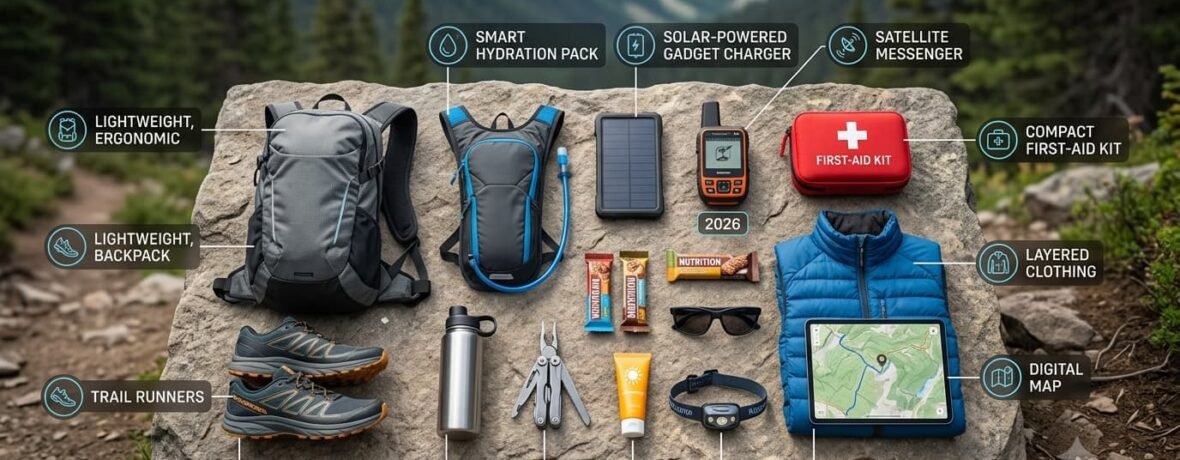
The list has not changed much in seventy years. What has changed is how light it can be.
A full day-hike kit that weighs under 3 kg before water and food.
The ten essentials were formalised by a mountaineering club in the 1930s, and the categories have proved remarkably durable. What has changed is the weight: the modern version of that list fits in a 22-litre pack and weighs less than three kilograms before water and food. This guide covers what belongs in every day pack, what to wear, and where to spend if your budget is limited.
Think in systems rather than items. Navigation, sun protection, insulation, illumination, first aid, fire, repair, nutrition, hydration and emergency shelter — each one is a category to satisfy, not a specific product to buy. Once you think that way, the list stops feeling like a shopping trip and starts feeling like a checklist.
The ten hiking essentials, updated for 2026
Navigation now means a downloaded offline map on your phone plus a paper map and compass as a genuine backup, not as decoration. Sun protection means a hat, sunglasses and sunscreen, which matter far more at altitude than most people believe. Insulation means a spare warm layer that stays in the pack even on hot days, because an injured or stationary hiker cools quickly. Illumination means a headlamp with fresh batteries on every hike, without exception.
First aid should be tailored rather than bought as a generic kit: blister treatment, tape, painkillers, an elastic bandage, gloves and any personal medication cover the overwhelming majority of trail incidents. Fire means a lighter and a small amount of tinder. Repair means a knife or multi-tool, a metre of duct tape and a length of cord. Nutrition means one more meal than you plan to eat. Hydration means water plus a means of treating more. Emergency shelter means a bivvy bag or a large survival bag weighing under 200 g.
What to wear: layering that works
Three layers cover almost every three-season day. A synthetic or merino base layer moves moisture off skin — never cotton. A fleece or light insulated midlayer provides warmth you can add and remove. A waterproof, breathable shell blocks wind and rain, and the wind protection alone is often the more useful function. Add hiking pants that dry quickly and stretch, and good socks, and you have a system that handles most conditions.
Building a kit for under $200
If your budget is tight, prioritise in this order: footwear that fits, good socks, a waterproof shell, a headlamp, and a pack. Everything else can be improvised, borrowed or bought secondhand. A capable day-hiking kit for around $200 in 2026 might be a $95 waterproof shoe, a $26 pair of merino socks, a $45 shell from a value brand, a $20 headlamp and a $30 pack found on sale. It will not photograph well and it will work perfectly.
What to leave at home
Most beginner packs contain three things that never get used: too much water where streams are reliable, spare clothing beyond one warm layer, and gadgets that duplicate a phone. Weigh your pack at home and question anything over 300 g that you did not use on the previous three hikes. Weight is comfort, and comfort is what determines whether you go out again next weekend.
Hiking essentials by priority
| Pick | Model / Option | Best for | Price | Weight | Rating |
|---|---|---|---|---|---|
| Headlamp | Essential on every hike | Petzl Actik Core | $55 | 88 g | 4.9/5 |
| Waterproof shell | Wind and rain protection | Decathlon MH500 | $70 | 320 g | 4.5/5 |
| Navigation | Offline map plus paper backup | Gaia GPS + OS map | $40/yr | 90 g | 4.8/5 |
| First aid and blister kit | Tailored, not generic | Custom 12-item kit | $25 | 160 g | 4.7/5 |
| Water treatment | Filter plus chemical backup | Sawyer Squeeze | $39 | 85 g | 4.6/5 |
| Emergency shelter | Injury or benightment | SOL Escape Bivvy | $50 | 156 g | 4.4/5 |
Weights are measured. Prices are typical 2026 street prices rather than full MSRP.
Seasonal adjustments to the standard list
Summer adds sun protection, electrolytes and significantly more water. Autumn and spring add a warmer midlayer, gloves and a hat, plus earlier turnaround times as daylight shortens. Winter changes the list more fundamentally: traction devices, a heavier insulated layer, a thermos, a closed-cell sitting pad and spare gloves become essentials rather than luxuries, and the emergency shelter becomes the item most likely to matter.
Group hiking allows you to share some items — a first aid kit, a repair kit and a stove can be communal — but never share navigation, illumination or insulation. Those three are personal, because the moment they matter is usually the moment the group has become separated.
One useful discipline is the annual audit. Once a year, empty the pack completely, replace expired medication and batteries, check that the shell still beads water, and re-treat it if not. Kit degrades quietly, and the failure is always discovered at the worst possible moment rather than on the kitchen table.
A note on phones, batteries and satellite messengers
Modern phones with satellite SOS have genuinely improved backcountry safety, but they are not a substitute for planning. Cold halves battery life, so carry the phone close to your body and bring a power bank. In remote terrain, a dedicated satellite communicator with two-way messaging remains the most reliable option, and it is worth the subscription for anyone who hikes alone or well outside coverage.
Geo guide: what to add for each environment
The core list stays constant; the additions change with the landscape.
- Desert — Four to six litres of water capacity, electrolytes, sun hoodie and a plan for shade in the middle of the day.
- Alpine — Warm layer plus gloves regardless of forecast, sunglasses for snow glare and an early start for storms.
- Temperate rainforest — Genuinely waterproof shell, dry bags for everything, and spare socks kept dry inside the pack.
- Bear country — Bear spray where legal, food storage canister and noise discipline on blind corners.
- Coastal and island trails — Tide table, wind shell, and extra water since coastal sources are often brackish or absent.
Conditions change fast in the mountains: always check the local land-manager forecast before you leave the trailhead.
Frequently Asked Questions
What are the ten hiking essentials?
Navigation, sun protection, insulation, illumination, first aid, fire, repair kit, nutrition, hydration and emergency shelter. Treat each as a category to satisfy rather than a specific product.
What should I pack for a day hike?
Water and a treatment method, food plus one spare meal, a waterproof shell, a warm layer, headlamp, first aid, map and compass, sun protection and a way to call for help.
How much water should I carry hiking?
Roughly 500 ml per hour in moderate conditions, and up to a litre per hour in heat. Plan refills at known sources rather than carrying the entire day’s supply, since water weighs a kilogram per litre.
What is the best hiking gear under $200?
A well-fitting waterproof shoe, merino socks, a value-brand waterproof shell, a reliable headlamp and a simple day pack. Spend on fit and weather protection before anything else.
Do I need a first aid kit for short hikes?
Yes, but a small one. Blister treatment, tape, painkillers, gloves and personal medication handle the vast majority of incidents on short trips and weigh under 160 g.