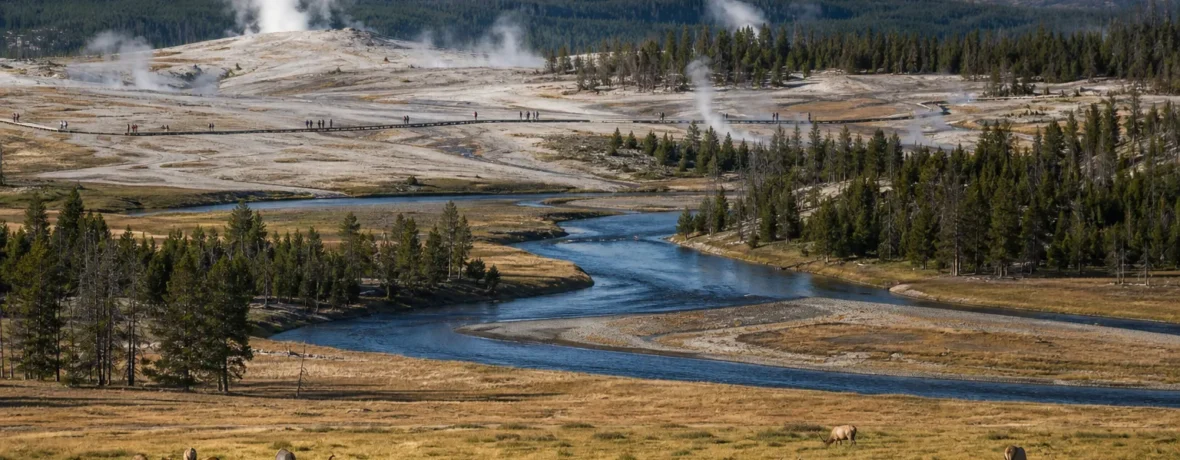
Yellowstone National Park is 3,472 square miles [8,991 sq km] and 2,221,766 acres [899,116 hectares]: bigger than Rhode Island and Delaware combined. The National Park Service park facts page says 96% is in Wyoming, 3% in Montana, and 1% is in Idaho.
How big is Yellowstone National Park in square miles?
Yellowstone is 3,472 square miles [8,991 sq km]. That number sounds tidy on a screen, but on the ground it means long drives, huge weather swings, multiple mountain ranges, broad valleys, lake country, geyser basins, waterfalls, and backcountry that can feel very far from the nearest road.
Here is the clean scale check, using the official figures from the National Park Service as of November 2026:
| Measure | Yellowstone figure | What it means for you |
|---|---|---|
| Total area | 3,472 square miles [8,991 sq km] | You cannot “see Yellowstone” in one quick lap. |
| Total acres | 2,221,766 acres [899,116 hectares] | It is a full landscape, not a single attraction. |
| North to south | 63 air miles [102 km] | Cross-park plans need real time buffers. |
| East to west | 54 air miles [87 km] | One entrance can be far from your trailhead. |
The NPS also adds a technical caution: no area figures have been scientifically verified, and work to confirm the park’s total area continues. For planning, use the official 3,472-square-mile and 2,221,766-acre figures.
How many acres is Yellowstone National Park?
Yellowstone National Park is 2,221,766 acres [899,116 hectares]. That is the official NPS acreage listed for the park as of November 2026.
For hikers, acreage is not trivia. It explains why Yellowstone trips break down best by region: Old Faithful and the geyser basins, Canyon and Hayden Valley, Mammoth and the northern range, Yellowstone Lake, Lamar Valley, and the more remote southern and eastern corners. Try to stitch all of that into a single rushed day and the park will win. Easily.
How big is Yellowstone National Park compared with other places?
Yellowstone is larger than Rhode Island and Delaware combined. That comparison comes straight from the NPS, and it is the fastest way to reset your expectations.
You are not visiting a city park with a famous geyser attached. You are entering a high-elevation volcanic plateau with forests, grasslands, lakes, canyons, thermal areas, and wildlife corridors spread across three states. The park’s surface is listed as roughly 5% water, 15% grassland, and 80% forest by NPS park facts, which helps explain why a hike can shift from open sage country to lodgepole forest to steaming basin edges in one outing.
Which states is Yellowstone National Park in?
Yellowstone is in Wyoming, Montana, and Idaho. The official split is 96% in Wyoming, 3% in Montana, and 1% in Idaho.
That matters when you choose an entrance. The North and West entrances are in Montana gateway towns. The South Entrance connects toward Grand Teton National Park and Jackson, Wyoming. The East Entrance points toward Cody. The Northeast Entrance leads toward Cooke City and the Beartooth region. On a map, those dots look friendly. In real driving time, they can be hours apart.
How long does it take to get across Yellowstone?
It takes several hours to drive between Yellowstone’s entrances. The park has five entrance stations, and the NPS tells visitors to expect long cross-park drives and to check road status before committing to a route.
As of November 2026, the official Yellowstone roads page says the only road generally open year-round to regular vehicles is the route from the North Entrance at Gardiner, Montana, through the park to Cooke City, Montana, via Tower Junction. Most park roads close to regular vehicles from early November to late April, with limited oversnow travel in winter. Conditions can change fast. Snow, construction, wildlife jams, fire activity, and temporary closures can turn a clean plan into a long detour.
How should you plan a hike in a park this large?
Plan by zone, not by wish list. Yellowstone is too large for “just one more stop” thinking.
- Pick your base first. Choose lodging or camping near the part of the park you most want to hike.
- Check the road status the day you travel. Do this before you leave cell service, not when you are already committed.
- Choose one main hike per day. Add overlooks, boardwalks, or short walks after that. Do not build the day around three distant trailheads.
- Pack for elevation and weather. Yellowstone can swing from sun to cold rain or snow fast, especially outside midsummer.
- Leave wildlife space. A bison beside the road is not a photo prop. It is a wild animal with right of way.
What rules should hikers know before visiting Yellowstone?
Day hiking does not require a backcountry permit, but overnight backcountry camping does. As of November 2026, the official Yellowstone backcountry camping page says a permit is required year-round for every overnight stay in the backcountry, and reservations are available through Recreation.gov.
A few rules deserve space in your brain before your boots hit dirt:
- Wildlife distance: As of November 2026, the official Yellowstone safety page says to stay at least 100 yards [91 m] from bears, wolves, and cougars, and at least 25 yards [23 m] from all other wildlife, including bison and elk.
- Thermal areas: Stay on boardwalks and designated trails. Hot spring crust can be thin, and thermal water can cause severe or fatal burns.
- Pets: Pets are not allowed on hiking trails, boardwalks, in thermal areas, or in the backcountry, except for qualifying service animals under park rules.
- Entrance passes: As of November 2026, the official Yellowstone fees page lists standard entrance passes at $20–$35, with a private vehicle pass costing $35 and valid for seven consecutive days.
- Vehicle reservations: As of November 2026, Yellowstone does not require a vehicle reservation to enter, but an entrance pass is required.
Why does Yellowstone feel even bigger than the map says?
Yellowstone feels bigger because distance is only one part of the equation. The park sits high, the roads curve, wildlife can stop traffic, trailheads are spread out, and seasonal closures can cut off the route you hoped to use.
Then there is the terrain. Boardwalk miles in a geyser basin do not feel like forest miles near Canyon. Open valley hiking near Lamar does not feel like climbing toward a pass. Lake weather can be its own beast. The park’s size is physical, but it is also logistical. Smart visitors slow down and let the map breathe.
Related reading
- How Big Is Yosemite National Park?
- How Big Is Kruger National Park?
- Is Big Sur a National Park?
- How Big Is Glacier National Park?
FAQ
Is Yellowstone the biggest national park in the United States?
No. Yellowstone is huge, but several Alaska national parks are larger. Yellowstone’s official size is 3,472 square miles [8,991 sq km], which still makes it one of the largest national parks in the contiguous United States.
Is Yellowstone bigger than Yosemite?
Yes. Yellowstone is larger than Yosemite by land area. Yellowstone is listed by the NPS at 2,221,766 acres [899,116 hectares], while Yosemite is much smaller in acreage.
Can you drive through all of Yellowstone in one day?
You can drive a long loop in a day when roads are open, but that is not the best way to experience the park. Yellowstone has five entrances, long distances, and frequent delays, so one day works better with one region and a short list of stops.
Do you need a permit to hike in Yellowstone?
No permit is required for day hiking. A backcountry permit is required year-round for overnight stays in Yellowstone’s backcountry, as verified by the NPS backcountry camping page as of November 2026.
How much of Yellowstone is in Wyoming?
Ninety-six percent of Yellowstone is in Wyoming. The remaining official split is 3% in Montana and 1% in Idaho.
How many days do you need for Yellowstone?
Three to five days gives you a stronger first visit than a single rushed day. With that amount of time, you can group hikes and sights by region instead of spending most of your trip in the car.