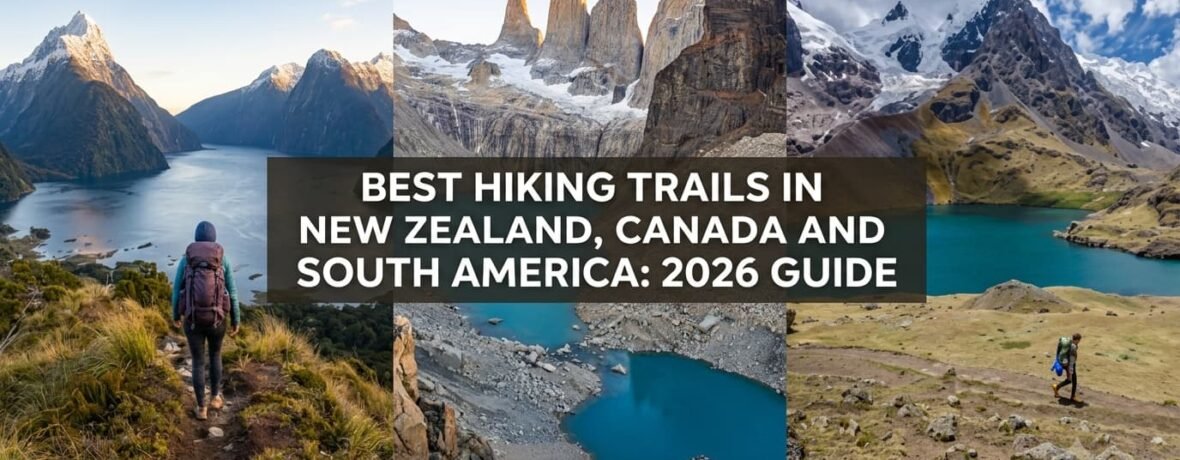
Three regions, three completely different kinds of walking — and three very different booking calendars.
Southern-hemisphere seasons make these regions ideal counterweights to a northern summer.
If you have a fortnight and a flight budget, three regions consistently deliver the most memorable hiking on the planet: New Zealand for compact alpine drama and superb huts, Canada for scale and wildness, and South America for high-altitude circuits that feel genuinely remote. This guide answers the practical questions — which trails, which months, which permits — rather than simply listing scenery.
The single biggest planning factor is the calendar. New Zealand and South America run on southern-hemisphere seasons, which makes them ideal for a European or North American winter escape. Canada compresses its high-country season into roughly ten weeks. Getting the month right matters more than getting the trail right.
New Zealand: the Great Walks and the better alternatives
New Zealand’s Great Walks are justifiably famous. The Milford Track offers rainforest, waterfalls and a mountain pass across four days. The Routeburn packs alpine views into 33 km. The Kepler is a demanding loop with a superb ridge section. All of them require hut bookings that open months ahead and sell out for peak season within minutes, which pushes many visitors towards better-value alternatives.
Those alternatives are often superior. The Rees-Dart, the Gillespie Pass Circuit and the Travers-Sabine in Nelson Lakes deliver comparable terrain with a fraction of the booking pressure. The trade-off is river crossings, which are the defining hazard of New Zealand tramping: after heavy rain, rivers rise quickly and crossing them kills people every year. If a river looks doubtful, wait. Levels typically drop within hours.
Canada: scale, bears and a short season
Canadian hiking is defined by size. The Skyline Trail in Jasper spends most of its length above treeline. Berg Lake in Mount Robson is one of North America’s finest three-day trips. The West Coast Trail on Vancouver Island is a rugged, ladder-strewn coastal classic that demands respect and a tide table. The Rockwall in Kootenay strings together passes and limestone walls across four days.
Two constraints dominate. First, the season is short: high routes are usually snow-free only from July to mid-September, and July can still hold snow in a heavy year. Second, bears are genuinely part of the planning. Carry spray where it is permitted, know how to use it, store food in the provided lockers or a certified canister, hike in groups and make noise on blind corners. Backcountry permits are required in national parks and are released on a schedule worth diarising.
South America: high circuits and thin air
The top hiking trails in South America are mostly circuits rather than linear trails. Torres del Paine in Chile offers the W or the full O circuit, with wind that must be experienced to be believed. The Huayhuash Circuit in Peru is arguably the most spectacular high-altitude trek anywhere, spending days above 4,000 m. Santa Cruz in the Cordillera Blanca is the accessible introduction to Peruvian trekking, and the Quilotoa Loop in Ecuador is a superb self-guided village-to-village walk.
Altitude is the deciding factor. Above 3,000 m, ascend no more than 300 to 500 m of sleeping altitude per day, build in rest days and know the symptoms of altitude sickness. Peruvian and Bolivian treks routinely cross passes above 4,700 m, which is not a place to discover you rushed the acclimatisation. Local guides and arrieros are not merely a convenience here; they are a genuine safety and cultural asset.
Booking, guides and getting there
New Zealand huts and Torres del Paine refugios both require booking months in advance for peak season. Canadian backcountry permits open on fixed dates by park. South American circuits can often be arranged locally a few days ahead, which suits flexible travellers but is changing as popularity grows. Build at least two spare days into any itinerary in Patagonia or Fiordland, because weather will eventually use them.
Destination trails compared: NZ, Canada and South America
| Pick | Model / Option | Best for | Price | Weight | Rating |
|---|---|---|---|---|---|
| Milford Track | New Zealand, 53 km, 4 days | Rainforest and Mackinnon Pass | Oct–Apr | Hut booking | 4.7/5 |
| Gillespie Pass Circuit | New Zealand, 58 km, 3–4 days | Great Walk scenery, fewer people | Dec–Mar | River skills | 4.6/5 |
| Skyline Trail, Jasper | Canada, 44 km, 2–3 days | Longest above-treeline route in the Rockies | Jul–Sep | Permit | 4.8/5 |
| West Coast Trail | Canada, 75 km, 5–7 days | Ladders, tides and coastal wilderness | May–Sep | Permit + orientation | 4.5/5 |
| Huayhuash Circuit | Peru, 130 km, 8–12 days | High-altitude Andean classic | May–Sep | Guide advised | 4.9/5 |
| Torres del Paine O Circuit | Chile, 130 km, 8 days | Granite towers and Patagonian wind | Nov–Mar | Refugio booking | 4.7/5 |
Ratings reflect overall trip quality including scenery, infrastructure and reliability of conditions.
What to pack differently for each region
New Zealand demands genuinely waterproof shells and fast-drying layers, because Fiordland receives extraordinary rainfall and huts do not always dry gear. Sandals for river crossings are worth their weight. Canada requires bear-safe food storage, insect protection in early summer and a warm layer even in August, since alpine nights drop below freezing. Bring a tide table for coastal routes.
South America needs sun protection above all else: at 4,500 m the ultraviolet load is brutal, and a wide-brimmed hat, high-factor sunscreen and proper sunglasses matter more than any garment. Add a warm sleeping bag rated well below the forecast, because high-altitude nights are far colder than daytime temperatures suggest, and pack layers for Patagonian wind that turns a mild day into a hard one.
Across all three regions, water treatment deserves thought. New Zealand backcountry water is often drinkable but not guaranteed. Canadian sources need filtering. Andean streams below grazing altitude should always be treated. A lightweight filter plus chemical backup covers every case and weighs almost nothing.
Travelling responsibly in fragile places
All three regions are dealing with rising visitor numbers. Hire local guides where guiding is a livelihood, stay in community-run accommodation, respect Māori cultural values around sacred peaks in New Zealand, and pack out everything in the Andes where waste management is limited. Book the shoulder season if you can — you will get better conditions, cheaper flights and a lighter footprint on the trails.
Geo guide: seasons and access at a glance
Timing is the first decision for each of these regions.
- Fiordland & Southern Alps, NZ — Great Walk season runs late October to April; bookings open in the preceding May and sell out fast.
- Nelson Lakes & Mount Aspiring, NZ — December to March is most reliable; river levels dictate route choices more than any forecast.
- Canadian Rockies — July to mid-September only; permit releases open on fixed dates in winter and go quickly.
- Vancouver Island coast — May to September with mandatory orientation on the West Coast Trail; tides govern daily distances.
- Peruvian Andes — Dry season May to September; plan two to three acclimatisation days in Huaraz or Cusco before any trek.
- Patagonia — November to March, with wind peaking in December and January; always build spare weather days.
Conditions change fast in the mountains: always check the local land-manager forecast before you leave the trailhead.
Frequently Asked Questions
What are the best hiking trails in New Zealand?
The Milford, Routeburn and Kepler are the famous Great Walks, while the Gillespie Pass Circuit, Rees-Dart and Travers-Sabine offer comparable scenery with far less booking pressure.
What are the best hiking trails in Canada?
The Skyline Trail in Jasper, Berg Lake in Mount Robson, the Rockwall in Kootenay and the West Coast Trail on Vancouver Island are the standouts, all within a July to September window.
What are the top hiking trails in South America?
The Huayhuash and Santa Cruz circuits in Peru, Torres del Paine in Chile and the Quilotoa Loop in Ecuador cover the range from high-altitude expedition to accessible village walking.
Do I need a guide for South American treks?
Not always, but guides and arrieros add real safety and local knowledge at altitude, and some areas require them. Independent trekking is straightforward on Santa Cruz and Quilotoa with proper acclimatisation.
When is the best time to hike in the southern hemisphere?
November to March for Patagonia and New Zealand, and May to September for the Peruvian Andes, which sits in a dry season rather than a summer season.