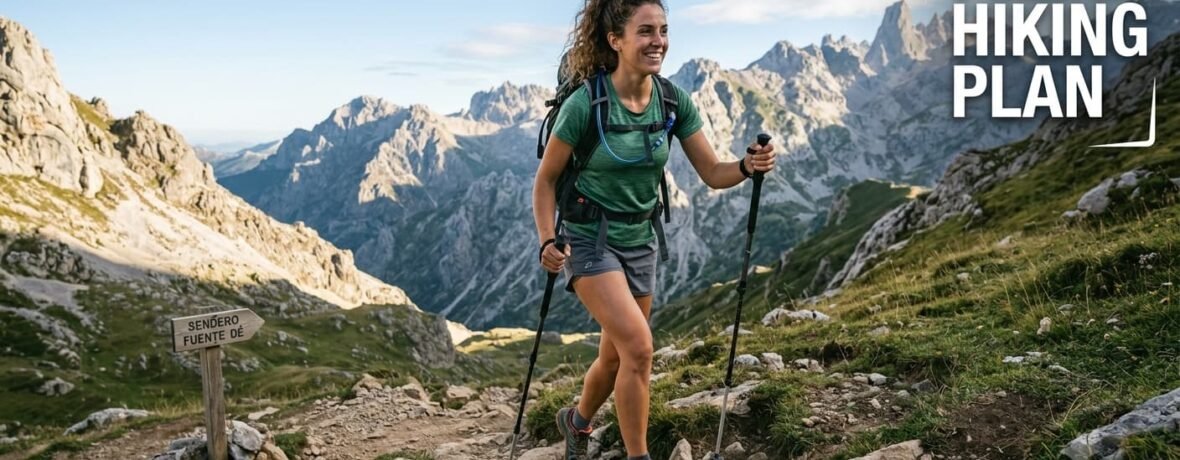
You do not need to be an athlete to hike well. You do need legs that have practised carrying you uphill.
Specificity beats intensity: loaded uphill walking is the training that transfers directly to the trail.
Hiking fitness is a specific quality, and it is not the same thing as being fit in general. Strong runners are regularly humbled by a day with 1,200 m of ascent under a 12 kg pack, and gym regulars often discover that their quadriceps have never been asked to absorb three hours of downhill. The good news is that hiking-specific fitness responds quickly. Eight weeks of sensible training changes an uncomfortable day into an enjoyable one.
The principle underneath everything below is specificity: the closer your training looks to the activity, the better it transfers. Walking uphill with weight on your back is the highest-value session you can do, and everything else in this plan exists to support it or to protect you from injury while you do it.
The eight-week hiking preparation plan
Weeks one and two establish a base. Aim for three walks per week: two of 45 to 60 minutes on rolling ground with no pack, and one longer walk of 90 minutes. Add two short strength sessions focused on squats, step-ups, calf raises and a plank progression. The goal is consistency, not effort — if you finish each week feeling that you could have done more, the plan is working.
Weeks three to five introduce load and gradient. Carry 5 kg on your long walk and increase it by 2 kg each week. Add a dedicated hill session: 20 to 30 minutes of sustained climbing on the steepest hill, stairs or treadmill incline you can find. Extend the long walk by roughly 15 per cent per week, and make one of those walks resemble your target route in surface and steepness.
Weeks six and seven are the peak. Your long walk should reach around 70 to 80 per cent of the distance and ascent of your target hike, carrying the pack weight you plan to use. Do at least one back-to-back weekend — a long walk on Saturday followed by a medium one on Sunday — because consecutive-day tolerance is what multi-day hiking actually demands. Week eight is a taper: cut volume by half, keep the intensity, and arrive rested.
Strength work that actually protects hikers
Four movements cover most of what a hiker needs. Step-ups onto a knee-height box build the exact pattern of climbing. Split squats address the single-leg strength that trails demand and that double-leg exercises hide. Calf raises, done both straight-legged and bent-knee, protect the Achilles and support long descents. And a hip-hinge movement such as a Romanian deadlift or a hip thrust builds the posterior chain that keeps a heavy pack from pulling you forward.
Do not neglect descent conditioning
Downhill walking is eccentric work: your quadriceps lengthen under load with every step. It is the reason people cannot walk down stairs for three days after a big mountain day, and it is trainable. Add slow, controlled step-downs — four seconds to lower — twice a week, and include genuine downhill walking in your outdoor sessions rather than always looping back on gentle ground. Three weeks of eccentric preparation reduces post-hike soreness dramatically.
Pacing and breathing on the day
The most common trail mistake is starting too fast. Set your pace so that you could hold a conversation in full sentences; if you cannot, you are borrowing from the last hour of the day. On steep ground, shorten your stride rather than slowing your cadence, and use the rest step — a momentary pause with the rear leg straight and locked — to let bones rather than muscles hold you between steps. It looks slow and it is remarkably efficient.
Are you ready? Hiking fitness benchmarks
| Pick | Model / Option | Best for | Price | Weight | Rating |
|---|---|---|---|---|---|
| Beginner day hike | Walk 8 km with 300 m gain | No pack, comfortable pace | 2–3 hrs | 4 weeks prep | 4.6/5 |
| Standard day hike | Walk 14 km with 600 m gain | 5 kg pack, steady effort | 4–5 hrs | 6 weeks prep | 4.7/5 |
| Big mountain day | Walk 20 km with 1,000 m gain | 8 kg pack, no cramping | 6–8 hrs | 8 weeks prep | 4.5/5 |
| Overnight backpacking | Back-to-back 15 km days | 12 kg pack both days | 2 days | 10 weeks prep | 4.4/5 |
| Multi-day trek | Three consecutive 18 km days | 14 kg pack, recovery intact | 3 days | 12 weeks prep | 4.3/5 |
| Altitude trek | Sustained effort above 3,000 m | Plus acclimatisation days | Varies | 16 weeks prep | 4.2/5 |
Benchmarks assume you can complete each test without excessive soreness the following day. If not, repeat that stage for another two weeks.
Recovery, nutrition and the parts people skip
Training adaptation happens during rest, not during effort. Take at least one full rest day each week, sleep as the priority recovery tool, and treat persistent joint pain as information rather than weakness. A modest amount of soreness in the two days after a hard session is normal; sharp pain, swelling or pain that worsens during activity is not, and pushing through it is how a six-week niggle becomes a six-month injury.
Fuel training walks the way you intend to fuel the hike. Aim for 200 to 300 calories per hour of moving time on anything over two hours, mostly carbohydrate, and drink around 500 ml per hour in moderate conditions and more in heat. Practise this in training so that your stomach is used to eating on the move — trail days are not the moment to discover that a particular bar disagrees with you at altitude.
Protein intake matters more than most hikers assume, particularly for anyone over 40. Roughly 1.6 g per kilogram of body weight per day supports the muscle adaptation your strength sessions are trying to create. Combine that with consistent sleep and the same programme produces noticeably better results than it does on a poor diet.
Training with limited time or a bad knee
If you have only two sessions a week, make them one long walk and one strength session. If your knees complain on descents, strengthen quadriceps and glutes, use poles to reduce joint load and shorten your stride downhill. If you cannot access hills, a treadmill at 10 to 15 per cent incline or a stairwell in an office building both work well, and a loaded pack turns either into a genuinely hard session.
Geo guide: training for the terrain you are heading to
Match your preparation to the specific demands of your destination.
- Alpine Europe — Long sustained ascents — train continuous 60 to 90 minute climbs rather than short repeats.
- Scottish Highlands — Steep pathless gradients and bog — add ankle stability work and practise on rough ground.
- Grand Canyon and desert — You descend first and climb out in heat — train the reverse profile and practise heat tolerance.
- High Andes and Himalaya — Aerobic base plus acclimatisation days; no fitness level substitutes for time spent adapting to altitude.
- Appalachian and Carpathian forest — Endless short climbs — train cumulative gain with repeated hill laps rather than one big ascent.
Conditions change fast in the mountains: always check the local land-manager forecast before you leave the trailhead.
Frequently Asked Questions
How long does it take to get fit for hiking?
Most people need six to eight weeks of consistent training for a demanding day hike, and ten to twelve weeks for multi-day backpacking. Prior fitness shortens this, but tendons and connective tissue adapt more slowly than muscles.
What is the best exercise for hiking?
Walking uphill with a loaded pack, because it is the closest match to the activity. Support it with step-ups, split squats, calf raises and eccentric step-downs for descent conditioning.
How do I stop my legs hurting after a hike?
Train the downhill specifically with slow step-downs, use trekking poles to reduce quadriceps load, and build up gradually. Post-hike soreness is mostly eccentric damage from descending, not from climbing.
Do I need to go to the gym to train for hiking?
No. Hills, stairs, a loaded backpack and bodyweight strength work cover almost everything. A gym helps with progressive loading but is a convenience rather than a requirement.
How much weight should I train with?
Start at 5 kg and build to the weight you actually plan to carry, adding around 2 kg per week. Never train with substantially more than your target load, as the injury risk outweighs the benefit.