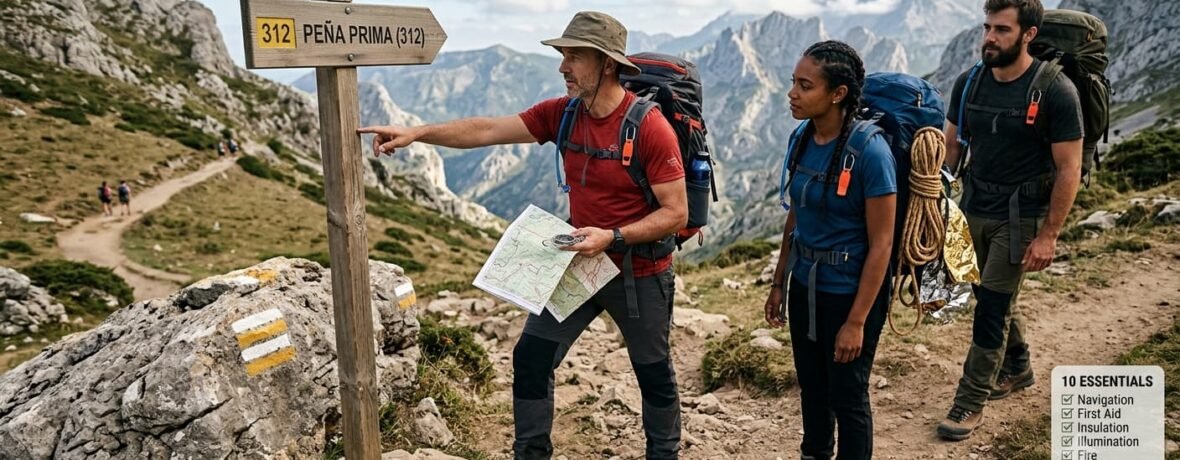
Safety on the trail is not equipment. It is a series of small decisions made before you are tired.
Most rescues involve fit, well-equipped people who simply ran out of daylight.
Hiking is a low-risk activity that occasionally produces serious consequences, and the difference between the two states is usually a handful of decisions. Rescue teams report the same causes each year: benightment, navigational error, slips on descent, weather that was worse than expected and medical events. None of them require exotic countermeasures. They require habits.
Below are the safety practices our editors follow personally, ordered by how much difference they make rather than by how impressive they sound.
Before you leave: the decisions that matter most
Tell someone your route and your expected return time, and agree what they should do if you are late. This single habit has ended more searches quickly than any device. Check a mountain-specific forecast rather than a valley one, paying attention to wind speed and freezing level rather than only to rain. Then plan your day against sunset with at least two hours of margin.
Set a turnaround time before you leave, while you are rested and rational. Write it down. The value of a pre-committed decision is that it removes the negotiation at 3 p.m. when you are tired, the summit looks close and the group dynamic pushes towards continuing. Rescue reports are full of parties who were forty minutes from the top and four hours from safety.
On the trail: navigation and pacing
Check your position at every junction, not only when something feels wrong. Carry a paper map and compass with the ability to use them, keep the phone warm and carry a power bank. Set a pace the slowest member can sustain, and place them at the front rather than the back — a group naturally walks at the speed of whoever leads.
Watch the ground on descents. Most hiking injuries happen going down, late in the day, on loose surfaces, when concentration has lapsed. Shorten your stride, use poles, and take a proper break before the descent begins rather than pushing through fatigue. If a section looks like it needs hands, stop and consider whether you have the skills, and whether you would be comfortable reversing it.
Weather, water and heat
Temperature drops roughly 6°C per 1,000 m of ascent, and wind chill compounds it. A pleasant valley morning can be genuinely dangerous on an exposed ridge. Carry the warm layer and the shell regardless of the forecast. In heat, start earlier, plan shade, drink to a schedule and know the difference between heat exhaustion, which needs cooling and rest, and heat stroke, which is a medical emergency.
Lightning deserves particular respect. Afternoon thunderstorms are predictable in most mountain ranges, and the answer is a start time early enough to be off exposed ground by early afternoon. If you are caught out, descend from ridges and summits, avoid isolated trees, and spread the group out while moving to lower terrain.
Wildlife, river crossings and other specific hazards
In bear country, make noise, store food properly and carry spray where legal. Around livestock, particularly cattle with calves, give a wide berth and let a dog off the lead rather than being pulled between the two. River crossings deserve the most caution of all: unbuckle your hip belt, face upstream, use poles, cross at the widest and shallowest point, and turn back if the water is above knee height and moving fast.
Hiking risks and how effectively they can be reduced
| Pick | Model / Option | Best for | Price | Weight | Rating |
|---|---|---|---|---|---|
| Benightment | Late start, slow pace | Turnaround time + headlamp | Very effective | All hikes | 4.9/5 |
| Slips on descent | Fatigue, loose ground | Poles, shorter stride, breaks | Effective | Rocky terrain | 4.6/5 |
| Navigation error | Cloud, snow, phone failure | Map, compass, offline GPS | Very effective | Remote areas | 4.8/5 |
| Hypothermia | Wet, wind, inactivity | Shell, spare layer, food | Very effective | Cool climates | 4.7/5 |
| Heat illness | Sun, no shade, low fluid | Early start, water schedule | Effective | Desert, summer | 4.5/5 |
| River crossing | High water, poor technique | Unbuckle, poles, turn back | Effective | NZ, Iceland, Alps | 4.4/5 |
Effectiveness reflects how reliably the countermeasure prevents the incident when applied consistently.
Emergency communication and what to do if things go wrong
A phone with satellite SOS covers a lot of ground in 2026, but a dedicated satellite communicator with two-way messaging remains the most reliable option for remote terrain and solo hiking. Know your local emergency number and procedure — in many countries a text to a registered mountain rescue number works where a call will not.
If an incident happens, stop and stabilise before doing anything else. Put warm layers on the casualty and on yourself, insulate from the ground, and eat and drink something. Then work out your exact position, decide whether the party can self-rescue, and if not, call early. Calling for help at 4 p.m. gives a rescue team daylight; calling at 8 p.m. does not.
Carry a small emergency shelter. A 150 g bivvy bag transforms the experience of waiting several hours for help in wind and rain, and it is the item most often cited by rescue teams as the difference between an uncomfortable evening and hypothermia.
Solo hiking safely
Hiking alone is a legitimate and rewarding choice, and it demands a more conservative decision threshold because there is nobody to help. Share your plan in detail, carry a satellite communicator, choose routes within your comfort range, and set an earlier turnaround than you would in a group. The margin you build in advance is the only margin you have.
Geo guide: the dominant hazard by region
Knowing which risk dominates where you are focuses your preparation.
- Scottish Highlands & Ireland — Navigation in cloud and rapid weather change; a compass bearing is a core skill, not an optional one.
- Colorado and the Alps — Afternoon lightning on exposed ridges; start early and be descending by midday in summer.
- Desert Southwest — Heat and water scarcity; the climb out of a canyon happens in the hottest part of the day.
- New Zealand and Iceland — River crossings after rain; levels rise fast and drop within hours, so waiting is usually the right answer.
- North American bear country — Food storage and surprise encounters; noise on blind corners prevents most incidents.
Conditions change fast in the mountains: always check the local land-manager forecast before you leave the trailhead.
Frequently Asked Questions
What are the most important hiking safety tips?
Tell someone your route and return time, check a mountain forecast, set a turnaround time before you leave, carry a headlamp and warm layer on every hike, and check navigation at every junction.
Is it safe to hike alone?
Yes, with a more conservative approach: detailed plan shared with someone, satellite communicator, familiar terrain and an earlier turnaround time. Solo hiking removes your margin, so decisions must be more cautious.
What should I do if I get lost hiking?
Stop, put on a warm layer, eat and drink, then try to relocate your position using the map and your last known point. If you cannot, stay put where you are visible and call for help early rather than wandering.
How do I avoid getting caught in the dark?
Plan your day against sunset minus two hours, set a turnaround time in advance, and always carry a headlamp with fresh batteries even on short hikes.
What should I do if I meet a bear?
Do not run. Speak calmly, make yourself visible, back away slowly and keep the group together. Carry spray where it is legal, know how to deploy it, and store food properly so encounters stay rare.