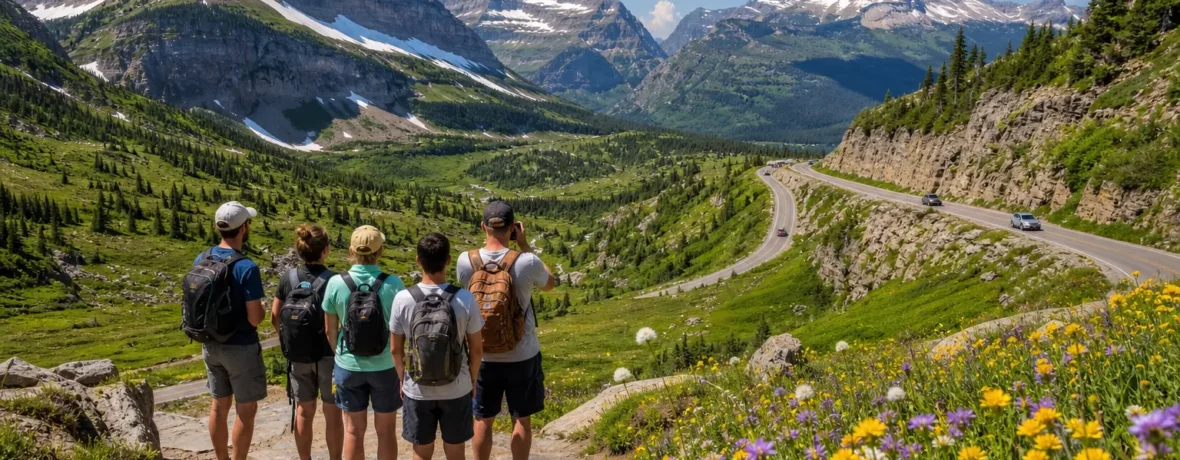
Logan pass Glacier National Park is reachable by car only when Going-to-the-Sun Road is open over the Continental Divide, usually late June or early July into fall. As of November 2026, no 2026 vehicle reservation was required, but July 1–September 7 parking used a 3-hour limit and shuttle tickets. NPS Logan Pass access rules (nps.gov)
When does Going-to-the-Sun Road open to Logan Pass?
There is no fixed opening date.
That’s the first thing to burn into your trip plan. Logan Pass sits at 6,646 ft [2,026 m], the high point of Going-to-the-Sun Road, and winter does not leave on your schedule. The National Park Service says the full road usually does not open until late June at the earliest, and the alpine section often closes for winter around the third Monday in October, though storms can shut it earlier. As of November 2026, NPS also says the Logan Pass area is not accessible by vehicle until the full road is open over the pass. NPS road conditions and transportation (home.nps.gov)
For a concrete recent example: Going-to-the-Sun Road fully opened for the 2026 season on June 22, 2026, giving drivers access to the full 50-mile [80 km] road and to Logan Pass from both West Glacier and St. Mary. That does not predict next year. It only shows the rhythm: snow, plows, avalanche paths, more snow, then the green light. (home.nps.gov)
Spring is the tricky season. Lower road sections can be open while the pass is still buried. You may be able to drive along Lake McDonald or from St. Mary to lower-elevation pullouts and still be blocked miles from the high country. Check the live road status before you leave lodging, before you lose service, and again at the entrance station.
How do you get to Logan Pass Glacier National Park?
You drive Going-to-the-Sun Road from the west or east when the alpine road is open.
From the west, you enter near West Glacier and climb past Lake McDonald, Avalanche, The Loop, and the Garden Wall country. From the east, you enter at St. Mary and climb past St. Mary Lake, Jackson Glacier Overlook, and Siyeh Bend. Both sides are spectacular. Both can be slow. Both can close fast in bad weather.
Without stops, NPS lists the drive from West Glacier to St. Mary on Going-to-the-Sun Road as 50 miles [80 km] and roughly 2 hours. That is the no-photo, no-traffic, no-bighorn-sheep version. Real summer timing can stretch. Parking, construction, wildlife jams, weather, and the narrow alpine section all add time. (home.nps.gov)
| Approach | Best for | Watch for |
|---|---|---|
| West Glacier / Apgar | Lake McDonald, west-side lodging, classic west-to-east drive | Long entrance lines and heavy traffic in peak summer |
| St. Mary | East-side stays, sunrise starts, faster access from St. Mary | Wind, weather shifts, and seasonal service changes |
| Park shuttle | Long hikes from Logan Pass when tickets are available | Ticket rules, boarding time, and return logistics |
Do you need a reservation to drive Going-to-the-Sun Road?
As of November 2026, NPS says vehicle reservations were not required anywhere in Glacier National Park for 2026.
That included Going-to-the-Sun Road, Many Glacier, Two Medicine, and the North Fork. Still, “no reservation” did not mean “unlimited access.” NPS stated that vehicles could be diverted from entrances or park areas during extreme congestion, with visitors holding service reservations, camping reservations, or backcountry permits allowed entry during temporary restrictions but still subject to delays. NPS vehicle reservation update (nps.gov)
Here’s the straight read: you did not need a road-entry reservation in 2026, but you still needed a plan. Glacier can turn into a rolling traffic puzzle by midmorning in July and August. If your goal is Logan Pass, treat daylight like a limited resource.
What were the Logan Pass parking rules in 2026?
From July 1 through September 7, 2026, private vehicle parking at Logan Pass was limited to 3 hours.
As of November 2026, the verified NPS rule for the 2026 summer pilot was simple: find an open space first, then get a free timestamped permit from the kiosk, then place it on your dashboard. The 3-hour limit was enforced 24 hours each day during that July 1–Labor Day window. Overnight parking was not allowed at Logan Pass except with a park permit for permitted backcountry users and Granite Park Chalet guests. (nps.gov)
That 3-hour window fits a short alpine stop, the visitor center, photos, an interpretive program, or the Hidden Lake Overlook hike. It does not fit a long Highline Trail day to Granite Park Chalet or down to The Loop. For that, you needed shuttle logistics in 2026.
- Park only in a marked space.
- Get the free timestamped permit after parking.
- Display the permit on your dashboard.
- Leave before your 3-hour window expires.
- Do not count on circling the lot until something opens.
How does the Logan Pass shuttle work?
In 2026, the Logan Pass shuttle used reserved tickets, not first-come, first-served boarding.
As of November 2026, NPS says the 2026 ticketed shuttle ran July 1 through September 7 and served Logan Pass from both sides of Going-to-the-Sun Road. Tickets were valid for one day, tied to a specific boarding location and time, and available through Recreation.gov or the Recreation.gov call center. Each ticket carried a nonrefundable $1 processing fee, and shuttle tickets were not sold inside the park. (nps.gov)
Boarding locations listed by NPS for 2026 included Apgar Visitor Center, Lake McDonald Lodge, St. Mary Visitor Center, and Rising Sun Picnic Area. Children age 2 and older needed their own ticket; infants under 2 could ride as lap children with a ticketed adult. Photo ID could be requested to verify the ticket purchaser. (nps.gov)
Use the shuttle when your hike breaks the 3-hour parking box. The big example is the Highline Trail. A short out-and-back on Highline can work from a parking space if you are disciplined, but a full point-to-point day belongs in the shuttle category.
How do you plan a Logan Pass visit step by step?
Build the day backward from road status, parking, and hike length.
- Check the official Glacier road status page before you commit to Logan Pass.
- Confirm whether the alpine section of Going-to-the-Sun Road is open from your side of the park.
- Choose your goal: short stop, Hidden Lake Overlook, Highline out-and-back, or a full point-to-point hike.
- If your plan takes longer than 3 hours during a timed-parking period, look for shuttle tickets.
- Buy or carry your entrance pass before reaching the gate.
- Pack water, layers, sun protection, and bear spray where you can reach it.
- Recheck trail status, because snow and bear activity can close trails even when the road is open.
The fastest way to ruin a Logan Pass day is to treat it like a roadside overlook. It is not. It is a high-alpine hub with limited pavement, huge demand, fragile plants, serious weather, and trails that can hold snow after the road opens.
What does it cost to visit Logan Pass?
You need a Glacier National Park entrance pass; shuttle tickets and entrance passes are separate.
As of November 2026, NPS lists Glacier standard entrance passes at $20–$35 depending on season and entry type, with a private vehicle pass at $35 and a winter private vehicle rate of $25 from November 1 to April 30. Glacier is cashless, so plan on paying with a card or using a digital pass. Non-US residents age 16 and older must pay an additional $100 per-person fee unless admitted with an Annual Pass or America the Beautiful Pass. NPS Glacier fees and passes (nps.gov)
If you used the 2026 Logan Pass shuttle, that shuttle ticket was a separate item with a $1 Recreation.gov processing fee. It did not replace your park entrance pass. Think of it this way: the entrance pass gets you into Glacier; the shuttle ticket gets you a seat on that specific Logan Pass shuttle run.
Can RVs and oversized vehicles drive to Logan Pass?
Only if they fit the Going-to-the-Sun Road size limits.
As of November 2026, NPS lists the key Going-to-the-Sun Road vehicle limits as 21 ft [6.4 m] long, 8 ft [2.4 m] wide, and 10 ft [3 m] tall. Vehicles or vehicle combinations longer than 21 ft, including bumpers, or wider than 8 ft, including mirrors, are prohibited between Avalanche Creek and Rising Sun. Vehicles taller than 10 ft may have trouble driving west from Logan Pass to The Loop because of rock overhangs. (home.nps.gov)
If you are traveling in a large RV, do not “try it and see.” That alpine road is narrow, busy, and unforgiving. Use a smaller vehicle, book a legal tour, or use shuttle options where they fit your route.
What are the best hikes from Logan Pass?
The two classic hikes are Hidden Lake and the Highline Trail.
The Hidden Lake Trail starts behind the Logan Pass Visitor Center. NPS lists Hidden Lake Overlook at 1.3 miles [2.1 km] one way with 608 ft [185 m] of gain and 128 ft [39 m] of loss. Continuing to Hidden Lake is 2.5 miles [4 km] one way with bigger descent and return effort. NPS Hidden Lake Trailhead (nps.gov)
The Highline Trail starts across Going-to-the-Sun Road from the Continental Divide sign near the Logan Pass parking lot. NPS lists the Highline as 11.8 miles [19 km] one way, with 2,388 ft [728 m] of gain and 4,773 ft [1,455 m] of loss, depending on the full route and side trips. It is exposed, weather-prone, and logistically more complicated if you finish away from your car. NPS Highline Trailhead (nps.gov)
| Hike | Distance | Best plan |
|---|---|---|
| Hidden Lake Overlook | 1.3 miles [2.1 km] one way | Short Logan Pass visit when trail is open |
| Hidden Lake | 2.5 miles [4 km] one way | Longer out-and-back with descent to the lake |
| Highline Trail | 11.8 miles [19 km] one way | Full-day hike with shuttle or careful transport logistics |
Are dogs allowed on trails at Logan Pass?
No, pets are not allowed on Glacier National Park trails.
As of November 2026, NPS allows pets in developed areas such as cars on park roads, frontcountry campgrounds, picnic areas, parking areas, and along roads when you are stopped. Pets are not allowed on trails, in the backcountry, along lake shores outside developed locations, or in buildings. Pets must be on a leash no longer than 6 ft [1.8 m], physically restrained, or caged. NPS pet rules for Glacier (nps.gov)
That means no Hidden Lake Trail with your dog. No Highline Trail. No “just to the overlook.” If a road is closed to vehicle traffic, NPS treats it as a backcountry trail for pet rules, and dogs are not allowed there either. (nps.gov)
What should you pack for Logan Pass?
Pack for alpine weather, sun, snow patches, and bears.
Logan Pass can feel warm in the parking lot and raw ten minutes later. The road may open while trails still hold snow. Wind can rip across the divide. Sun reflects off rock, boardwalk, and lingering snowfields. Go light if you want, but do not go flimsy.
- Entrance pass, shuttle ticket if using one, and photo ID
- Water; do not assume every seasonal water source is running
- Warm layer and rain shell
- Sun hat, sunglasses, and sunscreen
- Traction-aware footwear for wet boardwalk, rock, or snow patches
- Bear spray carried where you can grab it fast
- Map downloaded offline
- Snacks packed so wrappers and crumbs come back out with you
NPS bear guidance for Glacier is blunt: make noise, hike in groups when you can, stay alert, avoid trail running, carry bear spray, and secure food and garbage. Bear bells are not considered adequate by the park; calling out and clapping at intervals work better to announce yourself. (nps.gov)
Related reading
- Glacier National Park Pass and Vehicle Reservations
- National Park Pass Changes for 2026
- Every Kid Outdoors: The Free 4th Grade National Park Pass
- Parks Canada Discovery Pass: Price and Coverage
FAQ
Is Logan Pass open year-round?
No. The park is open year-round, but Logan Pass is not reachable by vehicle when the alpine section of Going-to-the-Sun Road is closed. As of November 2026, NPS says the Logan Pass Visitor Center is closed for winter from September 28 through June 26 and typically opens in late June to early July. (nps.gov)
Can you drive all of Going-to-the-Sun Road in one day?
Yes, when the full road is open. NPS lists West Glacier to St. Mary via Going-to-the-Sun Road as 50 miles [80 km] and roughly 2 hours without major stops, but you should allow more time for traffic, weather, wildlife, and viewpoints. (home.nps.gov)
Do you need a shuttle ticket for Hidden Lake Overlook?
Not always. If you park at Logan Pass during a timed-parking period, Hidden Lake Overlook is the kind of short hike NPS says can fit within a 3-hour visit, when the trail is open. For longer hikes from Logan Pass, the 2026 system pushed visitors toward shuttle tickets. (nps.gov)
Is the Highline Trail open when Going-to-the-Sun Road opens?
Not necessarily. The road can open while the Highline Trail remains closed because of snow or other hazards. In 2026, NPS announced the road open on June 22, while also stating that the Highline Trail from Logan Pass was closed due to snow conditions. (home.nps.gov)
Can you sleep in your car at Logan Pass?
No, not for ordinary overnight parking. As of November 2026, NPS says overnight parking at Logan Pass was not permitted during the 2026 timed-parking period except with a park permit issued to permitted backcountry users and Granite Park Chalet guests. (nps.gov)
Where should you check conditions before going?
Use the official NPS road, trail, and campground status pages before you go. NPS says those status maps contain the most recent available information, but conditions can still change quickly because of weather, downed trees, snow, wildlife activity, and other hazards. NPS Glacier road and trail status (nps.gov)