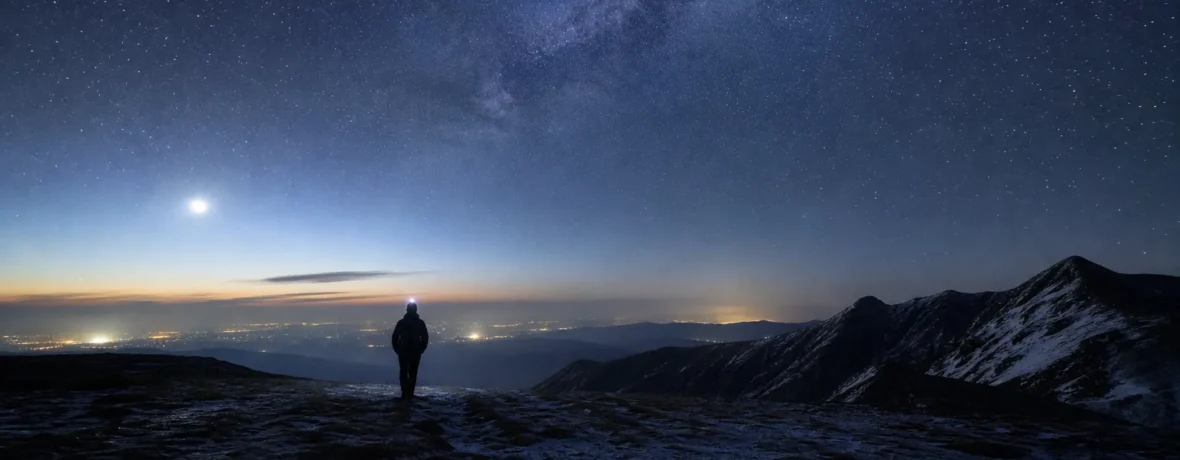
Yes—night hiking is worth it when you choose a familiar, legal trail, start small, and carry a reliable headlamp plus a backup light. For a 1- to 3-mile [1.6- to 4.8-km] route, you get cooler air, quieter trails, sharper senses, and a sky you miss at noon.
Is night hiking worth it?
Yes, but only if you treat it like its own skill.
Night hiking is not just “regular hiking, darker.” The trail changes. Your pace drops. Familiar sounds get louder. A root you would step over at noon can look like a snake at 9 p.m. That is exactly why it works. Night strips hiking down to attention.
The case for it is simple: most hikers are missing half the outdoors. After sunset, the temperature eases, the crowds thin, the wind often settles, and your little cone of light makes every step feel sharper. You stop scanning the next ridge and start noticing the next 20 feet [6 m]. That can make a short trail feel fresh again.
And no, night hiking should not be your first-ever hike. Earn some daytime trail sense first. Know how your shoes feel on rock, how your knees handle descents, how quickly you drink water, and how your brain reacts when the trail gets quiet. Then go after dark on a route you already know.
What makes night hiking better than hiking during the day?
Night hiking gives you quiet, cooler conditions, and a different kind of focus.
Day hikes often reward distance. Night hikes reward presence. You are not chasing a summit selfie or trying to beat every group to the overlook. You are moving through the same world with the volume turned down and the details turned up.
| What changes | Day hiking | Night hiking |
|---|---|---|
| Temperature | Hotter in open sun | Often cooler after sunset |
| Trail traffic | Busier on popular routes | Quieter, especially after dusk |
| Vision | Wide views and long sightlines | Shorter sightlines, sharper attention |
| Best payoff | Views, distance, landmarks | Stars, solitude, sound, mood |
The strongest argument for night hiking is not that it is more extreme. It is that it makes modest trails matter again. A 2-mile [3.2-km] loop near town can feel bigger after dark than a 10-mile [16-km] march in full sun. You notice the smell of damp leaves. You hear water before you see it. You learn how much noise your pack makes. That kind of awareness is useful everywhere.
Is it safe to hike at night?
Yes, if you reduce the variables before you start.
Night hiking gets risky when people combine darkness with poor planning, unfamiliar terrain, bad weather, weak batteries, and no turnaround time. Stack enough of those together and a simple walk becomes a problem. Strip them away and night hiking becomes a manageable, rewarding skill.
Start with public, open trails where night use is allowed. Check the land manager’s current rules before you go, because some parks close trails, parking lots, gates, or entire areas after dark. For general planning, the National Park Service Hike Smart guidance tells hikers to plan ahead, carry essential gear, and remember that some backcountry areas do not have cell service.
Pick a route with simple terrain. Save cliff edges, sketchy creek crossings, loose talus, and hard-to-follow social trails for daylight. At night, “easy” is not boring. Easy is smart.
- Tell someone your trailhead, route, start time, and expected return time.
- Download an offline map before leaving home.
- Carry a headlamp and a separate backup light.
- Use fresh or fully charged batteries.
- Bring a warm layer, even if the evening starts mild.
- Turn around if the trail becomes hard to follow.
What gear do you need for night hiking?
You need light, backup light, navigation, layers, and enough margin to fix small problems.
Your headlamp is the headline item, but do not stop there. A bright lamp with a low setting matters more than a tiny ultralight lamp that dies halfway back. A red-light mode can help preserve night vision and reduce glare for other hikers. The National Park Service’s after-dark park tips recommend checking conditions, knowing where you are going, and using light carefully during nighttime adventures.
Pack like you expect the hike to run 1 hour longer than planned. That does not mean hauling a winter expedition kit for a neighborhood loop. It means carrying enough to stay warm, visible, and oriented if you miss a junction or stop to help someone.
- Primary headlamp
- Backup flashlight or second headlamp
- Extra batteries or a power bank, matched to your light
- Offline map and a physical map for longer routes
- Warm layer and rain shell if weather could shift
- Water and a salty snack
- Small first-aid kit
- Whistle
- Reflective detail on clothing or pack if roads are involved
One more thing: trekking poles are more useful at night than many hikers expect. They feel the trail before your feet do. On rocky descents, that can save ankles, knees, and pride.
How do beginners start night hiking?
Start short, familiar, and early.
The best first night hike begins before full dark. Reach the trailhead 30 to 45 minutes before sunset, walk into dusk, and let your eyes adjust as the light fades. Do not make your first attempt a midnight start on a new trail. That is not bold. That is sloppy.
- Choose a trail you have already hiked in daylight.
- Keep it to 1 to 3 miles [1.6 to 4.8 km].
- Check the current trail status and parking rules through the official land manager.
- Invite one steady partner, not a giant group that will scatter.
- Set a hard turnaround time before you start.
- Use your lowest safe light setting on smooth tread.
- Stop at junctions and confirm the route before moving on.
- End while you still want more.
That last step matters. A good first night hike should feel controlled. You should finish thinking, “That was fun,” not “Never again.” Confidence grows fast when your first few outings are clean and simple.
What are the biggest mistakes people make while night hiking?
The biggest mistake is pretending darkness changes nothing.
It changes plenty. Your depth perception weakens. Trail signs can be harder to spot. Distances feel longer. A familiar descent can feel steeper. Wildlife may be more active. Other people may not see you until you are close. None of that should scare you off. It should make you prepare.
Avoid these common errors:
- Starting on an unfamiliar trail.
- Using a phone flashlight as the only light source.
- Blasting a headlamp into your partner’s face.
- Ignoring temperature drops after sunset.
- Relying on cell service for navigation.
- Pushing past a missed junction instead of stopping.
- Wearing earbuds that block natural sound.
The cleanest night hikers are patient. They pause more. They look back at junctions so the return trip makes sense. They let faster groups pass. They do not turn a simple outing into a rescue story by chasing ego.
What about wildlife, ticks, and cold?
Plan for them, but do not let them own the night.
Wildlife encounters depend on the region, season, and trail. Give animals space, keep food sealed, and make calm human noise when visibility is tight. If local land managers post bear, mountain lion, snake, or other wildlife guidance, follow that local guidance first.
Ticks are not just a daytime issue. The CDC tick prevention guidance recommends using repellent, treating clothing and gear where appropriate, avoiding brushy areas, and checking your body and clothing after being outdoors. That advice fits night hiking especially well because you may brush against vegetation you would have avoided in daylight.
Cold deserves respect too. Night air can drop fast, and sweat cools quickly when you stop moving. Mayo Clinic describes hypothermia as a medical emergency that occurs when the body loses heat faster than it can produce heat, with body temperature falling below 95°F [35°C]; see its hypothermia first-aid guidance for emergency signs and response. You are not trying to diagnose yourself on the trail. You are trying to avoid getting chilled in the first place.
When to see a doctor
Get medical help fast for severe cold exposure, injury, or concerning symptoms after a bite.
Call 911 or your local emergency number if someone may have hypothermia, is confused, has slurred speech, is stumbling badly, has slow or shallow breathing, or cannot warm up. For tick bites, contact a healthcare professional if you develop fever, rash, flu-like symptoms, or expanding redness after time outdoors. If you fall, hit your head, cannot bear weight, or have heavy bleeding, end the hike and seek care.
Night hiking should make you feel alive, not reckless. The line is clear: if a symptom would worry you in daylight, it should worry you more after dark.
Related reading
- Is the Inca Trail Worth It?
- Is an REI Membership Worth It?
- Why Winter Is the Best Hiking Season
- Is Climbing Everest Still Worth It?
FAQ
Is night hiking legal?
Sometimes, but not everywhere. Check the official park, forest, city, or state land manager before you go because hours, gates, parking access, permits, and seasonal closures can change.
Can you hike alone at night?
You can, but beginners should not start that way. Go with one reliable partner until you know how you handle darkness, route-finding, and small problems after sunset.
How bright should a headlamp be for night hiking?
Bright enough to see the tread clearly, with a lower setting for easy sections. A lamp with multiple brightness levels is better than one fixed beam because too much light can create glare and drain batteries faster.
What is the best time to start a night hike?
Start 30 to 45 minutes before sunset for your first few trips. That lets your eyes and nerves adjust gradually instead of dropping you into full darkness at the trailhead.
Should you use red light while night hiking?
Use red light when you are stopped, reading a map, or trying to preserve night vision. Use white light when footing, obstacles, or trail-finding require a clearer view.
So, is night hiking really worth trying?
Yes, night hiking is worth trying if you choose a simple legal route, carry proper lighting, and turn around early when conditions feel wrong. Done well, it makes familiar trails feel wild again without needing a bigger mountain.