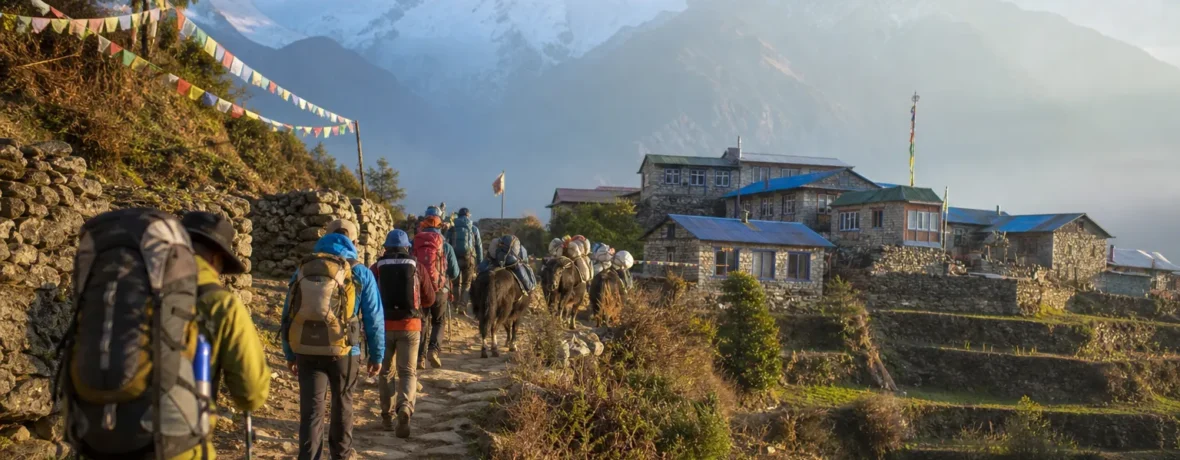
How much do Sherpas get paid? On Everest, experienced climbing Sherpa workers commonly earn $4,000 to $10,000 for a season when base pay, load carries, summit bonus, and tips are combined. Nepal’s legal daily minimum for high-altitude guides/workers is NPR 1,200 ($8.02), as of November 2026.
How much do Sherpas get paid on Everest?
Everest climbing Sherpa workers usually earn several thousand dollars in one spring season, not a simple hourly wage.
The cleanest number is the legal daily floor. Under Nepal’s Mountaineering Sixth Amendment rules, the listed daily wages are NPR 1,500 ($10.03) for a sirdar, NPR 1,200 ($8.02) for a mountain guide or high-altitude worker, and NPR 1,000 ($6.68) for a base camp worker, as of November 2026. Those dollar conversions use the Nepal Rastra Bank exchange rate for November 12, 2026.
That daily figure is not the full paycheck. Everest pay stacks up through expedition contracts, carries through the Khumbu Icefall, higher-camp load work, summit-day support, bonuses, and tips. A peer-reviewed paper on high-altitude mountaineering labor reported that Everest workers could earn $3,000 to $6,000 per season before tips; newer operator and industry reporting commonly puts strong Everest climbing staff in the $4,000 to $10,000 season range when bonuses and tips are included. See the labor discussion in this Sustainable Tourism study.
| Role | Legal daily wage as of Nov. 2026 | What the job means |
|---|---|---|
| Sirdar / lead Sherpa | NPR 1,500 ($10.03) | Leads local climbing staff, organizes loads, camps, and timing |
| Mountain guide / high-altitude worker | NPR 1,200 ($8.02) | Carries gear, supports climbers, fixes or uses ropes, works above base camp |
| Base camp worker | NPR 1,000 ($6.68) | Kitchen, camp, logistics, and support at base camp |
Is “Sherpa” a job title?
No, Sherpa is an ethnic identity, though the trekking world often uses the word loosely.
The Sherpa people are a Himalayan ethnic group with deep roots in northeastern Nepal and neighboring high mountain regions. The term has become shorthand for guides and climbing supporters, but not every Nepali porter, guide, cook, or high-altitude worker is Sherpa. That matters. If you are talking pay, the cleaner language is “climbing Sherpa,” “high-altitude worker,” “Nepali guide,” or “expedition staff.” For background, Yale’s eHRAF describes the Sherpa people as a Tibetan-related ethnic group in northeastern Nepal.
How do Sherpas get paid per climb?
They are usually paid by contract for the expedition, with extra money for summit success, carries, and tips.
Think of the paycheck as a bundle, not a single line item. A worker may receive a base expedition wage, then additional pay for carrying loads to Camp 1, Camp 2, Camp 3, or Camp 4, plus a summit bonus if a client reaches the top of Everest at 29,032 ft [8,849 m]. Some contracts also include gear allowance, food, transport, insurance, and rescue coverage.
Here is the basic pay stack:
- Base wage: The core expedition pay for the season.
- Load carries: Extra money for hauling oxygen, tents, ropes, fuel, and food higher on the mountain.
- Summit bonus: A reward when a client or team reaches the summit.
- Tips: Cash from clients, often pooled by the team or given directly.
- Gear and benefits: Boots, down suits, gloves, insurance, travel, meals, and sometimes training support.
Why can the daily wage look so low?
The legal minimum is only the floor, not the full seasonal earning.
That floor still looks jarring if you live in the United States. NPR 1,200 converts to $8.02 using the official buying rate on November 12, 2026. But Everest work is seasonal, high-risk, and paid through several channels. A strong spring season can beat Nepal’s national income levels by a wide margin; the World Bank lists Nepal’s 2025 GNI per capita at $1,570.
Still, “better than average income” does not make the job safe or fairly balanced. These workers cross avalanche terrain, haul loads through the Khumbu Icefall, sleep at thin-air camps, and carry responsibility for clients who may be weaker, slower, and less experienced. That is the tension at the heart of Everest.
Do Sherpas get tips?
Yes, tips are common and can be a meaningful part of total pay.
Tips vary by expedition price, company culture, client behavior, and whether the team summits. Some outfitters give climbers a suggested tip amount before the trip. Others leave it loose, which can punish workers if clients arrive unprepared or assume “the company handles it.”
If you are joining a guided Himalayan expedition, ask these questions before you book:
- What is the stated wage for high-altitude workers?
- Is the summit bonus included in the trip price or paid separately?
- What tip range do you recommend for climbing staff, kitchen staff, and porters?
- Are tips pooled or given directly?
- Does every worker receive written contract terms?
What benefits and insurance do Sherpa workers get?
They should receive insurance, but coverage is not the same as danger-free work.
The official Nepal Department of Tourism page for the Mountaineering Sixth Amendment rules lists the current regulation source. Under the updated provisions reported from those rules, insurance amounts are NPR 2,000,000 ($13,368) for sirdars, mountain guides, and high-altitude workers, and NPR 1,500,000 ($10,026) for base camp workers, as of November 2026.
Insurance sounds comforting on paper. On the mountain, the worker still has to face seracs, altitude, storms, frostbite, falls, and the brutal logistics of rescue above 26,247 ft [8,000 m]. A good operator does more than buy a policy. It supplies strong gear, realistic schedules, enough oxygen, fair rest, medical support, and the power to turn clients around.
Why are Western guides paid more?
Western guides usually earn more because they sell into higher-income markets and often work for premium international companies.
The pay gap is not only about skill. Many Nepali guides have extraordinary Everest experience, repeated 8,000-meter summits, and deep local judgment. Western guides may bring IFMGA credentials, English-speaking client management, rescue systems, and insurance structures that sell well to American and European climbers. The market rewards the package, not just the risk.
That can feel backward when the local worker carries loads through the icefall before the client even clips into a fixed rope. If you are paying for an expedition, your money sends a signal. Choose companies that publish clear staff support, use experienced local leadership, and treat porters, cooks, and high-altitude workers as professionals instead of background scenery.
What should you ask before booking an Everest or Himalayan trek?
Ask direct pay and welfare questions before you send a deposit.
A cheap expedition often saves money somewhere. Too often, that “somewhere” is staff pay, oxygen, food, gear, waste systems, or rescue readiness. You do not need to interrogate the operator like a lawyer. Just be blunt.
- Who carries loads above base camp, and how are they paid?
- What insurance is provided for porters, kitchen staff, and high-altitude workers?
- Are workers supplied with boots, gloves, down clothing, eye protection, and sleeping systems?
- What is the guide-to-client ratio above 26,247 ft [8,000 m]?
- What happens financially if the expedition is canceled by weather, illness, or route danger?
- Can staff refuse unsafe work without losing pay?
Related reading
- How Much Does It Cost to Get Into Yellowstone?
- How Much Does a Park Ranger Make?
- Can Dogs Get Altitude Sickness?
- What Sherpas Eat at Altitude
FAQ
How much does an Everest Sherpa make in one season?
An experienced Everest climbing Sherpa worker commonly makes $4,000 to $10,000 in a season when wage, bonuses, carries, and tips are combined. Newer or lower-altitude support staff may earn less, while lead staff can earn more.
How much is the legal daily wage for a high-altitude worker in Nepal?
The listed legal daily wage is NPR 1,200 ($8.02) for a mountain guide or high-altitude worker, as of November 2026. Sirdars are listed at NPR 1,500 ($10.03), and base camp workers at NPR 1,000 ($6.68).
Do Sherpas only get paid if climbers summit?
No, they should have base pay for the expedition work. Summit bonuses and tips can raise total earnings, but the base job includes carrying, camp work, route support, and client care even without a summit.
Are Sherpas underpaid?
Many people would say yes when comparing risk to reward. The work can pay well by Nepal income standards, but it remains dangerous, seasonal, and far below what many international guides earn.
Should trekkers tip porters and guides in Nepal?
Yes, tipping is expected on many guided treks and climbs. Ask your operator for a clear tipping plan before the trip, then carry enough cash so the people doing the hard work are not an afterthought.